
Most North Texas business owners are operating under outdated rules of thumb that could cost them millions at the closing table. You’ve likely heard that a 3x multiple is the standard, but in a market as dynamic as Dallas-Fort Worth, that assumption is a tactical error. You’ve spent years building your legacy, and the fear of leaving money on the table is a valid concern. If you’re asking what multiples are DFW businesses selling for in 2026, you’re already thinking like a strategist. You understand that your valuation isn’t just a number; it’s a reflection of your operational discipline.
This guide provides the hard data you need, from the 2.7x SDE average for small firms to the 6.5x EBITDA benchmarks seen in the $5M to $50M lower middle market. We’ll move beyond simple averages to examine why sectors like HVAC and insurance are commanding premiums as high as 11x. You’ll discover the specific tactical factors, such as low owner dependency and recurring revenue, that de-risk your operation and drive your specific multiple higher. We’re laying out a clear briefing to ensure you exit with the confidence and the value you’ve earned.
Key Takeaways
- Establish an accurate baseline for your exit strategy by understanding exactly what multiples are DFW businesses selling for in the 2026 market across various industries.
- Learn how to neutralize the “Owner Dependency Trap” to de-risk your operation and potentially add a full turn to your valuation multiple.
- Identify the critical thresholds for customer concentration to ensure your mission-critical revenue is protected during the scrutiny of due diligence.
- Understand why a 24-month tactical rollout is the standard timeframe for positioning a business to achieve a premium, mid-market exit.
2026 DFW Market Benchmarks: EBITDA Multiples by Industry
The North Texas economy in 2026 remains a mission-critical hub for national commerce. With a population exceeding 8.5 million and a resilient job market, buyer demand has reached a tactical peak. Investors are aggressively hunting for stable assets, which directly impacts what multiples are DFW businesses selling for today. For mid-market enterprises, valuation using multiples relies on EBITDA as the primary metric for operational efficiency. While small operations under $2 million in revenue still use Seller’s Discretionary Earnings (SDE), larger firms must transition to EBITDA to attract institutional interest. This shift represents the move from a “job” to a transferable business asset.
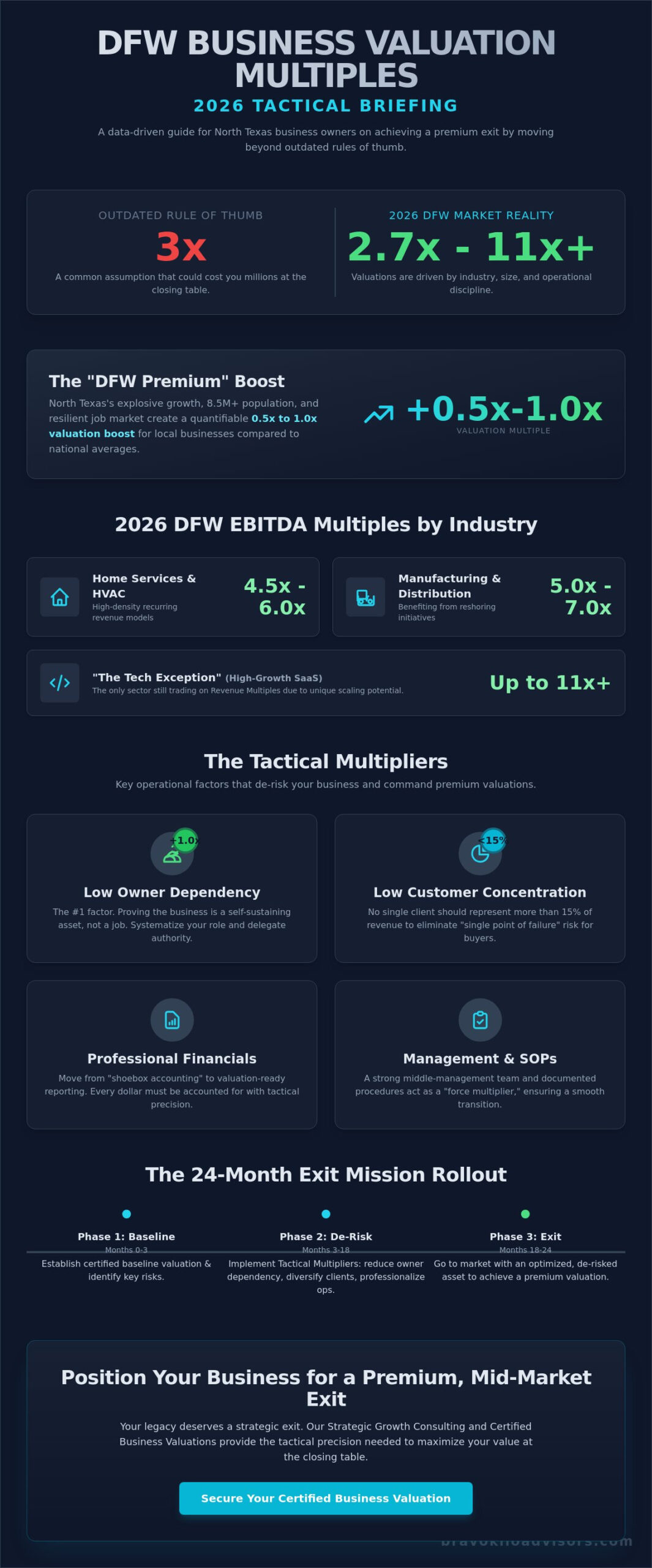
The “DFW Premium” is a quantifiable 0.5x to 1.0x boost local businesses often see due to the region’s explosive growth and favorable business climate.
To better understand this concept, watch this helpful video:
Industry-Specific Multiples: What to Expect in North Texas
Your industry dictates the baseline of your mission. In 2026, Home Services and HVAC companies are commanding 4.5x to 6x EBITDA due to their high-density recurring revenue models. Manufacturing and distribution firms are seeing 5x to 7x multiples as reshoring initiatives bring industrial operations back to the DFW core. Meanwhile, B2B professional services in high-growth corridors like Frisco and Plano are consistently outperforming national averages. At Bravo Kilo Advisors, we utilize Strategic Growth Consulting to ensure your EBITDA is optimized before you engage with potential buyers.
Revenue Multiples vs. EBITDA: When Does Top-Line Matter?
Focusing on top-line revenue is often a tactical error for traditional owners. Most DFW businesses should ignore revenue multiples to avoid over-valuation traps that stall a deal during due diligence. The “Tech Exception” applies almost exclusively to high-growth SaaS firms in the Dallas Innovation District, which still trade on revenue multiples due to their unique scaling potential. For everyone else, EBITDA is the only metric that ensures a successful extraction at the highest possible value. Relying on revenue figures alone creates a false sense of security that rarely survives a professional audit.
The Tactical Multiplier: Factors That Command Premium Valuations
Achieving a premium exit requires more than just a healthy bottom line. In the current market, what multiples are DFW businesses selling for is largely determined by the perceived risk profile of the operation. Buyers are willing to pay for predictability. Transferability of value is the #1 factor buyers use to justify a higher multiple. If the business can’t function without your daily intervention, you are trapped in the “Owner Dependency” cycle. Systematizing your role and delegating authority can effectively add 1.0x to your final multiple by proving the business is a self-sustaining asset.
Customer concentration is another critical vulnerability. No single client should represent more than 15% of your mission-critical revenue. High concentration creates a “single point of failure” that terrifies sophisticated investors. To secure a top-tier valuation, you must move from “shoebox accounting” to a Texas business valuation ready state. This involves professionalizing your reporting and ensuring every dollar is accounted for with tactical precision. If you’re unsure where your current financials stand, our team can provide a Certified Business Valuation to establish your baseline.
Operational De-Risking: The Mission-First Approach
Standard Operating Procedures (SOPs) are more than just paperwork; they are tactical assets that protect your legacy. A strong middle-management team acts as a force multiplier, ensuring that operations continue uninterrupted during a transition. According to current data on EBITDA Multiples by Industry, businesses with disciplined management structures consistently outpace their peers. This operational maturity is what attracts “Blue Chip” buyers who are looking for a turnkey mission.
Strategic Positioning in the DFW Corridor
Your geographic footprint is a powerful leverage point. When drafting your Confidential Information Memorandum (CIM), you must highlight how your presence in Dallas, Fort Worth, or the surrounding suburbs taps into the broader “North Texas Growth Story.” Buyers aren’t just purchasing your equipment; they’re buying a foothold in one of the most resilient economies in the nation. Positioning your business as a gateway to DFW’s expansion allows you to command a premium that reflects the region’s future potential rather than just your past performance.
The Exit Mission: Positioning Your Business for Maximum Value
A successful exit isn’t a single event; it’s a 24-month operational rollout. Waiting until you’re burned out to consider what multiples are DFW businesses selling for is a tactical error that often leads to leaving money on the table. We operate on an “Advisors before Brokers” philosophy because positioning your business for a premium exit requires strategic refinement long before the first offer arrives. A “list and pray” strategy might work for residential real estate, but it fails in the high-stakes world of mid-market M&A. You need a lead time that allows for the removal of operational friction and the cleaning of financial records.
Before entering the market, you must conduct a rigorous stress test on your financials. This process involves identifying potential red flags that a buyer’s due diligence team will inevitably exploit. Implementing Strategies to Maximize Company Value ensures your financials are resilient and your systems are scalable. Understanding the nuances of North Texas buyer behavior is why hiring a business broker in Dallas, TX is a superior tactical move compared to engaging a national M&A mill. A local advisor understands the DFW economic pulse and can articulate your value to the right local and national buyers.
The 4-Step Operational Rollout for a High-Multiple Sale
- Step 1: Certified Valuation – Establish your baseline with a professional Texas business valuation to avoid unrealistic expectations.
- Step 2: Value Enhancement – Target and neutralize “Value Killers” like customer concentration or outdated technology.
- Step 3: Strategic Buyer Identification – Focus on finding a “Transformational” buyer who sees the synergy in your operation, rather than just the highest bidder.
- Step 4: Tactical Negotiation – Maintain command-presence during the due diligence phase to prevent “re-trading” and ensure the deal closes on your terms.
The Emotional Transition: Protecting Your Life’s Work
Selling your business is more than a financial transaction; it’s the culmination of your life’s work. The weight of this transition requires a sincere, professional advisor who respects the legacy you’ve built. You’re moving from the role of “Founder” to “Succession Leader,” a shift that demands discipline and poise. Our mission is to handle the complexities of the deal so you can focus on your next chapter with confidence. Ready to see where your business stands? Start your tactical valuation mission with Bravo Kilo Advisors and secure the exit you deserve.
Command Your Exit: Executing a High-Value Transition
You now have a strategic overview of what multiples are DFW businesses selling for in the current 2026 market. Success isn’t found in passive market averages; it’s forged through operational discipline and tactical de-risking. By neutralizing owner dependency and diversifying your revenue, you move your operation from a standard multiple to a premium valuation. This mission requires a methodical 24-month rollout to ensure every detail of your financials is ready for the pressure of due diligence.
At Bravo Kilo Advisors, we bring a battle-tested command-presence to the boardroom. Our team of certified experts focuses exclusively on the $500,000 to $50 million DFW market, applying a tactical federal service background to keep negotiations steady. We prioritize the mantra of Advisors before Brokers, ensuring your life’s work is handled with precision. Request Your Tactical Business Valuation Briefing today to begin your exit mission. You’ve built an incredible legacy in North Texas. It’s time to ensure you extract the full value you’ve earned.
Frequently Asked Questions
Is a 5x multiple good for a Dallas-based business in 2026?
A 5x multiple is an exceptional result for a small business but may be a missed opportunity for a mid-market enterprise. For a clear perspective on what multiples are DFW businesses selling for, consider that small shops currently average 2.7x SDE. However, businesses in the $5M to $50M range are targeting a 6.5x EBITDA benchmark. If you are in high-demand sectors like HVAC or insurance, a 5x multiple would actually be well below the current 9x to 11x market premium.
What is the difference between an EBITDA multiple and an SDE multiple?
The primary difference lies in how the owner’s compensation is treated during the valuation mission. SDE, or Seller’s Discretionary Earnings, is used for owner-operated small businesses and adds back the owner’s salary and benefits. EBITDA is the standard for larger enterprises with established management teams. This transition typically occurs once a business surpasses $2 million in revenue. Buyers use EBITDA to evaluate the company as a standalone investment asset rather than a personal job.
How does the current interest rate environment in Texas affect business multiples?
Interest rates act as a governor on acquisition speed and pricing. When the cost of capital rises, buyers often face higher debt service requirements, which can exert downward pressure on valuation multiples. Despite this, the DFW market remains highly resilient. With a local median household income of $95,589 and a growing population of 8.5 million, the sheer volume of regional demand often offsets national economic cooling. Quality assets in North Texas continue to command competitive prices regardless of broader rate fluctuations.
Can I sell my DFW business for a high multiple if I am still the primary salesperson?
Securing a premium multiple is nearly impossible if you are the primary driver of revenue. This creates a “single point of failure” that increases the risk profile for any sophisticated buyer. To improve what multiples are DFW businesses selling for in your specific case, you must delegate sales operations to a dedicated team. Buyers pay for transferability. If the revenue mission depends entirely on your personal relationships, the buyer will discount the multiple to protect themselves against post-closing attrition.