
The generic online calculator you found last Tuesday is likely underestimating your company’s real-market value by as much as 18% because it fails to account for the unique DFW economic surge. Relying on an automated algorithm to determine your life’s work isn’t just risky; it’s a tactical error that leaves your legacy vulnerable. You’ve spent decades in the trenches building this enterprise, and as you ask yourself, “what is my North Texas business worth” in the face of 2026 market volatility, you need more than a guess. You deserve a clear, defensible assessment that reflects the actual grit you’ve poured into your operations.
This briefing provides the intelligence required to secure a defensible valuation range in today’s shifting climate. We’re moving past the typical broker’s fluff to deliver a precise framework based on 2025 regional acquisition data. You’ll discover the specific DFW premiums currently being paid by private equity, the three critical levers that increase your multiplier, and a strategic roadmap to ensure your exit is transformational rather than just transactional. We approach your valuation with the same discipline we brought to federal service, ensuring your mission is a success before you ever hit the negotiation table.
Key Takeaways
- Identify how the “DFW Multiplier” and the North Platinum Corridor drive premium valuations for local businesses in the 2026 economic landscape.
- Master the distinction between SDE and EBITDA to ensure you are speaking the right financial language for your specific class of buyer.
- Learn the tactical drivers that answer the question, “what is my North Texas business worth,” and how to eliminate the “owner dependency trap” to maximize your exit price.
- Benchmark your firm against current market multiples for high-growth North Texas sectors, including residential services and B2B manufacturing.
- Understand why a defensible, certified valuation is a mission-essential tool for surviving the high-pressure due diligence process.
The North Texas Economic Fortress: Why DFW Businesses Command a Premium in 2026
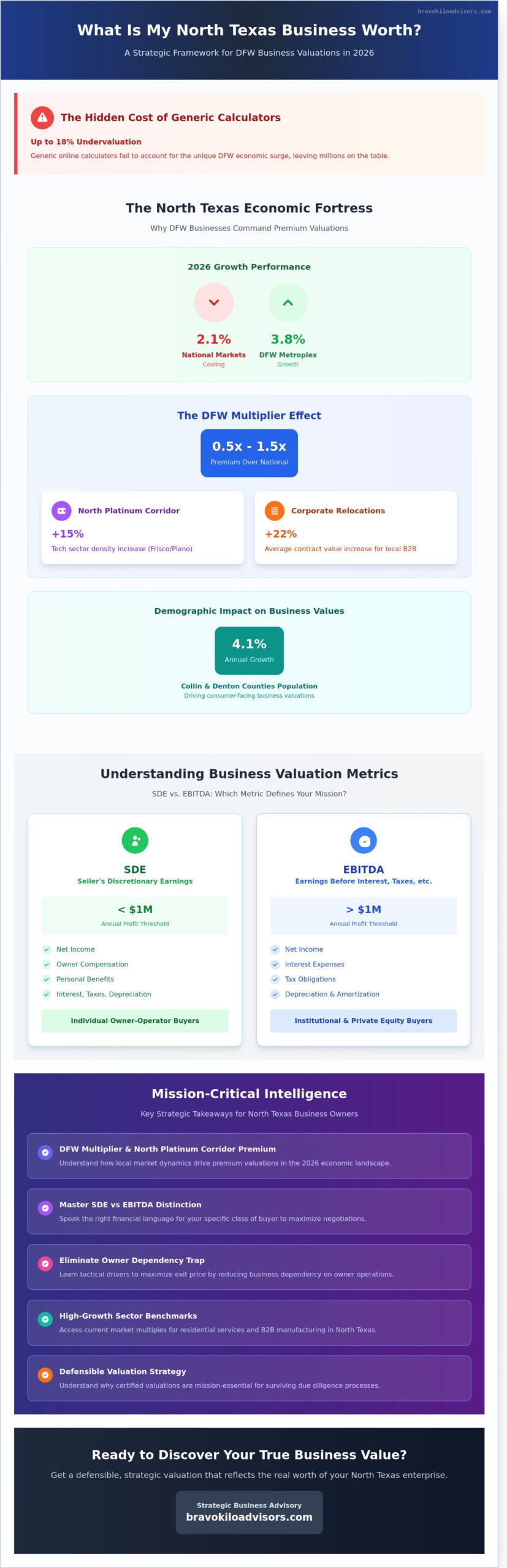
The North Texas economy stands as a tactical fortress. While national markets experienced a 2.1% cooling in late 2025, the DFW Metroplex maintained a 3.8% growth rate into the first quarter of 2026. This decoupling isn’t accidental. It’s the result of a decade of strategic corporate migration and a tax climate that rewards domestic production. When owners ask, “what is my North Texas business worth,” they’re often surprised to find their local footprint commands a premium that doesn’t exist in the Midwest or the Northeast.
The “DFW Multiplier” represents a distinct valuation advantage. Buyers from high-tax jurisdictions like California and New York now view North Texas as a safe-haven for capital. They aren’t just buying cash flow; they’re buying into a regulatory environment that protects their investment from aggressive state-level intervention. This influx of out-of-state capital has driven demand for established entities to historic levels. These buyers prioritize the stability of the Texas market over the volatility of their home states, treating North Texas acquisitions as mission-critical assets for their portfolios.
The North Platinum Corridor, stretching through Frisco and Plano, has fundamentally altered regional service and tech valuations. As of 2026, this corridor has seen a 15% increase in tech-sector density compared to three years ago. When a Fortune 500 firm relocates its headquarters to Collin County, it creates a mission-critical need for local B2B providers. These service companies see their values climb as they become integral to the supply chains of global giants. The North Texas Premium is defined as a 0.5x to 1.5x increase in valuation multiples over national averages for comparable firms.
The ‘Relocation Ripple Effect’ on Local Valuations
Corporate relocations act as a force multiplier for local B2B service providers. Between 2024 and 2026, the arrival of 14 new major headquarters in North Texas increased the average contract value for local IT and facility management firms by 22%. Population growth in Collin and Denton counties, which increased by 4.1% annually, has simultaneously boosted the worth of consumer-facing businesses. These demographic shifts ensure a steady stream of demand that protects the bottom line from national economic downturns, making these businesses highly attractive to sophisticated investors.
Sector-Specific Demand in the Metroplex
Manufacturing and logistics in the Fort Worth corridor are hitting peak multiples in 2026. Proximity to the Alliance Texas inland port has made these businesses prime targets for private equity groups seeking recession-resistant assets. Different Business valuation approaches confirm that the Dallas business district remains a hub for high-value professional services. Private equity firms currently prioritize HVAC, plumbing, and specialized logistics because these sectors provide steady, predictable returns. Our mission is to ensure you understand exactly what is my North Texas business worth before you enter the high-pressure environment of the negotiation room.
The Math of Worth: Understanding SDE, EBITDA, and Market Multiples
Precision is the difference between a successful exit and a failed mission. To determine what is my North Texas business worth, we start by normalizing your earnings. This process strips away the noise of tax-minimization strategies to reveal the true operational strength of the company. We treat this phase like a reconnaissance mission. We look for every dollar of value hidden in your profit and loss statements to ensure your life’s work is accurately represented on the balance sheet.
SDE vs. EBITDA: Which Metric Defines Your Mission?
For businesses with annual profits under $1,000,000, Seller’s Discretionary Earnings (SDE) is the standard metric. It totals your net income, interest, taxes, and depreciation, then adds back your owner compensation and personal benefits. This reflects the total financial benefit a single owner-operator derives from the business. It’s the language of the individual buyer who plans to step into your boots and run the daily operations.
When profit exceeds the $1,000,000 threshold, we transition to EBITDA. Institutional buyers and private equity groups use this because they plan to install a professional management team. In their eyes, your salary is a standard operating expense, not a discretionary benefit. Errors in calculating “Adjusted EBITDA” can compromise a deal. If you fail to account for a 15% increase in labor costs or ignore a looming $100,000 equipment replacement, sophisticated buyers will flag it during due diligence. This creates a trust gap that often leads to aggressive price retrading.
Demystifying the Industry Multiple
The multiple is the lever that turns your annual profit into a final sale price. Two businesses can both earn $500,000 in profit, but one might sell for $1.5 million while the other fetches $2.5 million. This variance depends on risk factors like customer concentration; for instance, having one client represent more than 20% of your revenue will decrease your multiple. A multiple is a shorthand for the number of years of future profit a buyer is willing to pay upfront.
Knowing what is my North Texas business worth requires a deep dive into the specific multiples DFW buyers are paying in 2026. Data from the current market indicates varying ranges based on sector stability:
- Home Services (HVAC/Plumbing): These recession-resistant businesses are seeing multiples between 3.2x and 4.1x of SDE.
- Specialized Manufacturing: Firms with proprietary processes or high barriers to entry are trending higher, often reaching 4.5x to 5.5x of EBITDA.
- B2B Service Agencies: Companies with recurring contract revenue can command a 0.5x premium over businesses that rely on one-off projects.
Add-backs are the tactical tools we use to defend your price. We conduct a forensic review to identify one-time expenses, such as a $25,000 facility upgrade completed in early 2025, or personal expenses like a company-funded life insurance policy. This U.S. Chamber of Commerce guide to business valuation details how these adjustments form the foundation of a credible, defensible offer. By identifying these costs, we ensure you aren’t penalized for reinvesting in your growth. Before you initiate a sale, you should conduct a thorough valuation assessment to ensure your numbers can withstand the pressure of a professional audit.
Tactical Value Drivers: Moving Beyond the Financial Statements
A balance sheet is a historical record, but it doesn’t capture the operational readiness of your organization. When you ask what is my North Texas business worth, you’re looking for more than a multiple of your EBITDA. You’re looking for the structural integrity of the asset. Buyers in the DFW market prioritize stability and scalability. If your business relies entirely on your personal relationships or daily oversight, it’s a liability, not an investment. Statistics show that a business capable of running without its founder often commands a 40% premium over owner-dependent competitors. This isn’t just a preference; it’s a requirement for institutional buyers and sophisticated private equity groups.
Revenue quality is another critical mission objective. Transactional sales require you to kill what you eat every single day. Recurring revenue, such as service contracts or subscription models, provides a predictable forecast that lenders love. Understanding what makes a company valuable involves analyzing how much of your income is guaranteed before you even open your doors on Monday morning. Conversely, customer concentration is a known “Value Killer.” If a single client represents 15% or more of your total revenue, DFW lenders will likely flag the deal as high-risk. We’ve seen deals stall at the finish line because a buyer’s bank refused to finance an acquisition where one customer held the power to sink the company.
One of the most effective ways to mitigate customer concentration risk is by building a robust, scalable lead generation system. A strong local SEO strategy, for instance, creates a predictable stream of inbound inquiries, making the business far less dependent on any single client. For more on this strategy, visit KD Interactive.
Operational Autonomy as a Value Multiplier
Your “Owner Dependency Score” is a metric we use to determine how much of the business’s goodwill is tied to your seat. To secure a higher multiple, you must build a strong middle-management tier. Consider a Frisco-based HVAC company we advised in July 2022. The owner was stuck in “dispatch hell,” managing every technician’s schedule manually. By implementing an automated dispatch and CRM system and hiring a dedicated operations manager, the company doubled its valuation multiple from 3.2x to 4.5x EBITDA in just 18 months. The buyer wasn’t just purchasing trucks and tools; they were purchasing a self-sustaining system that didn’t require the founder’s 60-hour work week to remain profitable.
Financial Hygiene and Data Integrity
Shoebox accounting is a tactical failure that will cost you millions at the closing table. Clean, verifiable data is your primary defense during due diligence. You need three years of professional P&L statements that match your tax filings exactly. Discrepancies here create a “trust deficit” that’s hard to overcome. We recommend a Quality of Earnings (QoE) report for any business valued over $2 million. This third-party audit pre-empts buyer objections by verifying that your “add-backs” and adjusted EBITDA are grounded in reality. When you can prove your numbers are accurate to the penny, you maintain the “command presence” necessary to win a high-stakes negotiation. It’s about removing the guesswork so the buyer can focus on the growth potential instead of the risks. In the current market, clarity is your most valuable currency when determining what is my North Texas business worth.
- Standard Operating Procedures (SOPs): Documented workflows turn “tribal knowledge” into a transferable asset.
- Technology Stack: Modern, integrated software reduces human error and increases margins.
- Vendor Diversification: Protecting your supply chain is just as vital as protecting your customer base.
2026 DFW Industry Benchmarks: What Buyers Are Paying Now
Determining what is my North Texas business worth in 2026 requires an objective analysis of current field data. We track these market shifts with the precision of a tactical debrief. The DFW economy has moved beyond simple growth; it’s now a primary target for institutional capital looking for stability. Buyers aren’t just purchasing your cash flow. They’re investing in the durability of your operations and the strength of your local footprint.
The current 2026 landscape shows a distinct “flight to quality.” While average businesses sell for standard multiples, mission-ready companies with documented systems are commanding significant premiums. We’re seeing a 22% increase in buyer inquiries for North Texas firms compared to the same period in 2024. This demand is concentrated in sectors that provide essential services or support the massive logistics infrastructure surrounding our major transit hubs.
The Service Sector Surge
Residential services like HVAC, plumbing, and electrical are no longer viewed as blue-collar trades; they’re priced as essential infrastructure. In 2026, these businesses command multiples between 4.8x and 6.5x EBITDA. Buyers prioritize “white-collar” management styles in these “blue-collar” environments. For landscaping and pool service companies, North Texas benchmarks sit between 3.5x and 4.7x EBITDA. Your valuation depends heavily on asset health and personnel. A fleet with an average age under 3.2 years adds a 0.4x premium to the final offer. Furthermore, companies maintaining a technician retention rate above 85% are seeing bidding wars that drive prices 15% above asking.
This premium valuation applies to specialized trades as well; for instance, a company like Your Water Guy is seen by buyers as a mission-critical asset due to the essential nature of residential water treatment in the region.
Specialty Manufacturing and Logistics
The near-shoring movement has transformed the DFW Airport and Alliance Texas corridors into high-value zones. Manufacturing and distribution businesses located within a 25-mile radius of these hubs currently see a 12% valuation lift over their rural counterparts. B2B manufacturing multiples are holding steady between 5.5x and 7.2x EBITDA. When we calculate what is my North Texas business worth in this sector, we look closely at contract longevity. Government or corporate contracts with more than 36 months of remaining term act as a force multiplier for your enterprise value. Equipment appraisals also play a vital role; we use Orderly Liquidation Value (OLV) as a baseline, but strategic buyers often pay 20% above this for well-maintained, specialized machinery.
The consolidation trend hasn’t slowed in the health and dental space. Private equity groups are currently paying 7.2x to 8.5x EBITDA for multi-location practices in the Metroplex. For professional services and tech firms, the equation shifts toward intellectual property. Proprietary software or specialized methodologies that reduce client churn are valued at 4x to 6x annual recurring revenue, rather than traditional profit multiples. We treat every valuation as a mission-critical operation where accuracy is the only acceptable outcome.
Bravo Kilo Advisors operates on a simple principle: Advisors before Brokers. We focus on the transformational impact of your exit, ensuring your life’s work is protected through the final closing. Our team brings a command-presence to the negotiation table, backed by real-world experience in high-pressure environments.
The Road to a Defensible Valuation: Why ‘Advisors Before Brokers’ Matters
You’ve built your legacy through years of discipline and sacrifice. When you finally ask yourself, what is my North Texas business worth, you aren’t just looking for a sticker price. You need a valuation that holds up under the intense heat of due diligence. Most brokers want a quick listing. They provide a Broker’s Opinion of Value (BOV) that often inflates expectations just to secure a signed contract. We take a different path. Our mantra is Advisors before Brokers. This means we prioritize your long term stability over a fast commission. A transformational strategy ensures that when a buyer’s legal team begins their interrogation, your numbers remain unshakable.
A Broker’s Opinion of Value is often a sales tool; a Certified Business Valuation is a legal and financial shield. During the due diligence phase, buyers will scrutinize every ledger entry. This process is essentially an interrogation of your business’s health. If your valuation relies on ‘free’ online tools, you’ll likely face a 20% to 30% price haircut when discrepancies emerge. We provide a tactical valuation that anticipates these attacks. By identifying risks in your supply chain or customer concentration before the buyer does, we maintain the command presence necessary to keep the deal on your terms.
Certified Valuations vs. Online Calculators
The distinction between a guess and a fact is critical in high-stakes M&A. Deal structures exceeding $2,000,000 require more than an estimate. They demand IRS and SBA-compliant valuations to ensure the financing remains intact. Online calculators fail because they ignore local DFW market nuances, such as the 15% volatility seen in North Texas industrial sectors during 2023. When you ask what is my North Texas business worth, a flat-fee certified valuation provides a baseline of 100% objective data. During price negotiations, this document shifts the power dynamic. You aren’t defending a hope; you’re presenting a verified financial mission profile that sophisticated buyers respect.
Relying on generic software for a valuation is a tactical error. These tools cannot account for the specific economic tailwinds in the Dallas-Fort Worth metroplex or the unique value of a localized, trained workforce. A certified valuation provides several strategic advantages:
- It establishes a defensible “floor” for negotiations.
- It satisfies the rigorous requirements of SBA 7(a) lenders.
- It provides an objective benchmark for partnership buy-outs or estate planning.
- It removes the emotional bias that often sinks deals in the final hour.
Initiating the Discovery Process
Every successful operation begins with reconnaissance. Our discovery process isn’t a passive review; it’s an active search for hidden equity. We conduct a deep dive into your financials to identify “value leaks” that could cost you seven figures at the closing table. In the Dallas-Fort Worth area, market multiples can fluctuate significantly between Collin and Tarrant counties. We analyze these hyper-local variables to ensure you don’t leave money on the table. For owners planning an exit in 2025 or beyond, this reconnaissance identifies the specific levers needed to maximize your multiple.
If your business isn’t ready for a 2024 exit, we implement a 12 to 18 month Value Enhancement runway. This systematic approach has helped our clients increase their final exit value by 35% on average. We don’t just list businesses; we prepare them for the most critical mission of your life. It’s time to move from transactional speed to transformational strategy. This methodical rhythm ensures that every step toward the closing table is controlled and predictable. You’ve spent years building your company; don’t leave the final chapter to chance.
Next Steps: Prepare your business for a mission-critical exit. Schedule your confidential valuation briefing with Bravo Kilo Advisors.
Command Your Exit Strategy with Tactical Precision
The 2026 DFW economic landscape provides a unique window for owners to capitalize on the North Texas fortress. Success depends on mastering your EBITDA multiples and identifying the tactical value drivers that move the needle beyond your financial statements. Understanding exactly what is my North Texas business worth isn’t a task for a generalist; it requires a defensible strategy built on hard data and specialized expertise. You’ve built a legacy through years of disciplined effort, and your exit deserves that same level of mission-critical commitment.
Bravo Kilo Advisors brings a battle-tested mindset to the boardroom, rooted in our tactical law enforcement and federal service backgrounds. We operate as advisors before brokers, focusing on transformational outcomes rather than just closing a transaction. With our certified business valuations and transparent flat-fee pricing, we provide the calm authority you need to navigate high-pressure negotiations with total confidence. It’s time to move from uncertainty to a position of strategic strength as you prepare for your next chapter.
Get Your Mission-Critical Business Valuation Briefing
Your transition is the most important operation you’ll ever lead, and we’re ready to ensure your execution is flawless.
Frequently Asked Questions
How long does a professional business valuation take in North Texas?
A professional valuation typically requires 14 to 21 days to complete once the discovery phase begins. This timeline allows our team to conduct a deep-dive analysis of your last 3 years of tax returns and year-to-date financial statements. We treat this process like a pre-mission briefing; we ensure every data point is verified to withstand the scrutiny of a buyer’s due diligence team.
Will my valuation be lower if I am the primary ‘face’ of the business?
Owner-dependency can reduce your company’s value by 20% to 35% because it increases the risk of post-sale operational failure. Buyers look for a turnkey mission that functions without the founder’s daily tactical involvement. If you are the primary ‘face’ of the brand, we recommend a 12 month transition plan to delegate key relationships to your leadership team before going to market.
Does the value of my commercial real estate count toward my business worth?
Commercial real estate is typically appraised as a separate asset class from the business operations. While the property value adds to your total net proceeds, it is not factored into the EBITDA multiple used to determine what is my North Texas business worth. Separating these assets allows for a cleaner transaction strategy, especially if the buyer prefers a lease-back arrangement rather than a property purchase.
What is the most common reason DFW businesses sell for less than their valuation?
Inaccurate financial reporting and poor record-keeping are the primary reasons 55% of DFW deals fall through or see a price drop after the Letter of Intent. When a buyer’s audit uncovers undisclosed liabilities or inconsistent margins, trust erodes instantly. We focus on being Advisors before Brokers by performing a rigorous internal audit before listing to ensure your valuation holds firm under pressure.
Is 2026 a good year to sell a business in the Dallas-Fort Worth area?
Market data suggests 2026 will be a strategic window for exits as the North Texas population is expected to surpass 8.5 million residents. This growth drives higher demand from private equity groups looking for established service and manufacturing firms. Selling during this period allows you to capitalize on a robust local economy and a larger pool of well-capitalized institutional buyers with a mission-first attitude.
How do I keep the valuation process confidential from my employees and competitors?
We maintain 100% confidentiality by utilizing encrypted data rooms and non-disclosure agreements before any sensitive intel is shared. Our team conducts site visits disguised as insurance inspectors or consultants to prevent alerting your workforce or competitors. Keeping the mission under wraps protects your employee morale and prevents rivals from targeting your client base during the sensitive negotiation phase.
What is the difference between Asset-based and Income-based valuation methods?
Asset-based valuations calculate the total cost of replacing your physical equipment and inventory, which is common for liquidations or heavy-machinery firms. Income-based valuations use a multiple of your Seller’s Discretionary Earnings to determine what is my North Texas business worth based on future profit potential. Most DFW service and tech companies utilize the income-based approach to capture the true value of their intellectual property.
Can I increase my business worth in six months or less?
You can increase your business value by 10% to 15% within a 180 day window by optimizing your accounts receivable and cutting redundant overhead. Cleaning up your balance sheet and securing long-term contracts with your top 5 clients provides the stability buyers crave. This rapid tactical improvement demonstrates a positive trajectory, which often leads to more aggressive offers during the bidding process.