
Your business exit isn’t a transaction; it’s a mission-critical operation where the margin for error is zero. In a Dallas-Fort Worth market where over 100,000 small businesses anchor the regional economy, the difference between a successful handoff and a failed listing often comes down to the tactical caliber of your small business brokers. You’ve spent decades building this legacy. You likely feel that a single breach of confidentiality could destabilize your workforce or give competitors an opening they haven’t earned.
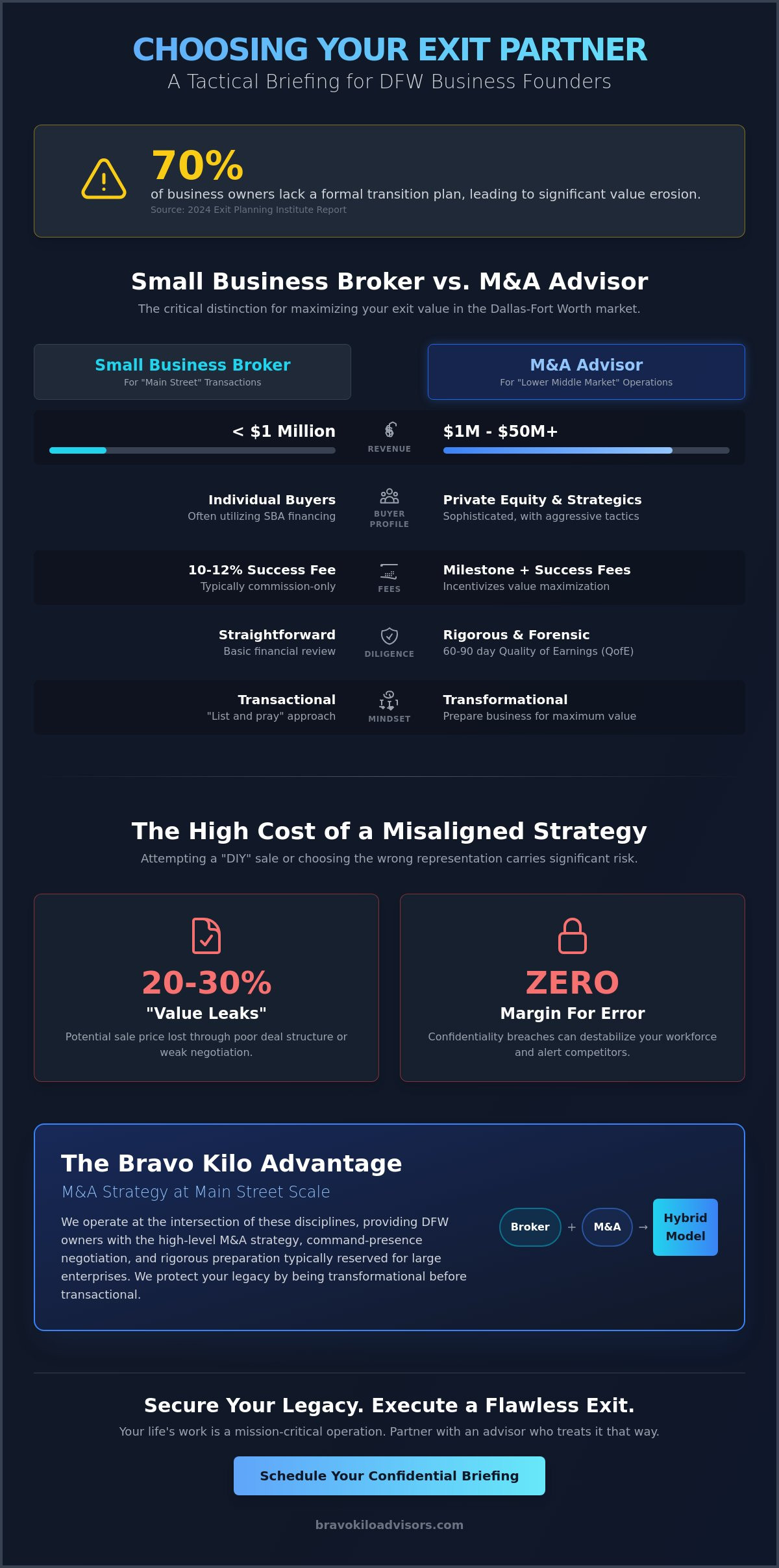
We agree that your life’s work shouldn’t be left to chance. According to the 2024 Exit Planning Institute report, 70% of owners lack a formal transition plan, a gap that often leads to significant value erosion during a sale. This guide provides the intelligence you need to partner with an advisor who brings a command-presence to every negotiation, ensuring you don’t leave your hard-earned equity on the table. We’ll examine the 2026 DFW market landscape, the vital distinction between brokers and M&A advisors, and the strategic roadmap required for a high-value, confidential transition.
Key Takeaways
- Distinguish between main-street brokerage and complex M&A to ensure your representation is properly scaled for your firm’s revenue and complexity.
- Identify the specific vetting criteria for small business brokers that safeguard your confidentiality and leverage hyper-local North Texas market data.
- Follow a disciplined five-step operational roadmap to transition from tactical assessment and valuation to a successful, high-value closing.
- Adopt a “Transformational before Transactional” mindset to protect your life’s work and secure a legacy that extends beyond the boardroom.
- Leverage federal-level negotiation strategies to maintain command-presence during the high-pressure phases of the business sale process.
What is a Small Business Broker and Why Do DFW Owners Need One?
Selling a private enterprise in the Dallas-Fort Worth Metroplex is a high-stakes operation that requires more than a simple listing. A Business broker acts as a professional intermediary, managing the intricate process of valuing, marketing, and transitioning a small to mid-sized company. In the 2026 North Texas market, these professionals serve as the shield between a founder’s legacy and the aggressive tactics of sophisticated buyers. Relying on small business brokers ensures that the transition is handled with the precision of a mission-critical objective rather than a trial-and-error experiment.
Many DFW owners attempt the “DIY” route to save on commissions, but this often results in “value leaks” where 20% to 30% of the potential sale price is lost through poor structure or weak negotiation. Confidentiality is another casualty of the solo approach. Without a controlled process, news of a sale can leak to competitors or employees, destabilizing the business before a Letter of Intent is even signed. The primary mission of a broker is to bridge the gap between a founder’s years of sweat equity and a buyer’s specific investment criteria, ensuring both parties find common ground without compromising the company’s integrity.
The Role of a Broker in the North Texas Economy
The DFW market is not a monolith; it is a collection of high-velocity growth corridors. From the tech-heavy expansion in Frisco and Plano to the industrial resurgence in Fort Worth, local expertise is mandatory. Generic national advice fails to account for the 0% state income tax in Texas, which significantly increases buyer appetite and drives higher business valuations compared to coastal markets. Our region’s explosive population growth, projected to continue through 2030, makes North Texas a primary target for private equity and individual investors alike. A business broker is a tactical navigator for a founder’s most significant financial mission.
Transactional vs. Transformational Brokerage
In a sophisticated M&A environment like Dallas, the “list and pray” approach is a recipe for failure. We operate on the principle of Advisors before Brokers, meaning the strategy starts long before the business hits the market. This transformational approach focuses on preparing the business for the scrutiny of due diligence, ensuring that the transition is seamless for both the staff and the new ownership. Tactical experience in high-pressure environments allows us to maintain deal momentum when negotiations become difficult. By prioritizing the transformation of the business into a “buyer-ready” asset, we achieve closing rates that far exceed industry averages. This disciplined, process-oriented method ensures that small business brokers deliver more than just a buyer; they deliver a successful conclusion to a founder’s career.
Small Business Broker vs. M&A Advisor: Knowing the Difference
Choosing between a broker and an M&A advisor is a tactical decision that dictates the outcome of your exit mission. Standard small business brokers typically focus on Main Street transactions where annual revenue stays below $1M. These deals are often straightforward, involving individual buyers and traditional SBA financing. In contrast, M&A advisors manage the Lower Middle Market, handling complex transactions ranging from $1M to $50M or more. Bravo Kilo Advisors operates at the intersection of these disciplines. We provide DFW owners with the high-level strategy of an M&A firm even when the business is still scaling, distinguishing our approach from typical small business brokers who may lack tactical depth.
Fee structures also diverge based on the mission scope. Brokers generally rely on commission-only success fees, often averaging 10% to 12% of the final sale price. M&A advisors frequently utilize milestone fees to cover the intensive preparation phase, followed by a smaller percentage success fee upon closing. This ensures the advisor is incentivized to maximize value, not just rush a closing. The due diligence required for a $10M enterprise in North Texas is significantly more rigorous than a Main Street deal. It involves a deep-dive Quality of Earnings (QofE) report that can span 60 to 90 days of forensic financial scrutiny.
When to Hire a Specialized M&A Advisor
Your DFW business has outgrown a standard broker when the buyer profile shifts from individuals to private equity groups or strategic competitors. These sophisticated buyers use aggressive negotiation tactics that require a command-presence on your side of the table. A certified business valuation is the first step in determining if your operation requires this specialized level of representation. If your exit involves complex deal structures like earn-outs or equity rolls, you need an advisor who understands the long-term legal and financial implications of those terms.
The Value of Strategic Growth Consulting
Exit planning is a multi-year operation, not a last-minute scramble. We believe in being Advisors before Brokers, which means cleaning up your balance sheets and operational workflows at least 24 months before a sale. This preparation ensures your financials meet the strict standards of Dallas-based private equity firms. A true advisor increases the enterprise value before ever taking the business to market. This transformational approach shifts the focus from a simple transaction to a strategic mission. If you’re unsure where your company stands, you should request a confidential briefing to assess your current market position.
How to Vet Small Business Brokers in Dallas-Fort Worth
Selecting from the pool of small business brokers in the Metroplex is a high-stakes decision that dictates your exit’s success. You aren’t just hiring a salesperson; you’re appointing a lead negotiator for your life’s work. This process requires a briefing-style evaluation of their tactical capabilities and local intelligence.
A broker must demonstrate a granular understanding of DFW’s shifting landscape. By 2026, real estate trends in the North Texas corridor have created complex valuation variables. Your advisor should know how the 3.8% labor participation shift in Tarrant County or the commercial zoning changes in Collin County affect your specific industry. If they can’t speak to these local nuances, they aren’t equipped to defend your asking price during due diligence.
Security is the next pillar of the vetting process. Confidentiality isn’t a suggestion; it’s a strict operational protocol. Ask potential small business brokers for their specific data-room encryption standards and their method for “blind” marketing. In a tight-knit community like the DFW business sector, a single leak to a competitor or a key employee can compromise the entire mission. You need an advisor who treats your data with the same discipline used in federal service.
- The Battle-Tested Test: Request specific examples of deals they saved when a buyer attempted a “re-trade” or when financing stalled at the eleventh hour.
- Professional Credentials: Ensure they use industry-standard methodologies. A broker who guesses at numbers is a liability.
- Local Intel: They should have a direct line to North Texas lenders and legal experts who specialize in the Texas Business Organizations Code.
Red Flags to Avoid in North Texas Brokerage
Avoid brokers who promise “top dollar” or “record-breaking exits” without presenting a certified business valuation frisco. Relying on “rules of thumb” is a tactical error that leads to deal fatigue and failed closings. Be wary of advisors who pressure you into 12-month restrictive listing agreements without providing a written, step-by-step tactical plan. Transparency in the buyer vetting process is non-negotiable. If they can’t explain how they verify a buyer’s liquid capital, they’re wasting your time.
The Importance of Command Presence
Your broker’s negotiation style becomes the face of your company. We believe in being Advisors before Brokers. This means maintaining a command presence in the boardroom, projecting calm authority even when negotiations become heated. A mission-first attitude ensures the deal stays on track when emotions run high. Vetting for professional poise and ethical standards is essential. You want a veteran who has navigated high-pressure environments and understands that integrity is the only foundation for a transformational exit.
The Mission-Critical Roadmap: The 5-Step Sale Process
Exiting a business is a high-stakes operation that requires more than just a listing; it demands a disciplined deployment. Industry data shows that roughly 80% of businesses put on the market never actually reach the closing table. This failure often stems from a lack of a structured, tactical approach. At Bravo Kilo Advisors, we operate under the mantra of Advisors before Brokers, ensuring every move is calculated to protect your legacy and maximize your return.
- Phase 1: Tactical Assessment & Certified Valuation. We begin with a deep-dive analysis of your operation. This isn’t a “ballpark” estimate. We establish a certified valuation based on hard data, market comps, and your specific EBITDA to ensure we enter the market with a defensible position.
- Phase 2: Strategic Positioning & Confidential Marketing. Intelligence is everything. We build a comprehensive “Blind Profile” that highlights your company’s strengths without compromising your identity. This protects your staff and client relationships from unnecessary exposure.
- Phase 3: Buyer Vetting & Command-Led Negotiations. We filter out the “looky-loos.” Only buyers with verified liquidity and a strategic fit reach the briefing room. We lead the negotiations to ensure the terms align with your mission objectives.
- Phase 4: Mission-Critical Due Diligence Management. This is the most grueling phase of the operation. We manage the flow of information, keeping the “deal clock” moving while protecting you from buyer fatigue or aggressive re-trading tactics.
- Phase 5: The Successful Close & Legacy Transition. We cross the finish line with a focus on a clean handoff. Our goal is a “mission accomplished” state where the buyer is prepared for ownership and your financial future is secured.
Preparing for the North Texas Market
Success in the DFW market starts with operational readiness. You must gather three years of clean financials and tax returns that reflect the true health of the business. We look for “Value Killers” that could tank your price, such as a customer concentration where a single client represents over 20% of your revenue. To understand how sophisticated buyers analyze these local listings, review our guide on companies for sale in texas.
Managing the Deal Flow
The Letter of Intent (LOI) serves as a tactical milestone, not the end of the journey. Once signed, it triggers an exclusivity period where the clock becomes your greatest enemy. Experienced small business brokers know that momentum is the only way to survive due diligence. We act as the central command, coordinating with attorneys and CPAs to ensure every document request is met with precision. This methodical rhythm builds confidence in the buyer, confirming that they’re acquiring a well-run machine. When you work with elite small business brokers, you aren’t just selling an asset; you’re executing a calculated transition of power.
Ready to see how your business stands up to a tactical assessment? Schedule your mission-critical valuation briefing today.
Why Bravo Kilo Advisors is the Strategic Choice for DFW Founders
Choosing between small business brokers in the Dallas-Fort Worth metroplex often feels like a choice between transactional volume and genuine partnership. At Bravo Kilo Advisors, we eliminate that friction by operating under a singular mantra: Advisors before Brokers. We prioritize your long-term legacy over a quick commission check. Our team treats your business transition as a high-stakes mission where failure isn’t an option. We don’t just list businesses; we execute strategic exits that honor the decades of sweat equity you’ve invested in North Texas.
Our firm brings a tactical advantage to the DFW boardroom that traditional intermediaries can’t match. We apply federal-level negotiation tactics and precision planning to every deal. This command-presence ensures that when we sit across from private equity groups or strategic buyers, your interests are defended with the same intensity found in mission-critical operations. We combine these local North Texas roots with a global reach. While we understand the unique economic drivers of the 13-county DFW region, our network extends nationwide to find the right buyer who values your culture as much as your EBITDA.
The Bravo Kilo Difference
We operate with a mission-first attitude. This means we maintain a briefing-style communication rhythm that keeps you informed at every stage of the process. Order and transparency aren’t just goals; they’re our standard operating procedure. We understand the emotional weight of walking away from your life’s work. Our approach blends technical proficiency with protective empathy, ensuring you feel secure while we navigate the complexities of due diligence and final closing. We focus on transformational outcomes, not just transactional ones. Our process includes:
- Strict adherence to a predetermined communication schedule to eliminate uncertainty.
- A methodical approach to valuation that stands up to the most rigorous buyer scrutiny.
- Protective measures that shield your employees and brand during the sensitive marketing phase.
Your Next Strategic Move
The 2026 market in North Texas is moving fast. Waiting to plan your exit often results in leaving significant capital on the table. You’ve spent years building your company; you shouldn’t rush the final chapter. The first step is a confidential briefing to assess your current market position and identify potential roadblocks. It’s time to transition from founder to strategist. Secure your legacy with a tactical advisor at Bravo Kilo Advisors and ensure your business’s next phase is as successful as its first. We are ready to lead your mission to a successful conclusion.
Execute Your Mission-Critical Exit Strategy
Your DFW business represents years of disciplined effort and significant personal sacrifice. Navigating the 2026 market demands more than a standard listing service; it requires a strategic partner who treats your sale as a high-stakes operation. We’ve identified how to vet small business brokers and why a 5-step roadmap is essential for protecting your equity. At Bravo Kilo Advisors, we bring a battle-tested perspective to the boardroom. Our founder leverages a tactical law enforcement and federal negotiation background to secure the best possible terms for our clients. We specialize in DFW companies with annual revenues ranging from $500,000 to $50 million. Our commitment is to be advisors before brokers. This mission-first approach ensures your transition is transformational rather than merely transactional. You’ve handled the heavy lifting of building a successful enterprise. Now, it’s time to apply precision to your exit. We’re ready to lead the way through every complex negotiation with integrity and poise. Your legacy is the mission. Let’s finish it strong.
Partner with a tactical advisor for your DFW business sale
Frequently Asked Questions
What is the average commission for small business brokers in Dallas?
Small business brokers in Dallas typically charge a success fee ranging from 10% to 12% of the final sale price for transactions under $1 million. For larger deals exceeding $2 million, the fee often scales down to 7% or 8% based on the Lehman Formula. You should expect a minimum commission floor, often starting at $25,000, to cover the operational costs of the mission. This ensures your advisor has the resources to execute a high-level marketing strategy.
How long does it typically take to sell a business in North Texas?
Selling a business in North Texas takes an average of 6 to 9 months from the initial listing to the final closing. This timeline includes a 60 day period for due diligence and a 30 day window for final legal execution. If your financials aren’t audit-ready, the process can extend beyond 12 months. We treat this as a phased operation where speed never compromises the security of the deal or the value of your legacy.
Will my employees or competitors find out I am selling my business?
We utilize strict Non-Disclosure Agreements and blind profiles to ensure your employees and competitors remain unaware of the sale until the final stages. Only 15% of prospective buyers typically pass our initial vetting process to see sensitive data. This tactical approach protects your current operations from internal unrest or external poaching. We believe in being Advisors before Brokers, ensuring your mission stays secure through a controlled flow of information.
Do I need a certified valuation before I list my business for sale?
You don’t always need a formal certified valuation, but 80% of successful exits in DFW begin with a professional Opinion of Value. A certified report from an NACVA professional is essential if you’re seeking SBA 7(a) financing for your buyer. Without a data-backed valuation, you risk a 20% price gap during the negotiation phase. We provide the strategic clarity needed to defend your asking price against aggressive buyer tactics.
Can a business broker help me find financing for a buyer?
Yes, a professional advisor coordinates with preferred SBA lenders to pre-qualify your business for buyer financing before the listing goes live. Statistics from the Small Business Administration show that pre-qualified listings sell 30% faster than those without a clear capital path. We manage the communication between the buyer and the lender. This ensures the mission remains on track and the capital raising phase doesn’t stall the closing at the finish line.
What is the difference between a business broker and an M&A advisor in DFW?
Small business brokers typically handle main street companies with annual revenues under $2 million, while M&A advisors manage mid-market transactions up to $50 million. Brokers focus on high-volume listings; advisors provide a more tactical, transformational approach to the deal structure. Our firm operates as Transformational before Transactional, focusing on the strategic outcome rather than just a quick handoff. Both roles serve the DFW market but require different levels of specialized discipline and experience.
What happens if my business doesn’t sell within the contract period?
If your business doesn’t sell within the 6 to 12 month contract period, we conduct an after-action review to identify the tactical failures. You aren’t typically obligated to pay a success fee if a closing doesn’t occur. Market data suggests that 25% of businesses fail to sell due to unrealistic pricing or poor financial records. We use this data to pivot the strategy and prepare for a secondary market rollout with improved positioning.
How do I know if my business is ready for the North Texas market?
Your business is ready for the North Texas market when you have 3 years of clean tax returns and a documented standard operating procedure. DFW buyers currently look for a debt service coverage ratio of at least 1.25. If your owner-benefit is growing by 5% annually, you’re in a strong position to negotiate. We assess your command-presence in the industry to ensure you’re entering the market from a position of tactical strength.