
Your professional legacy in the North Texas market is either a scalable asset or a high-paying job; 2026 buyers will decide which it is before you ever reach the negotiating table. The “Dallas Premium” is real, but it is only accessible to firms that have successfully de-risked their operations from founder dependency. You have likely spent years building a reputable brand, yet the fear of your business failing without you or the uncertainty of 2026 EBITDA multiples can make the exit process feel like a high-stakes gamble. Concerns about confidentiality in our tight-knit DFW professional community only add to the pressure of the transition.
Selling a professional services firm in Dallas requires the same tactical precision you apply to your client work. We understand the emotional and financial weight of this mission. This guide will show you how to navigate the current M&A landscape where general professional services firms are commanding 5x to 10x EBITDA multiples. You will learn to streamline your operations for maximum enterprise value and execute a confidential buyer selection process. We will detail the specific steps to move from an initial assessment to a final resolution, ensuring your firm remains a mission-critical operation for the next generation of leadership.
Key Takeaways
- Leverage the “Dallas Premium” by understanding the 2026 normalized EBITDA standards that set North Texas firms apart from national averages.
- Execute a financial fortification plan that prepares three years of P&L statements for the rigorous scrutiny of high-level M&A negotiations.
- De-risk your exit by documenting mission-critical SOPs that guarantee operational continuity without your daily involvement.
- Navigate the complexities of selling a professional services firm in Dallas using a “Blind Profile” strategy to maintain absolute confidentiality from local competitors.
- Identify the tactical differences between strategic, financial, and individual buyers to ensure your legacy lands in the right hands.
Valuing a Professional Services Firm in the Dallas Market
Precision is the baseline for selling a professional services firm in Dallas. To capture maximum value, you must establish a baseline using “normalized EBITDA,” which strips away non-operational noise to reveal the true earning power of the firm. Common add-backs in the 2026 Dallas market include non-recurring legal fees, excess owner compensation, and personal expenses. This adjustment provides a transparent view for sophisticated buyers who utilize various business valuation methods to assess your firm’s health.
To better understand this concept, watch this helpful video:
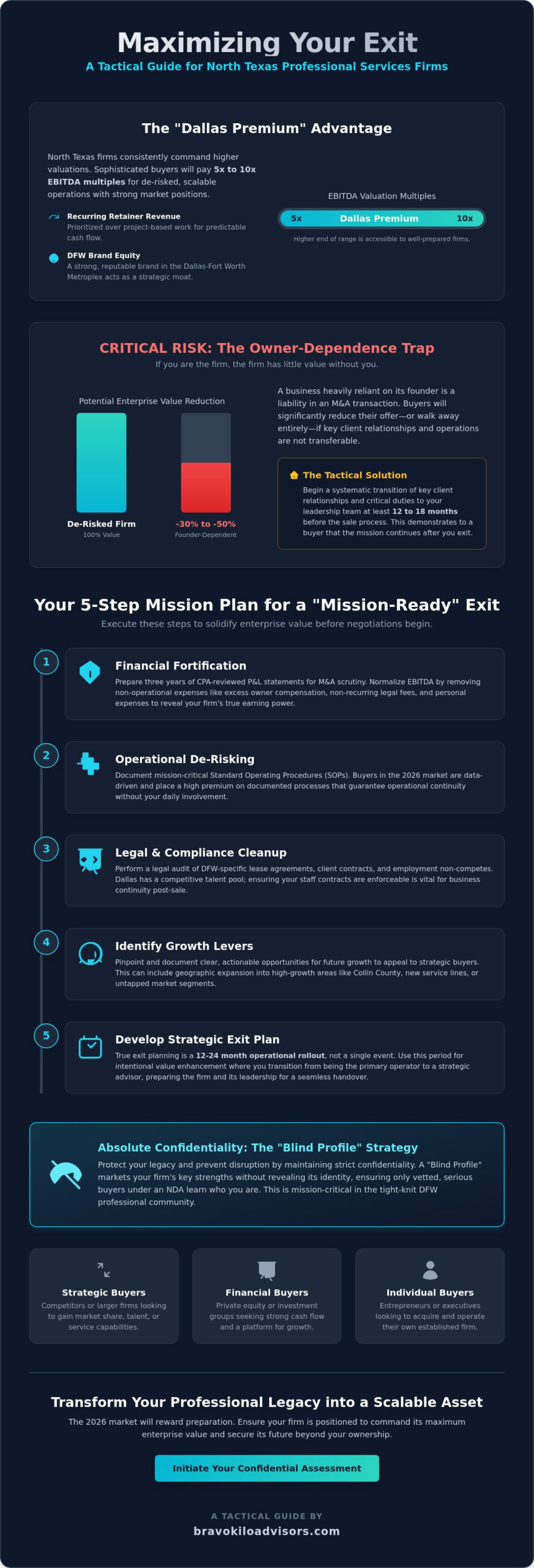
The “Dallas Premium” is a distinct economic advantage. Because North Texas continues to see robust gains in professional and business services, local firms often command multiples at the higher end of the 5x to 10x EBITDA range. Buyers are specifically looking for a mix of revenue and market position. They prioritize recurring retainer revenue over project-based work because it offers predictable cash flow. Intangible assets, such as your firm’s brand equity in the DFW Metroplex and documented market share, function as a strategic moat that justifies these higher valuations.
The Owner-Dependence Trap: De-risking Your Firm
If you are the firm, the firm has no value without you. A business heavily reliant on a single founder often sees a 30% to 50% reduction in enterprise value during the due diligence phase. You must execute a tactical transition of key client relationships to junior partners at least 12 to 18 months before the sale process begins. This proves to a buyer that the mission continues even after you exit. For a deeper look at specific methodology, consult our guide on Texas Business Valuation.
Tactical Preparation: A 5-Step Mission Plan for DFW Owners
Preparation is the phase where enterprise value is either solidified or surrendered. When selling a professional services firm in Dallas, you can’t rely on market momentum alone. You need a disciplined rollout that addresses every operational vulnerability before a buyer initiates their reconnaissance. This process begins with financial fortification. You must audit three years of P&L statements to ensure “mission-ready” transparency. This isn’t just about clean books; it’s about understanding the tax implications of selling a business and how your asset allocation will affect your net proceeds at closing.
Operational systems are your next priority. You must document Standard Operating Procedures (SOPs) that allow the business to function without your direct intervention. Buyers in the 2026 market are data-driven and place a premium on documented processes. Following this, perform a legal cleanup of DFW-specific lease agreements and employment non-competes. Dallas has a unique, competitive talent pool, and ensuring your staff contracts are enforceable is vital for business continuity. Finally, identify growth levers that appeal to strategic buyers, such as geographic expansion into high-growth areas like Collin County, where professional services demand remains high.
Exit Planning: The Difference Between Selling and Transitioning
True exit planning is a 12-24 month operational rollout, not a one-time transactional event. It’s a period of intentional value enhancement where you move from being the primary operator to a strategic advisor. Hiring a Business Broker in Dallas, TX during this phase provides the outside perspective needed to identify “blind spots” in your firm’s structure. If you’re unsure where your firm stands, you might consider a professional value enhancement assessment to bridge the gap between your current state and your target exit price.
To be considered “Mission-Ready” by sophisticated DFW buyers, your financial documentation should include:
- Three years of CPA-reviewed or audited financial statements.
- A detailed schedule of “add-backs” to justify your normalized EBITDA.
- Proof of recurring revenue streams, such as multi-year client retainers.
- A clear breakdown of client concentration to prove no single account exceeds 15-20% of total revenue.
- Updated federal and state tax filings, including compliance with the 8.25% Dallas combined sales tax rate where applicable.
Executing the Sale: Navigating the North Texas Buyer Landscape
Executing the final phase of selling a professional services firm in Dallas requires a command of the current buyer landscape. You aren’t just looking for any offer; you’re looking for the right fit among three primary groups. Strategic competitors seek to expand their DFW footprint by acquiring established client lists. Financial buyers, specifically Private Equity firms, remain highly active in 2026. These firms often pay approximately 3 turns of EBITDA more than strategic buyers to secure premium assets in the United States. Finally, individual “Search Fund” buyers offer a more personal transition for owners who want a dedicated successor to lead the firm directly.
Maintaining operational security is paramount during this process. We utilize a “Blind Profile” strategy to market your firm. This high-level summary provides enough data to attract serious interest without revealing your identity to local competitors or employees. This protective layer ensures your reputation remains intact while we vet potential suitors under strict non-disclosure agreements. Once a qualified buyer is identified, you move to the Letter of Intent (LOI) stage. This document outlines the price, structure, and timeline, serving as the blueprint for the final mission.
After the LOI is signed, you enter the due diligence gauntlet. This is an exhaustive audit where the buyer scrutinizes your 2026 performance, financial records, and operational SOPs. It’s vital to keep the firm running at peak efficiency during this time. Any dip in performance during the audit can lead to re-trading or a total deal collapse. Your focus must remain on the business while your advisors manage the information flow.
Confidentiality and Command: Managing the Transaction
Deal fatigue is a real threat in high-stakes negotiations. A battle-tested advisor maintains momentum, ensuring that the process doesn’t stall during the final push toward closing. Beyond the numbers, cultural fit is essential for your legacy. You’ve built a Dallas brand; the buyer must align with your employee values and service standards to ensure long-term impact. When you are ready to transition, you can Sell Your DFW Business Confidentially with Bravo Kilo Advisors.
Secure Your Professional Legacy in the DFW Market
Success in the 2026 M&A market is not a matter of chance; it’s the result of a disciplined operational rollout. By normalizing your EBITDA, de-risking your firm from founder dependency, and utilizing a “Blind Profile” strategy, you position yourself to capture the highest possible enterprise value. Your years of service in the North Texas community have built a brand worth protecting. The transition of that legacy requires the same mission-first attitude you applied to building it.
Navigating the complexities of selling a professional services firm in Dallas demands a partner who understands the local landscape. Our team provides specialized North Texas M&A expertise and Certified Business Valuations to ensure your data stands up to the most rigorous buyer scrutiny. We operate on success-based transaction fees, aligning our objectives directly with your clean exit and maximum return. You’ve done the hard work of building a reputable firm; now it’s time to execute the final phase with tactical precision.
Request a Confidential Strategic Valuation for Your Dallas Firm today. You can move forward with confidence, knowing your professional transition is being handled with integrity and poise.
Frequently Asked Questions
How much is my professional services firm in Dallas worth in 2026?
Most professional services firms in the North Texas market are valued between 5x and 10x EBITDA in 2026. Specific sub-sectors like consulting or marketing often see multiples ranging from 4x to 9x. Your firm’s final value depends on recurring revenue stability and owner independence. Firms with over $5 million in EBITDA typically command higher multiples because they attract institutional private equity interest looking for the Dallas Premium.
How long does it take to sell a service-based business in North Texas?
The typical timeline for selling a professional services firm in Dallas ranges from six to twelve months from the initial assessment to the final closing. This duration accounts for the preparation phase, marketing through a “Blind Profile,” and the intensive due diligence gauntlet. Complexities in client contracts or the need for a longer founder transition period can extend this mission. Starting your exit planning early ensures the business is mission-ready.
Do I need a business broker or an M&A advisor for a professional firm sale?
The choice depends on the complexity and enterprise value of your firm. Business brokers typically handle smaller, local transactions with individual buyers. M&A advisors specialize in larger, strategic negotiations involving private equity or national competitors. For sophisticated owners, an advisor provides the tactical leadership necessary to manage high-stakes due diligence and maximize value through competitive bidding environments. They ensure your professional legacy is handled with precision.
What is a Quality of Earnings (QoE) report, and do I need one for my Dallas firm?
A Quality of Earnings report is a rigorous analysis of your firm’s financial health that validates the sustainability of your historical earnings. Unlike a standard audit, it focuses on identifying non-recurring revenue and verifying “normalized EBITDA” for a buyer. Commissioning a sell-side QoE report is a strategic move that de-risks the deal. It provides transparency and prevents buyers from re-trading the price during the final stages of the transaction.