
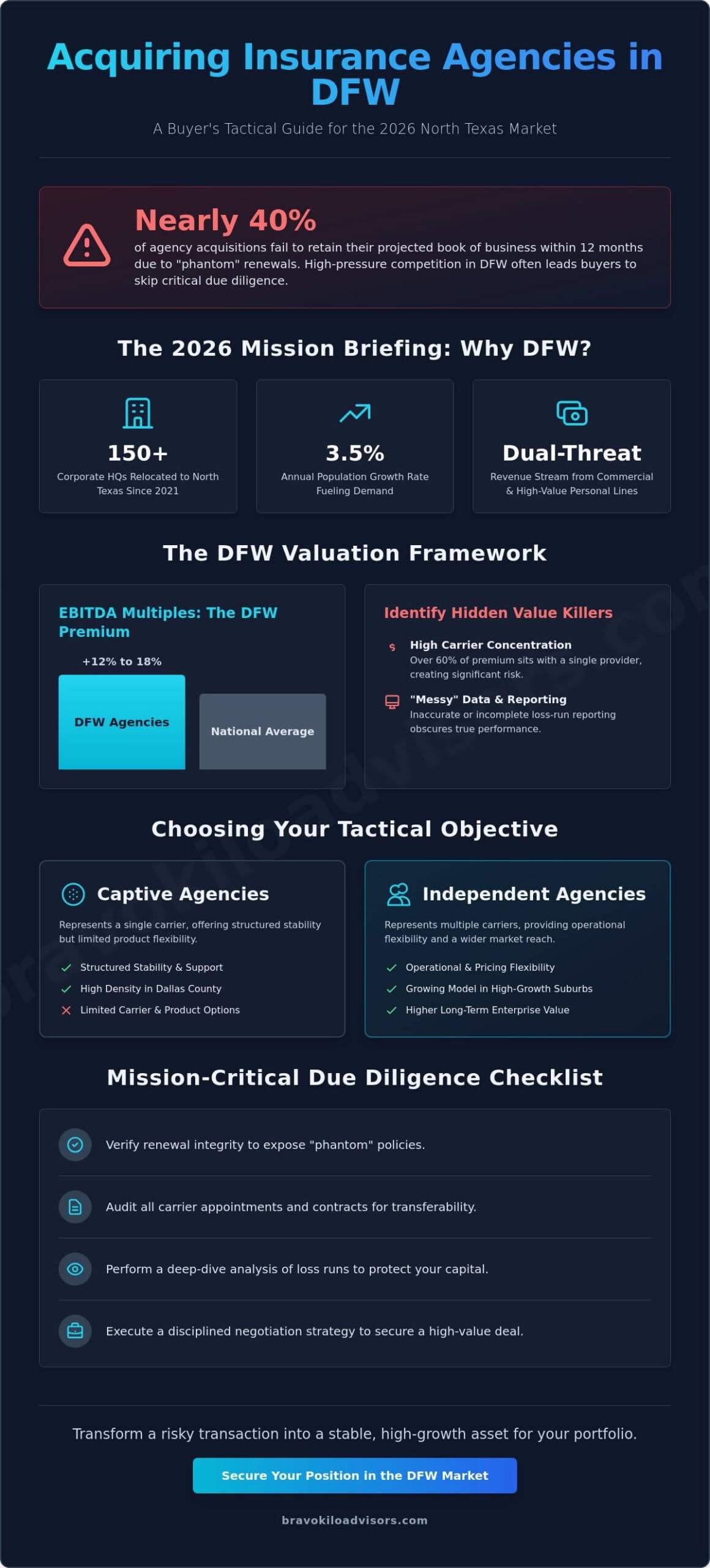
In the 2024 fiscal year, industry data indicated that nearly 40% of independent agency acquisitions failed to retain their projected book of business because of “phantom” renewals that disappeared within 12 months of the closing date. You’ve likely seen the high-pressure environment surrounding insurance agencies for sale in the Dallas-Fort Worth metroplex, where competition often forces buyers to skip the tactical due diligence required for a clean transition. We understand that your capital represents years of discipline; seeing it eroded by lost carrier appointments or inflated valuations is an unacceptable outcome.
This strategic guide provides the mission-critical intelligence you need to navigate the North Texas market with a tactical, first-principles approach. You’ll learn how to verify renewal integrity, secure carrier contract transfers, and identify high-value opportunities in the rapidly expanding DFW suburbs. We’re moving beyond the standard brokerage model to deliver a briefing on the exact steps required to transform a risky transaction into a stable, high-growth asset for your portfolio.
Key Takeaways
- Analyze the 2026 DFW economic landscape to understand why North Texas remains a high-stakes, command-presence market for insurance acquisitions.
- Master the strategic framework for valuing insurance agencies for sale, focusing on EBITDA multiples while identifying hidden value killers that can jeopardize your investment.
- Determine your tactical objective by weighing the structured stability of captive agencies against the operational flexibility of the independent model.
- Execute a rigorous due diligence mission by auditing carrier appointments and loss runs to protect your capital and ensure post-closing continuity.
- Navigate the complex M&A timeline with a disciplined negotiation strategy designed to secure high-value deals without overextending your resources.
The 2026 Mission Briefing: Why Pursue Insurance Agencies for Sale in DFW?
The North Texas economic climate isn’t just growing; it’s fortifying. By early 2026, the DFW metroplex has solidified its position as the top destination for corporate migration in the United States. This isn’t a mere trend. It’s a fundamental shift in the American economic theater. For those scouting insurance agencies for sale, the objective is clear. You aren’t just buying a book of business. You’re securing a perimeter in a market that remains insulated from broader national volatility.
Bravo Kilo Advisors operates on a core principle: we prioritize transformational acquisition over transactional buying. Transactional buyers look at the past twelve months of EBITDA; strategic buyers look at the next ten years of demographic dominance. In 2026, the high-ground is located in the northern expansion zones. Frisco, Plano, and Celina have transitioned from suburban outposts to economic command centers. Securing a presence here provides a command-position for both high-value personal lines and complex commercial accounts.
DFW Demographic Shifts and Insurance Demand
The influx of over 150 corporate headquarters to North Texas since 2021 has created a massive surge in commercial line opportunities. This corporate density drives a secondary wave of residential growth in the Golden Corridor, where home values have maintained a steady appreciation rate through 2025. This creates a dual-threat revenue stream for agencies that can service both the executive’s firm and their private estate. The DFW insurance market in 2026 stands as a reinforced fortress of recurring revenue, backed by a diverse industrial base and a relentless influx of high-net-worth residents.
The Competitive Landscape of North Texas Agencies
Dallas County currently sees a high density of captive agencies, yet the market is shifting toward independent models that offer more flexibility. When evaluating insurance agencies for sale, understanding the role of an insurance broker versus a captive agent is critical for defining your tactical objective. Local market knowledge acts as a force multiplier. Knowing which zip codes in Collin County are under-insured allows for precision targeting post-acquisition. Before moving forward, consult our latest business listings to align your search with current market trends.
The 2026 landscape demands a disciplined approach. Success requires more than just capital; it requires a mission-first attitude and the willingness to navigate complex negotiations with integrity. We treat every deal as a mission-critical operation because we know your legacy is on the line. Our role is to ensure you occupy the strongest possible position before the first contract is signed.
Valuing Insurance Agencies for Sale: The DFW Strategic Framework
Valuation is the frontline of any acquisition mission. In the 2026 market, assessing insurance agencies for sale requires a shift from legacy revenue-based models to sophisticated EBITDA-based analysis. While national trends fluctuate, the Dallas-Fort Worth corridor maintains a unique economic profile that demands a tactical approach. You cannot rely on back-of-the-napkin math when your capital is on the line. A disciplined buyer treats valuation as a reconnaissance phase; identifying hidden risks before they become liabilities.
Several “Hidden Value Killers” can compromise an agency’s price. These include high carrier concentration where 60% of premium sits with one provider, or “messy” data that prevents accurate loss-run reporting. If the books aren’t clean, the risk premium increases. We recommend consulting the SBA guide to buying a business to understand the foundational requirements for acquisition financing. Securing a certified valuation before you sign a Letter of Intent (LOI) is a non-negotiable step to protect your interests. It provides the objective data needed to stay firm during high-pressure negotiations.
EBITDA Multiples for North Texas Agencies
DFW agencies currently command a premium of 12% to 18% over national averages. This surge is driven by the region’s massive corporate relocation trend and a 3.5% annual population growth rate. Buyers are paying for the stability of the North Texas economy. When calculating your offer, focus on Adjusted EBITDA to account for owner add-backs and one-time expenses. For a deep dive into these methodologies, review our Texas business valuation guide. Retention rates in DFW are a critical influencer; agencies maintaining a 92% or higher personal lines retention rate often see an additional 0.5x multiplier on their final price.
Intangible Assets: Carrier Appointments and Staff
The “Blue Sky” value of an agency often rests on its carrier appointments. In a hard market, access to Tier-1 carriers is a strategic asset that can take years to build from scratch. You aren’t just buying a book of business; you’re buying established trust. However, “Key Man” risk is a significant threat in smaller DFW firms. If the agency’s success depends entirely on the founder’s personal relationships, the value drops the moment they exit the building.
Our “Advisors before Brokers” approach defines valuation as a measure of a firm’s ability to thrive under new leadership without losing its operational momentum. We look at the strength of the middle-management and the durability of the client service model. If you are ready to move from searching to executing, our team provides the strategic advisory necessary to ensure your offer is both competitive and protected.
Captive vs. Independent: Choosing Your Tactical Objective
Acquiring an insurance agency requires a clear mission profile. You’re choosing between a turnkey brand and a flexible, multi-carrier operation. When evaluating insurance agencies for sale in the North Texas corridor, this decision dictates your operational freedom, your ability to pivot during market shifts, and your ultimate exit strategy. We view this as a choice between a fortified position and a mobile strike force.
The Captive Model in DFW
Captive agencies, such as those under the State Farm, Farmers, or Allstate banners, offer immediate brand recognition. In a saturated market like Dallas, this visibility is a force multiplier for lead generation. You inherit a battle-tested system and a localized reputation. However, you operate within a strict perimeter. Your product suite is limited to what the parent company offers. If their rates become uncompetitive in the 75201 zip code, you lack the tactical flexibility to shop the market for your clients.
Investors must scrutinize the “contract value” or buy-out clauses inherent in these agreements. Unlike independent firms, your equity is often tied to corporate formulas rather than pure market multiples. When conducting your Regulatory and Due Diligence Considerations, pay close attention to the non-compete restrictions. These can limit your future maneuvers if you decide to transition out of the captive system later.
The Independent Advantage
Independence is a growth strategy built on versatility. Independent agencies act as strategic advisors rather than product vendors. In the 2026 DFW landscape, property insurance is increasingly volatile due to wind and hail risk. An independent agent can leverage 20 different carriers to find the best coverage for a commercial client in Plano or a homeowner in Southlake. This ability to pivot ensures your retention remains high even when specific carriers tighten their appetite.
The independent model offers superior strategic growth potential because you own the “book of business” outright. You can sell to private equity, a local competitor, or a national aggregator. If you’re looking for a different recurring revenue play with less regulatory friction, you might compare this to the ATM business for sale model. While both offer steady cash flow, the independent agency provides a deeper level of consultative value to the local business community.
Analyzing carrier appetite for 2026 shows a trend toward specialization. Many carriers are pulling back from high-density urban risks while expanding in the suburban expansion zones like Celina and Prosper. An independent agency allows you to align your portfolio with these shifting appetites. You’re not just buying a job; you’re acquiring a scalable asset that can adapt to the Texas economy. This flexibility is why many sophisticated buyers prioritize independent insurance agencies for sale when building a long-term investment portfolio.
Tactical Due Diligence: A Checklist for North Texas Buyers
Due diligence is the phase where we separate tactical reality from seller optimism. When evaluating insurance agencies for sale, you aren’t just buying a book of business; you’re acquiring a complex web of carrier relationships, state mandates, and human capital. Our approach treats this stage like a pre-mission briefing. We look for the hidden friction points that could compromise your ROI after the ink dries.
The operational review must start with a deep dive into the “Loss Runs” and renewal lists from the last 36 months. High loss ratios across a specific niche, such as commercial trucking or North Texas habitational real estate, can signal poor underwriting standards that will lead to carrier friction later. A healthy agency should demonstrate a retention rate of at least 85% to 90%. If the numbers dip below this, you’re looking at a leaking bucket rather than a stable asset.
- Carrier Appointment Audit: Confirm which carriers will allow a “Change of Control” without requiring a brand-new appointment process.
- Compliance Check: Ensure all producers are properly licensed for the lines of authority they sell.
- Cultural Fit: The DFW labor market remains exceptionally tight. With local unemployment rates hovering near 3.8% in early 2026, losing a key producer during the transition could result in a 15% to 20% immediate drop in revenue.
Financial and Legal Reconnaissance
Verifying the “Quality of Earnings” (QofE) is mission-critical. We look beyond basic tax returns to analyze the trailing twelve months of commission statements. This ensures that the EBITDA represented in the prospectus isn’t inflated by one-time contingency bonuses or non-recurring revenue. We also scrutinize DFW office leases. With commercial rents in areas like Frisco and Southlake seeing 10% increases over the last two years, you must ensure the current lease is transferable or provides a viable exit strategy.
The Texas Department of Insurance oversees the rigorous vetting of agency ownership transfers to maintain market stability and consumer protection across the state.
Carrier and Client Retention Strategy
Securing the “Mission” post-closing requires early engagement with carrier representatives. You must interview key carriers to confirm their willingness to transfer appointments to the new entity. Some national carriers have strict premium volume requirements that may trigger a “re-contracting” phase if your existing portfolio doesn’t align with their 2026 growth targets.
- Review the top 20% of clients who typically generate 80% of the agency’s revenue.
- Develop a 90-day “Post-Mission” communication plan to introduce the new leadership without triggering client anxiety.
- Assess the technology stack to ensure seamless data migration from the seller’s Agency Management System (AMS).
Success in this environment requires specialized support. You can read more in our guide on hiring a business broker in Dallas, TX to understand how professional representation protects your interests during the due diligence phase. When looking for insurance agencies for sale, the goal isn’t just to close the deal; it’s to ensure the agency is built to scale. Buyers diversifying across North Texas industries may also find value in reviewing our analysis of a machine shop for sale in DFW, where similar due diligence principles around workforce retention and contract continuity apply.
Executing the Acquisition: Why Command-Presence Matters
Moving a deal from initial interest to a definitive closing requires more than just capital. It demands a command-presence. In the North Texas market, the M&A timeline for insurance agencies for sale typically follows a 90 to 120-day cycle. This window is a high-pressure environment where momentum is your greatest asset. You must maintain a steady, methodical pace to prevent deal fatigue from setting in. We treat the transition from the Letter of Intent to the closing table as a mission-critical operation that requires absolute precision.
The Negotiation Phase
We use tactical empathy to align with the seller’s legacy goals. Many DFW agency owners have spent 20 to 30 years building their books of business. They aren’t just selling a cash flow. They’re transferring a lifetime of work. We structure earn-outs to protect your investment, often utilizing a 24 to 36-month performance window to ensure client retention targets are met. Our philosophy remains transformational before transactional. This approach wins the best deals because it builds the trust necessary to survive the friction of deep-dive due diligence.
- Tactical Alignment: Identifying the seller’s non-monetary needs, such as staff retention or brand continuity.
- Risk Mitigation: Implementing holdbacks and clawback provisions to secure the book’s value.
- Strategic Momentum: Maintaining a 48-hour turnaround time on all critical document reviews to keep the mission on schedule.
Your DFW M&A Command Center
Bravo Kilo Advisors operates as your tactical lead in North Texas. We provide an advisory edge that traditional brokers cannot match. Having a local DFW presence is vital during the final stages of a negotiation. When tensions rise at the closing table, we bring a calm, battle-tested perspective to the boardroom. We prioritize being advisors before brokers, ensuring every decision supports your long-term strategic mission. Our team has seen the pitfalls of the 2026 market and prepared the roadmap to bypass them.
Finalizing the mission requires a disciplined approach to the definitive purchase agreement. We coordinate with legal and tax professionals to ensure the transition of carrier appointments and licensing is seamless. You don’t just want to buy an agency; you want to command a growing asset. Our process ensures you reach the closing table with your strategy intact and your new agency ready for immediate scale. Secure your DFW acquisition strategy with Bravo Kilo Advisors to ensure your next move is executed with the precision it deserves.
Secure Your Objective in the North Texas Market
The 2026 DFW landscape demands a disciplined approach to acquisition. You’ve seen why the Dallas-Fort Worth metroplex remains a primary target for growth, but success requires more than just identifying insurance agencies for sale. It requires a tactical framework rooted in precision and high-stakes authority. Our team brings M&A expertise forged in federal service to every negotiation, ensuring your interests are protected with the same intensity as a mission-critical operation. We provide Certified Business Valuations to ensure your offer is backed by defensible data, not speculation. We operate as advisors before brokers, prioritizing your long-term mission over a simple transaction. This mission-first strategy ensures your due diligence is exhaustive and your command-presence is felt at the closing table. You’re not just buying a book of business; you’re securing a legacy in a region where the population is projected to reach 10 million by the 2030s. Move with intent and professional backup to secure your future.
Schedule your confidential DFW acquisition briefing today
We’re ready to help you execute this transition with total confidence.
Frequently Asked Questions
What is the average multiple for insurance agencies for sale in DFW right now?
Insurance agencies for sale in the DFW market currently command multiples between 2.0 and 3.2 times annual commissions for smaller books, while larger operations trade at 7 to 9 times EBITDA. These valuations depend heavily on retention rates and carrier mix. We analyze 36 months of historical data to ensure the multiple reflects actual cash flow stability. High growth agencies in North Texas often see a 0.5 premium due to the region’s 15% population growth.
Can I buy an insurance agency in Texas if I don’t have an insurance license?
You can legally acquire an agency without a personal insurance license, but you must appoint a licensed Designated Agent to oversee operations. Texas Department of Insurance regulations require this individual to maintain active licensure for the agency to retain its firm license. We ensure your mission plan includes a qualified manager to handle technical advisory roles. Most strategic buyers without licenses hire a General Manager within the first 30 days of ownership.
How long does the carrier appointment transfer process usually take in North Texas?
The carrier appointment transfer process in North Texas typically requires 60 to 90 days to complete. Each carrier has a specific protocol; some require a 30 day notice before the closing date. We treat this as a mission-critical timeline to avoid revenue gaps. Delays often occur if the buyer’s background check takes longer than 14 business days, so we initiate paperwork early in the due diligence phase to maintain momentum.
Is it better to buy a personal lines or commercial lines agency in Dallas?
Commercial lines agencies in Dallas offer higher retention rates and larger premiums, while personal lines provide greater volume and lower barriers to entry. Commercial accounts often see 90% retention compared to 85% for personal lines in competitive urban markets. Your choice depends on your tactical goals. If you want stable, long-term contracts, commercial is the better target. Personal lines allow for faster scaling through digital marketing and lead generation strategies.
What are the biggest risks when buying an independent agency in DFW?
The primary risk when buying an independent agency is key man dependency where 40% or more of the revenue is tied to the previous owner’s personal relationships. If the seller leaves and 20% of the clients follow them, your ROI evaporates. We mitigate this through 24 month non-compete agreements and structured transition periods. Another risk involves high concentration in a single carrier, which can lead to instability if that carrier changes its commission structure.
How does the ‘Quality of Earnings’ report differ for insurance agencies?
A Quality of Earnings report for insurance agencies focuses specifically on recurring commission versus one-time contingency bonuses. We strip out non-recurring revenue to find the true baseline of the operation. This process involves verifying the stickiness of the book by reviewing 3 years of policy data. Standard accounting might miss a 10% dip in renewals that a tactical report will identify. It’s about ensuring the mission remains profitable after the handoff.
Does Bravo Kilo Advisors help with financing the acquisition of an agency?
Bravo Kilo Advisors provides strategic guidance to secure acquisition capital through our network of SBA and private lenders. We don’t lend money directly, but we prepare the mission-ready financial package needed to secure a loan. Our team has a 95% success rate in helping clients navigate the underwriting process. We act as your lead negotiators to ensure terms don’t compromise your agency’s long-term health. Our focus is transformational, not just transactional.