
In the high-velocity DFW market, your company’s value is more than just a multiple of your bottom line. It’s a reflection of your ability to maintain a stable workforce while regional labor costs rise at 4-6% annually. Understanding how to value a construction business in North Texas requires looking past national averages to the specific ground-level realities of the Metroplex. You’ve likely spent years building a reputation, yet you might still feel uncertain about how to account for unbilled backlog or whether you’re leaving money on the table.
It’s a common concern for owners who want to ensure their professional legacy is handled with precision. We’ll show you how to master the specific metrics that determine your true market value in 2026. This guide provides a strategic briefing on valuation methodologies, the impact of the current 6.75% prime rate on buyer appetite, and the DFW value drivers you must optimize before a sale. You’ll gain the clarity needed to navigate complex negotiations with the confidence of a seasoned expert who has seen every scenario.
Key Takeaways
- Analyze the tactical shifts in the 2026 Metroplex landscape that make traditional valuation models obsolete.
- Learn how to value a construction business in North Texas using the income-based “gold standard” to capture your firm’s true earning power.
- Determine if your operation’s value is driven by tangible assets or strategic backlog to ensure you don’t leave money on the table.
- Leverage your skilled North Texas crew as a primary value driver, recognizing that human capital is your most resilient asset in a labor-strained market.
- Implement strategic diversification tactics to protect your firm’s marketability from the risks of high customer concentration.
The North Texas Construction Landscape: Why Valuation is Different in 2026
Determining how to value a construction business in North Texas requires a tactical assessment of your firm’s tangible assets and its future earning potential. In 2026, this calculation is no longer a simple accounting exercise. It is a mission-critical operation that accounts for your equipment fleet and the resilience of your unbilled backlog. You’ve built a legacy in a high-stakes environment, and your valuation should reflect the discipline required to maintain profitability in a complex market.
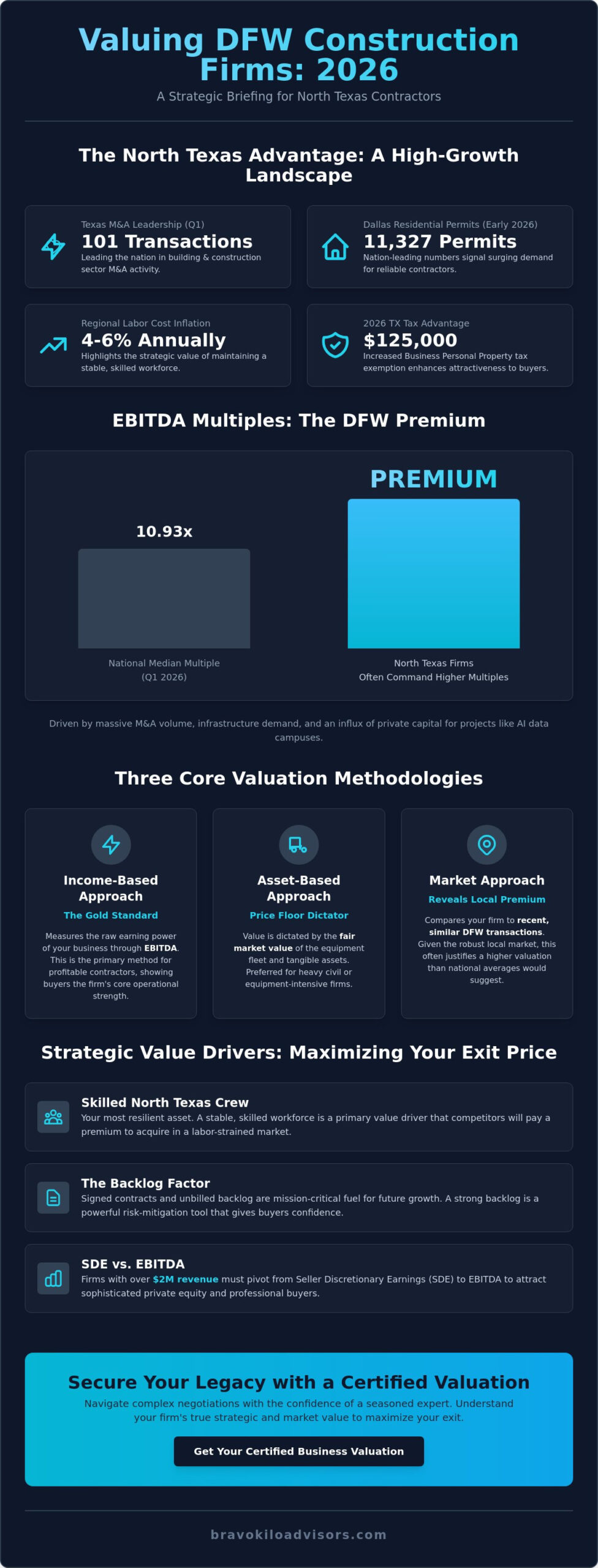
The DFW region is currently experiencing an unprecedented infrastructure boom. With Dallas leading the nation by issuing 11,327 new residential building permits in early 2026, the demand for reliable contractors has surged. Billions of dollars in private investment for AI-focused data campuses have also turned North Texas into a global hub. This massive influx of capital changes how we apply standard business valuation methods. You aren’t just selling a balance sheet; you’re selling a platform that can execute in the most competitive market in the country.
To better understand how these variables interact, watch this visual breakdown of industry-specific metrics:
There is a distinct difference between Market Value and Strategic Value for a DFW contractor. Market value is what a typical buyer might pay based on national multiples and standard cash flow. Strategic value is the premium a competitor pays to gain your skilled crew, your established vendor relationships, or your footprint in a high-growth corridor. Business valuation is the mission-critical baseline for any successful exit strategy.
DFW Market Multipliers: The North Texas Advantage
The expansion into suburban nodes like Frisco, Plano, and Fort Worth has created localized hot zones for construction activity. While national median EBITDA multiples for the sector were recorded at 10.93x in Q1 2026, North Texas firms often command a premium. This is driven by the sheer volume of M&A activity, with Texas leading the nation with 101 transactions in the building products and construction sector during the first quarter. When analyzing how to value a construction business in North Texas, you must also account for tax advantages. The 2026 increase in the Texas Business Personal Property tax exemption to $125,000 provides a cleaner balance sheet, making local firms even more attractive to sophisticated buyers.
The Three Primary Methods to Value a Construction Firm
To accurately determine how to value a construction business in North Texas, we deploy three primary methodologies. Each approach serves a specific strategic objective depending on your firm’s operational structure. Most professional buyers look for a blend of these metrics to justify their investment. For a result that stands up to the high-stakes scrutiny of due diligence, securing a certified business valuation is a necessary tactical step.
The Income-Based Approach remains the gold standard for profitable DFW contractors. This method focuses on EBITDA (Earnings Before Interest, Taxes, Depreciation, and Amortization). It measures the raw power of your business engine. Conversely, the Asset-Based Approach is preferred for heavy civil or equipment-intensive firms. If your balance sheet is dominated by a massive fleet, the fair market value of that equipment dictates the price floor. Finally, the Market Approach compares your firm to recent DFW transactions. Given the robust North Texas construction landscape in 2026, this comparison often reveals a premium for local firms.
EBITDA vs. SDE: Which Metric Matters for You?
Smaller owner-operator firms typically use Seller Discretionary Earnings (SDE). This metric adds your salary and personal benefits back into the profit. It shows what a new owner-operator could expect to take home. However, larger firms with revenue over $2 million must pivot to EBITDA. Professional buyers and private equity groups prioritize EBITDA because they want an operation that functions independently of the founder. This transition is a critical shift in how sophisticated partners view your company’s scale.
The Backlog Factor: Valuing Future Revenue
Backlog is your most effective risk-mitigation tool. Buyers view signed contracts as mission-critical fuel for future growth. A consistent “burn rate” across a diversified project list is far more valuable than one massive, high-risk contract. It proves your pipeline is resilient. If you’re considering an exit, you should focus on value enhancement services to ensure your backlog is structured for maximum impact.
Strategic Value Drivers: Maximizing Your Exit Price in DFW
Understanding how to value a construction business in North Texas goes beyond plugging numbers into a formula. To maximize your exit price, you must optimize the intangible assets that sophisticated buyers prioritize. In the current 2026 climate, your labor force is often more valuable than your heavy machinery. With regional construction wages rising at 4-6% annually, a stable, skilled crew is a defensive moat that protects a buyer from the ongoing DFW labor shortage. Buyers aren’t just purchasing your past performance; they’re investing in your team’s ability to execute future projects.
Customer diversification is another critical driver. If a single client represents more than 20% of your revenue, you’re carrying significant “concentration risk” that will depress your multiple. You must also demonstrate that your firm is process-driven rather than founder-led. A business that relies entirely on your personal relationships is difficult to transition. By building scalable systems, you ensure the mission continues after you step away. These improvements are central to the exit planning process, transforming a standard contractor into a high-value acquisition target.
Financial Cleanliness: The Mission-Critical Prep
Transparency is the bedrock of trust in high-stakes negotiations. “Shoebox accounting” or co-mingled personal expenses will kill a deal in the DFW market before it starts. Professional buyers expect a Quality of Earnings (QoE) report to justify your EBITDA and prove the sustainability of your cash flow. This level of financial discipline provides the reassurance needed to command a premium multiple. It signals that your operation is managed with the precision of a mission-critical project.
Choosing the Right Advisory Partner
A national firm might understand general construction, but they often miss the nuances of the “DFW Premium.” Partnering with a local business broker in Dallas, TX ensures your firm is positioned correctly within the context of the North Texas boom. We apply tactical leadership to your professional legacy. We navigate the complexities of how to value a construction business in North Texas with the precision of a seasoned expert, ensuring you don’t leave money on the table when it’s time to transition.
Secure Your Professional Legacy in the Metroplex
The 2026 North Texas market offers a unique window of opportunity for construction firm owners. You’ve navigated the complexities of labor shortages and rising costs. Now it’s time to realize the value of that discipline. We’ve explored how a robust backlog and a stabilized workforce act as force multipliers for your firm’s marketability. Mastering how to value a construction business in North Texas is the first step toward a successful transition that protects everything you’ve built.
Leaving your exit to chance isn’t a strategic option. Our team includes Certified Business Valuators who bring specialized expertise to the DFW industrial and construction sectors. We operate on success-based transaction fees; this ensures our objectives remain perfectly aligned with your long-term goals. We provide the tactical leadership necessary to navigate high-stakes negotiations with poise. You deserve a partner who understands the emotional and financial weight of this mission.
Get a Certified Valuation for Your Construction Business today to establish your mission-critical baseline. Your hard work has built the infrastructure of North Texas. Let us help you secure the reward you’ve earned.
As you plan for life after the sale, you might be considering new adventures on the road. To prepare for a safe and confident transition into the RV lifestyle, you can learn more about specialized programs offered by Lone Star Truck Driving Academy.
Frequently Asked Questions
What is the average EBITDA multiple for a construction company in Texas?
Texas construction firms currently see a wide range of multiples depending on their scale and specialization. As of Q1 2026, the median national EBITDA multiple for the building products and construction sector reached 10.93x, though local DFW firms often command a premium due to regional demand. Smaller operations with revenue under $3 million typically trade at multiples between 1.8x and 3x. Larger enterprises with established management teams frequently exceed these benchmarks.
How does my equipment and fleet affect the final valuation?
Do I need a certified business valuation before listing my company for sale?
Yes, obtaining a certified business valuation is a mission-critical step to ensure your reporting is defensible under professional scrutiny. This document provides a roadmap for the negotiation process and prevents you from leaving money on the table. It moves the conversation from subjective estimates to objective, data-driven reality. When you understand how to value a construction business in North Texas with precision, you project a command-presence that serious buyers respect.
How does unbilled backlog impact the purchase price of a construction business?
Unbilled backlog is the most reliable indicator of future revenue and serves as a vital risk-mitigation tool for any buyer. A healthy, diversified backlog proves that your firm has a steady burn rate and isn’t reliant on a single high-risk project. Buyers often adjust the final purchase price based on the quality and margin of these signed contracts. This forward-looking data point is central to determining how to value a construction business in North Texas effectively.