
What if the value killers lurking in your financial statements are more dangerous to your legacy than a market downturn? In a market as competitive as the Dallas-Fort Worth area, which was recently ranked the number one real estate market to watch by the Urban Land Institute, knowing how to prepare a business for sale in Texas is the only way to ensure your mission remains on track. You’ve spent years building your company, and the anxiety of being undervalued or compromising confidentiality in the DFW market is a heavy burden to carry. We believe in being advisors before brokers, recognizing that this transition is a significant emotional and professional milestone that requires protective empathy and tactical precision.
This briefing will show you how to harden your financials and navigate the 2026 regulatory environment, including the new $125,000 inventory tax exemption and updated real estate licensing under Senate Bill 1968. You’ll learn how to secure a defensible, high-market valuation while maximizing your after-tax proceeds through elite exit planning. We’ll walk through the mission-critical steps of value enhancement, the difference between advisor-led strategies and standard brokerage, and how to execute a precision exit that stands up to the most rigorous scrutiny.
Key Takeaways
- Identify and neutralize “Value Killers” like owner-dependency and customer concentration before they compromise your deal during due diligence.
- Discover how to prepare a business for sale in Texas by standardizing 36 months of financials to be “Quality of Earnings” ready.
- Implement “Financial Hardening” with surgical precision to separate personal expenses from business operations and protect your exit proceeds.
- Learn why a transformational M&A Advisor is essential for navigating high-stakes DFW negotiations compared to a standard transaction broker.
- Establish “Business Readiness” by optimizing leadership and operations to ensure your legacy survives the transition to a new owner.
The Mission Briefing: Conducting a Tactical Audit and Business Valuation
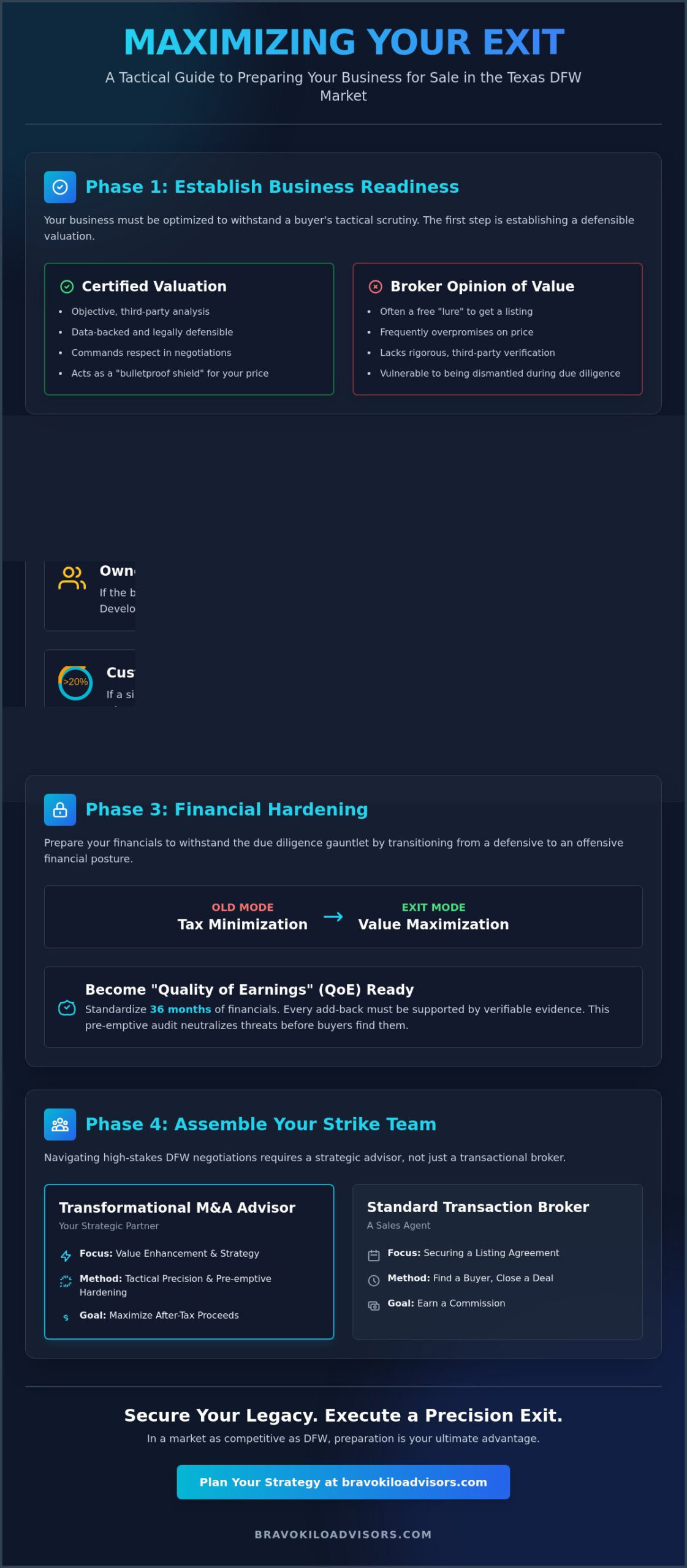
Before you engage the market, you must achieve “Business Readiness.” This isn’t just about clean books; it’s a state where your financials, operations, and leadership are optimized to survive a buyer’s tactical scrutiny. You’ve spent years building this legacy. Protecting it requires a cold, hard look at your current position. Learning how to prepare a business for sale in Texas starts with understanding the business valuation methods used to determine your company’s worth, specifically the Seller’s Discretionary Earnings (SDE) model. SDE is the standard for Texas mid-market deals, capturing the total financial benefit you derive from the operation.
To better understand the groundwork required for your Texas business transition, watch this brief overview:
Establishing a baseline is not optional. You must secure a certified business valuation to ensure your asking price is defensible. Without a data-backed foundation, you’re flying blind into a high-stakes negotiation where buyers will look for any excuse to chip away at your price.
Certified Valuation vs. Broker Opinions of Value
Many brokers offer a “Broker Opinion of Value” for free. It’s often a lure. These estimates frequently overpromise on price just to secure a listing agreement, leaving you vulnerable when a sophisticated buyer starts their due diligence. A flat-fee certified valuation acts as a bulletproof shield. It provides an objective, third-party figure that commands respect at the bargaining table and keeps your mission on track.
Neutralizing Tactical Value Killers
A Value Killer is any operational friction that increases buyer risk and lowers valuation multiples. If your business can’t function without your daily presence, it’s a liability, not a transferable asset. We also target customer concentration. If a single client represents more than 20% of your revenue, you’ve triggered the “20% rule” trap. Buyers view this as a mission-critical vulnerability. Diversifying your client base and eliminating messy add-backs are essential tasks when learning how to prepare a business for sale in Texas.
Operational Hardening: Preparing Financials for the Due Diligence Gauntlet
Success in a Texas exit requires more than just a willing buyer. It requires a business that can withstand a hostile interrogation of its records. When you’re learning how to prepare a business for sale in Texas, you must transition from tax-minimization mode to value-maximization mode. This process, which we call financial hardening, begins with standardizing 36 months of financial statements. These documents must be Quality of Earnings ready, meaning they can survive a deep-dive audit without revealing hidden liabilities or inconsistent reporting.
Audit your add-backs with surgical precision. Every adjustment to EBITDA, from one-time equipment repairs to non-operating travel expenses, must be supported by verifiable evidence. If you can’t prove an expense was personal or non-recurring, a sophisticated buyer will strip it from your valuation. This level of preparation is a core part of value enhancement services and ensures you don’t leave money on the table during the final negotiation.
The Quality of Earnings (QoE) Pre-Check
In 2026, sophisticated buyers won’t just take your word for your profitability. They hire third-party CPAs to verify your EBITDA through a formal Quality of Earnings report. Understanding what to expect when selling a business includes anticipating this level of scrutiny. Red flags like aggressive revenue recognition or inconsistent inventory accounting can kill a deal in the eleventh hour. By conducting your own pre-check, you identify and neutralize these threats before the buyer’s team sets foot in your office.
Owner-Independence: The Key to Multiplier Expansion
A business that relies on the founder’s daily presence is a high-risk asset. To expand your valuation multiple in the North Texas market, you must prove the operation can function without you. Documenting every Standard Operating Procedure (SOP) is your tactical manual for this transition.
- Shift key vendor and customer relationships to your management team.
- Implement automated reporting systems that provide real-time oversight.
- Ensure your leadership team has the authority to make mission-critical decisions.
A business that runs itself commands a premium because it represents a lower-risk investment for the next owner. This is how to prepare a business for sale in Texas while ensuring your legacy remains intact and your exit remains secure.
Assembling the Strike Team: Why DFW Owners Need Advisors, Not Brokers
Entering the market without a specialized team is a tactical error that leads to deal fatigue or total collapse. To execute a successful exit, you need a strike team designed for high-stakes maneuvers. This team consists of an M&A advisor to lead the strategy, a specialized CPA to manage the financial fallout, and a Texas-licensed transaction attorney to secure the legal perimeter. When you’re learning how to prepare a business for sale in Texas, you quickly realize that the right personnel determine whether you secure a premium multiple or settle for a subpar offer.
Confidentiality is your greatest asset in the DFW market. If rumors of a sale leak prematurely, you risk losing key employees and spooking vendors. We manage every interaction with surgical discretion to protect your legacy. This command presence carries into the Letter of Intent (LOI) phase. We ensure the terms favor your long-term goals rather than just the buyer’s timeline. Navigating an LOI requires a steady hand and a deep understanding of deal structures to ensure the momentum remains in your favor.
Advisors before Brokers: The Bravo Kilo Philosophy
A standard broker focuses on the listing; we focus on the transformation. Our strategic guide for DFW owners emphasizes that value enhancement must happen long before the first offer arrives. This philosophy ensures your life’s work is positioned for maximum impact. Tactical experience in high-pressure environments allows us to see through buyer tactics and protect your interests with the precision of a mission-critical operation.
The 2026 North Texas M&A Landscape
The DFW market remains a primary target for corporate migration and private equity. In 2026, buyer appetite for Texas-based manufacturing and service firms is particularly aggressive. Understanding how to prepare a business for sale in Texas means staying ahead of these Texas business market trends to time your exit perfectly. We monitor the local landscape to ensure your business hits the market when demand is at its peak and the environment is most favorable for your goals.
Mission Success: Your Tactical Roadmap to a Premium Exit
You’ve built a life’s work that deserves a precise, high-value exit. Navigating the North Texas market in 2026 requires more than just a listing; it requires a strategic deployment of resources. By conducting a tactical audit and hardening your financials, you transform your company from a daily operation into a defensible, high-multiplier asset. We know that the difference between a failed deal and a premium closing often comes down to the quality of your strike team and the accuracy of your certified valuation. These steps ensure your legacy is protected throughout the entire transition.
Mastering how to prepare a business for sale in Texas is about controlling the narrative before the first buyer enters the room. We bring tactical M&A expertise rooted in federal service to ensure your mission stays on track and your confidentiality remains uncompromised. You don’t have to face the due diligence gauntlet alone. Our team provides the command presence and protective empathy needed to navigate high-pressure negotiations with integrity and poise.
Secure your legacy with a mission-critical exit strategy from Bravo Kilo Advisors. Your hard work has brought you to this threshold. Now, let’s ensure the final transition is the victory you’ve earned.
Frequently Asked Questions
How long does it take to prepare a business for sale in Texas?
Optimal preparation requires 12 to 24 months of lead time to achieve “Business Readiness.” This window allows for the operational hardening and financial standardization necessary to maximize your valuation multiple. Rushing this timeline often leads to deal fatigue or a failed due diligence process when buyers uncover unaddressed “Value Killers.”
What is the difference between an asset sale and a stock sale in Texas?
In an asset sale, the buyer purchases specific items like equipment, inventory, and goodwill, while you retain the legal entity and its liabilities. A stock sale involves the transfer of the entire corporation, including all past and future obligations. Most Texas mid-market transactions are structured as asset sales to minimize buyer risk, though the final choice depends on your specific exit strategy.
Do I need a business broker or an M&A advisor for a $5M sale?
At the $5M threshold, you need a strategic M&A advisor who prioritizes transformational outcomes over simple listings. Standard brokers often lack the tactical experience required to navigate the complex due diligence and negotiation phases of a mid-market deal. An advisor acts as a force multiplier, focusing on value enhancement to ensure you don’t leave money on the table at the closing desk.
How can I keep the sale of my business confidential from my employees?
Maintaining operational security is a mission-critical component of how to prepare a business for sale in Texas. We utilize “blind profiles” that highlight your company’s financial strengths without revealing its identity or specific DFW location. All buyer interactions are conducted off-site or after hours to protect employee morale and prevent vendor friction during the sensitive negotiation phase.