
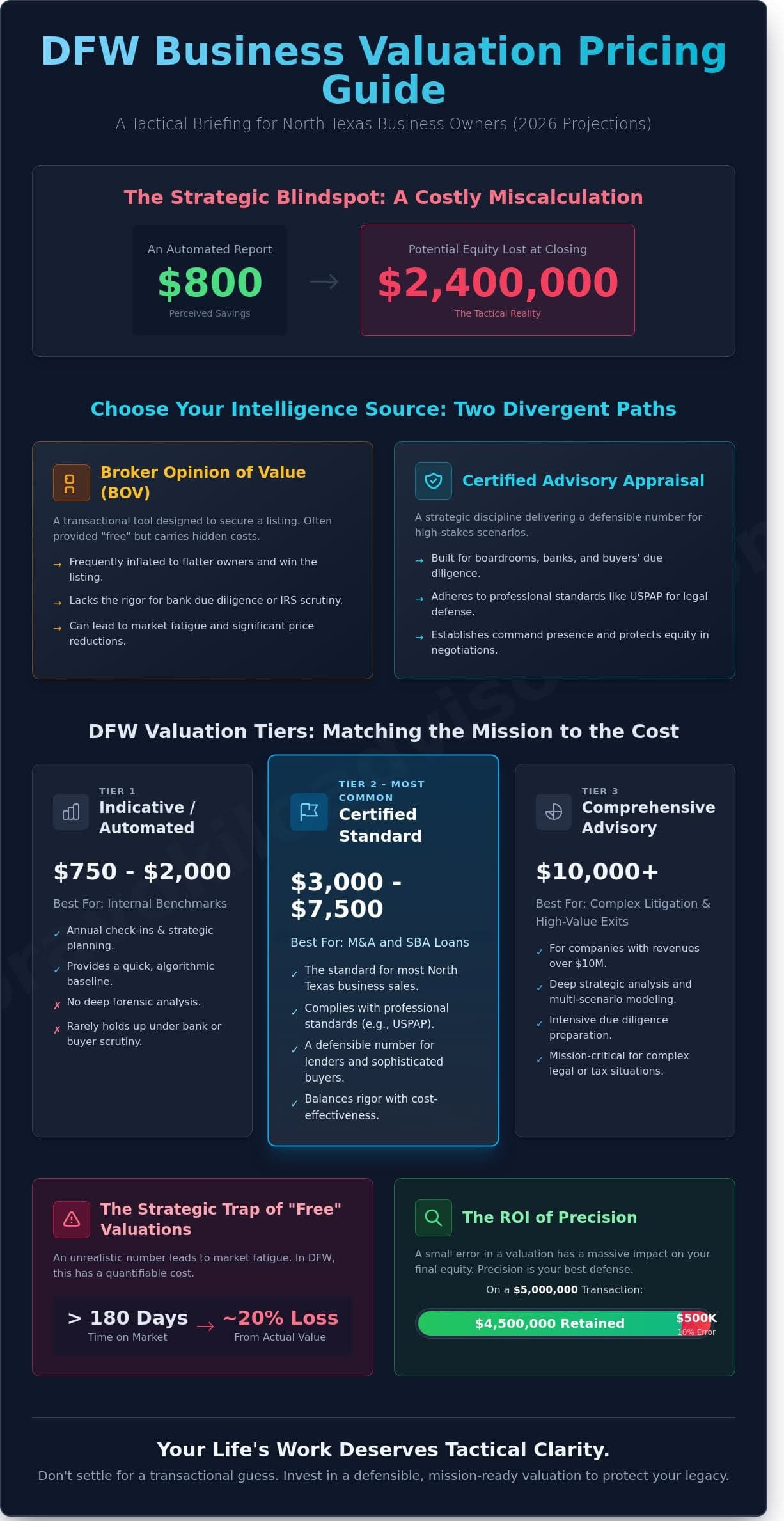
What if the $800 automated report you bought to save money actually costs you $2.4 million at the closing table? In the North Texas market, the gap between a superficial estimate and a certified appraisal is often the difference between a successful exit and a failed mission. Many owners asking how much does a business valuation cost in DFW find themselves staring at a confusing spread of quotes ranging from $800 to $15,000 without understanding the tactical reality behind those numbers.
You’ve spent decades building your enterprise; it’s natural to feel anxious when a buyer or the IRS begins scrutinizing your life’s work. Precision is your best defense. We understand that you need a defensible, mission-ready number that holds up under high-pressure due diligence. This 2026 pricing guide breaks down the real-world costs of professional valuations in the DFW Metroplex and explains how a strategic investment in precision protects your equity. We’ll outline the specific tiers of valuation services, the ROI of a certified report, and the three-step roadmap to securing a price that reflects your company’s true worth.
Key Takeaways
- Identify the critical price differences between broker estimates and advisor-driven appraisals to ensure your valuation survives professional scrutiny.
- Discover exactly how much does a business valuation cost in DFW by analyzing the specific revenue tiers and industry complexities that drive professional fees.
- Learn how to select the right valuation “mission”-from tax planning to litigation-while maintaining the high standards necessary to protect your life’s work.
- Master the use of a defensible valuation report as a tactical briefing that establishes command presence and silences aggressive buyers during negotiations.
- Understand why prioritizing advisors before brokers ensures a transformational outcome that secures your legacy beyond a simple transaction.
The DFW Business Valuation Landscape: Why Prices Vary in 2026
Business valuation is a strategic assessment of your company’s economic worth within the hyper-competitive North Texas market. It isn’t a gut feeling or a guess based on what your neighbor sold for last year. In 2026, DFW remains a global hub for middle-market transitions; therefore, your valuation must be a data-backed reality. When asking how much does a business valuation cost in DFW, you’re really asking for the price of financial intelligence. You need to understand that Business valuation involves analyzing the income, assets, and market position of your firm to ensure you don’t leave money on the table during a mission-critical exit.
The price you pay depends heavily on the source. Brokers often provide Broker Opinions of Value (BOVs) which are transactional tools designed to secure a listing. Advisors, however, treat valuation as a strategic discipline. We prioritize being Advisors before Brokers. This means our reports are built for the boardroom and the bank, not just a sales pitch. DFW’s current M&A climate is aggressive, with 15% more out-of-state buyers entering the Metroplex than in 2024. This demand increases the complexity of your valuation as we account for local economic shifts and industry-specific multipliers in counties like Collin and Tarrant.
You’ve spent years building your legacy. It’s natural to have an emotional attachment to the brand you created. However, a buyer won’t pay for your sweat equity unless it’s translated into normalized EBITDA and tangible assets. We bridge the gap between your gut feeling and the hard data that institutional investors demand. This transition from emotional to financial value is where the real negotiation begins.
The Three Main Tiers of Valuation Pricing in North Texas
- Tier 1: Indicative/Automated Reports ($750 – $2,000). These are best for internal benchmarks or annual check-ins. They use algorithmic data to provide a baseline without deep-dive forensic analysis. They’re useful for planning but rarely hold up under the pressure of a bank’s due diligence.
- Tier 2: Certified Standard Valuations ($3,000 – $7,500). This is the standard for SBA 7(a) loans and most North Texas business sales. These reports comply with professional standards and provide a defensible number for lenders and sophisticated buyers.
- Tier 3: Comprehensive Advisory Valuations ($10,000+). For companies with revenues exceeding $10 million or those involved in complex litigation, this tier offers deep strategic analysis. It includes multi-scenario modeling and intensive due diligence preparation to ensure your mission succeeds.
Why “Free” Valuations Can Be the Most Expensive
A free valuation from a broker is often a strategic trap. These estimates are frequently inflated to flatter the owner and win a listing agreement. When you go to market with an unrealistic number, you face market fatigue. In DFW, a listing that sits for more than 180 days often sells for 20% less than its actual value because buyers sense desperation. You lose time, credibility, and eventually, equity.
Understanding how much does a business valuation cost in DFW requires looking past the initial invoice to the long-term mission. A 10% error in a $5,000,000 DFW transaction results in a $500,000 loss of equity that could have funded a decade of your retirement. Precision is your best defense against a failed negotiation. Don’t settle for a transactional guess when your life’s work is on the line. We provide the tactical clarity you need to move forward with confidence.
Types of Business Valuations and Their Use Cases
Every business valuation begins with a clearly defined mission. You don’t bring a knife to a gunfight; similarly, you don’t bring a back-of-the-napkin estimate to a $10 million exit negotiation. We categorize these engagements by their specific objective: tax compliance, mergers and acquisitions, litigation support, or strategic exit planning. In the Dallas-Fort Worth metroplex, the benchmark for a defensible report is the Uniform Standards of Professional Appraisal Practice (USPAP). These guidelines act as the rules of engagement. They ensure that the final number stands up to intense scrutiny from the IRS or a judge in a Tarrant County courtroom. When you ask how much does a business valuation cost in DFW, the answer depends entirely on the level of precision and the “mission” required for your specific scenario.
By 2026, the distinction between EBITDA multiples and Seller’s Discretionary Earnings (SDE) has become more pronounced in the North Texas market. Professional buyers and private equity groups targeting the Frisco tech corridor typically focus on EBITDA to measure scalable profitability. They want to see how the engine runs without the owner’s personal expenses. Conversely, manufacturing firms in Fort Worth or the Mid-Cities often rely on SDE to account for the owner’s total financial benefit. Your specific industry dictates the methodology. A high-growth SaaS company requires a different lens than a legacy logistics firm with a fleet of 50 trucks. We analyze the 12% growth projected for the DFW economy in 2026 to ensure your valuation reflects future potential rather than just historical data. This tactical approach ensures you aren’t leaving money on the table when it’s time to execute your exit strategy.
Certified vs. Non-Certified: Knowing the Difference
Choosing the right level of certification is a strategic decision that impacts both cost and defensibility. A Certified Valuation Analyst (CVA) is mandatory for high-stakes scenarios like IRS 409A filings, divorce proceedings, or partner disputes. These reports offer the highest level of protection because they follow rigorous professional standards. A Broker Opinion of Value (BOV) provides a quick pulse on the market. It is useful for internal discussions, but it lacks the weight needed for a boardroom or a legal deposition. If your goal is a transaction exceeding $5 million, a non-certified report is a liability. Understanding these tiers helps clarify how much does a business valuation cost in DFW for your specific needs.
Methodologies That Drive the Final Number
- The Asset Approach: This method focuses on the fair market value of everything the company owns. It is the primary choice for capital-heavy North Texas industries like construction or heavy manufacturing where equipment values are substantial. We see this often in the industrial zones near DFW International Airport.
- The Market Approach: We use DFW-specific “comps” to determine value based on what similar businesses sold for within the last 18 months. This relies on localized data from the 13-county metro area to ensure the numbers are grounded in reality.
- The Income Approach: This strategy focuses on the present value of future cash flows. It is essential to understand how to value a company using methods like Discounted Cash Flow (DCF), especially as DFW’s 2026 economic landscape shifts toward service-based and technology-driven sectors.
Precision in these calculations prevents tactical errors during a negotiation. If you are preparing for a transition, our team can help you identify the strategic value drivers that maximize your final exit price. We approach every valuation with the same discipline we applied in federal service, ensuring your life’s work is protected by data and command-presence rather than guesswork.
Tactical Precision: Why Quality Valuations Protect Your Legacy
Think of your business valuation as a tactical briefing for the most important negotiation of your life. It’s the intelligence report that dictates how you move, speak, and hold your ground when you’re finally in the boardroom. When you enter a high-stakes negotiation, you need a command presence that silences aggressive buyers before they can start chipping away at your price. A defensible report provides this authority. It signals to the other side that you aren’t just guessing; you’re operating from a position of verified strength. While many owners focus on how much does a business valuation cost in DFW, they should also consider what it costs to walk into a deal unarmed. Cheap appraisal mills prioritize transactional speed, leaving you vulnerable to sophisticated buyers who specialize in finding cracks in poorly constructed reports.
Professional advisors provide protective empathy. This means we treat your life’s work with the same precision we would a mission-critical operation. We identify “Value Killers” peculiar to the North Texas market, such as customer concentration in the local construction sector or unoptimized real estate holdings, before they surface during due diligence. Understanding What is a Business Valuation involves recognizing that a report is only as strong as the data supporting it. Our approach ensures that every line item is battle-tested and ready for the most intense scrutiny from private equity groups or strategic competitors.
Defensibility Under Pressure
A high-quality valuation anticipates buyer objections before they’re ever voiced. It acts as a tactical shield during the financial scrutiny phase, protecting your equity from “re-trading” attempts where buyers try to lower the price at the last minute. For example, in a 2023 engagement for a Frisco-based service company, our deep-dive analysis closed a $2.1 million valuation gap. The owner’s original internal records missed key EBITDA add-backs that would have gone unnoticed by a standard appraisal mill. By identifying these early, we prevented the buyer from using those discrepancies as leverage to lower the offer during the 90-day due diligence window. We don’t just hand you a number; we provide the ammunition to defend it.
Beyond the Number: The Strategic Roadmap
We operate on a philosophy of Advisors before Brokers. This means we view the valuation as a diagnostic tool for operational improvements rather than just a static price tag. We help you move from being transaction-focused to being transformation-focused. This shift ensures your exit planning isn’t just about leaving, but about maximizing the 20 or 30 years of work you’ve invested. A 2026 valuation acts as a mission-critical blueprint for growth by highlighting the specific operational levers that must be pulled to increase enterprise value before a formal exit. When you evaluate how much does a business valuation cost in DFW, you’re really investing in a strategic roadmap that guides your firm toward its highest possible potential. We provide the steady, methodical rollout required to ensure your legacy remains intact long after the final closing documents are signed.
Cost Drivers for Business Valuations in Dallas-Fort Worth
Determining how much does a business valuation cost in DFW is a matter of tactical scope and operational risk. Every engagement is a mission-critical operation where the precision of the data dictates the strength of your position. We don’t view valuations as mere paperwork; they’re the strategic foundation for your next move. The workload varies significantly based on the assets deployed and the complexity of the target entity. A $500,000 revenue service business requires a standard forensic review of three years of tax returns. In contrast, a $50 million mid-market enterprise involves complex capital structures and tiered management levels. This shift in scale typically increases the professional man-hours by 50% or more.
Industry specifics also dictate the level of specialized intelligence required. Valuing a Plano medical practice isn’t the same as assessing a local retail shop. Medical valuations must account for Stark Law compliance, payer mix analysis, and specialized equipment depreciation. These regulatory hurdles require a higher level of command-presence from your advisor. If you’re facing a 7-day turnaround for a pending acquisition, expect a “Mission-Critical” premium. Rapid deployment of elite analytical resources often adds a 25% surcharge to the standard fee. We prioritize accuracy under pressure, ensuring the timeline doesn’t compromise the integrity of the deal.
The “DFW Factor” remains a primary influence on professional service fees. As of late 2023, the Dallas-Fort Worth Metroplex maintains a robust economic climate with a 3.9% unemployment rate. This local stability keeps demand for high-level advisory services high. You’re paying for local market intelligence that understands the North Texas land rush and the specific labor challenges facing Metroplex owners. We believe in being Advisors before Brokers, which means our fees reflect a commitment to long-term strategic reliability rather than a quick transaction.
Geographic and Sector Nuances
In high-growth corridors like Frisco and North Dallas, valuations often focus on intellectual property and recurring revenue models within the tech sector. These require sophisticated discounted cash flow analyses. Conversely, Fort Worth and the Mid-Cities are dominated by industrial, logistics, and manufacturing firms where asset-based approaches and supply chain stability are paramount. If your business operates five locations across the Metroplex, the audit-level analysis becomes more rigorous. Consolidating multi-site financials adds 15 to 20 hours of labor to ensure every location’s performance is accurately captured.
The Data Quality Variable
Clean financial records are your best defense against escalating costs. When your books are mission-ready, our team can move straight to analysis. If an advisor must enter a “Financial Cleanup” phase to reconstruct missing 2022 records or reconcile commingled personal expenses, your costs will climb. We’ve seen “cleanup” fees add $3,000 to $7,000 to a standard engagement. You should also watch for hidden costs. Some firms charge separate fees for data room hosting or require a $5,000 retainer for expert testimony in litigation cases. Our approach is Transformational before Transactional, focusing on transparent pricing that reflects the true scope of the mission. Understanding how much does a business valuation cost in DFW starts with a clear assessment of your current data integrity.
Ready to secure a precise, battle-tested assessment of your company’s worth? Contact Bravo Kilo Advisors for a professional valuation briefing today.
Mission Success: Choosing the Right DFW Valuation Partner
Mission success in the DFW business landscape requires more than just a spreadsheet. It demands a tactical partner who understands that your company is your life’s work. At Bravo Kilo Advisors, we operate on a foundational principle: Advisors before Brokers. This distinction matters because a broker focuses on the commission, while an advisor focuses on the strategic outcome. We prioritize being Transformational before Transactional in every engagement we take on.
My background in federal service and tactical law enforcement informs our entire approach. We treat your valuation like a mission-critical operation where precision is the only acceptable standard. In the Dallas-Fort Worth market, where middle-market deal volume is projected to remain steady throughout 2024, a “close enough” estimate won’t cut it. We bring the same level of scrutiny found in high-stakes federal investigations to your boardroom. While the initial inquiry is often how much does a business valuation cost in DFW, the focus should quickly shift to the return on that investment. A flawed report can cost you millions during a botched negotiation.
We move beyond the numbers to focus on execution. A valuation report is a weapon for negotiation, not just a static document. It acts as your shield, preventing buyers from lowering the price during the final 30 days of due diligence. We use the data to drive a successful closing by anticipating buyer objections before they happen. This proactive stance ensures that you maintain control of the narrative from the first discovery session to the final signature.
Questions to Ask Your Valuation Advisor
Don’t settle for a surface-level estimate. Ask if they’re a certified appraiser or just a broker. A broker might give you a gut feeling, but a certified professional provides a defensible document. Inquire about their specific experience in the North Texas market for your industry. DFW’s economic climate is unique; your advisor needs to know why. Finally, ask how they’ll defend the price during due diligence. If they can’t explain the logic, they can’t protect your equity.
The Bravo Kilo Operational Process
- Phase 1: Discovery and Intelligence Gathering. We conduct a deep-dive financial analysis. We examine 36 to 60 months of tax returns and P&L statements to identify hidden value and add-backs that others miss.
- Phase 2: Tactical Assessment. We select the precise methodology for your sector. We benchmark your company against 10 to 15 similar firms in the DFW area to ensure your position is backed by hard data.
- Phase 3: The Briefing. We deliver the certified valuation and a strategic roadmap. This isn’t just a delivery of a document; it’s a full strategy session on how to use the report to maximize your exit value.
The stakes are too high to leave your exit to chance. You’ve spent years building your legacy, and it deserves a process that respects that effort. When you’re ready to move from uncertainty to a position of strength, we’re ready to lead the way. Secure your DFW business valuation with Bravo Kilo Advisors and prepare for a confidential discovery session that puts your interests first.
Secure Your Legacy With Precision Data
Your business represents years of disciplined execution and personal sacrifice. In the 2026 DFW market, a valuation isn’t just a financial report; it’s a tactical roadmap for your next mission. The data shows that while complexity drives investment, transparency remains paramount. Business owners find that understanding how much does a business valuation cost in DFW allows them to budget for a certified report that stands up to the most rigorous due diligence. We believe in being advisors before brokers, ensuring your transition is transformational rather than merely transactional.
At Bravo Kilo Advisors, we operate with a mission-first mindset. We provide Certified Business Valuations with Flat-Fee Pricing to eliminate the uncertainty of hourly billing. Our team brings tactical M&A experience to the table, having navigated deals ranging from $500,000 to $50,000,000. Based in Frisco and serving the entire DFW Metroplex, we provide the command-presence needed to navigate complex negotiations. You’ve spent a lifetime building your company. Now, it’s time to defend its true value with the precision it deserves.
Get a Certified Business Valuation for Your DFW Company
Frequently Asked Questions
Is a business valuation tax-deductible in Texas?
Business valuations are typically tax-deductible under IRS Section 162 as an ordinary and necessary business expense. If you’re conducting the valuation for estate planning or tax compliance, it’s a strategic investment in your mission’s longevity. You should consult with a tax professional to confirm how this applies to your specific 2024 filing.
How long does the valuation process take for a DFW business?
A standard valuation process for a North Texas business takes 14 to 21 business days once we’ve gathered all internal intelligence. While many owners focus on how much does a business valuation cost in DFW, the timeline is just as vital for a controlled operational rollout. We execute a 5-step verification process to ensure the final report is battle-tested and ready for the boardroom.
Can my local Dallas CPA perform a certified business valuation?
Your local Dallas CPA can only perform a certified valuation if they hold specific credentials like the CVA or ABV designation. Only 15% of general practitioners possess these specialized tactical qualifications. Engaging an advisor without these certifications risks a 30% reduction in credibility during high-pressure negotiations or IRS audits. We prioritize advisors before brokers to ensure your valuation stands up to the most rigorous scrutiny.
What documents do I need to provide for a valuation in Frisco or Plano?
You must provide a minimum of 3 years of federal tax returns and year-to-date financial statements, including balance sheets and P&L reports. For businesses in Frisco or Plano, we also require a detailed list of equipment assets and current lease agreements. This 36-month look-back period provides the baseline intelligence needed to build a defensible strategy for your company’s future.
How often should a North Texas business owner update their valuation?
North Texas business owners should update their valuation every 12 to 18 months to account for rapid market shifts. In a high-growth environment like the DFW metroplex, a 24-month-old valuation is often obsolete and may undervalue your mission by 15% or more. Regular updates ensure you’re always prepared for an unsolicited offer or a sudden change in the competitive landscape.
What is the difference between an Enterprise Value and an Equity Value?
Enterprise Value represents the total worth of the operation including its debt and cash; Equity Value is the amount remaining for shareholders after all liabilities are settled. Think of Enterprise Value as the total cost of the mission and Equity Value as your take-home portion. We focus on transformational before transactional outcomes by ensuring you understand which number dictates your final payout at the closing table.
Does the DFW real estate market affect my business valuation?
The DFW real estate market directly impacts your valuation through lease rates or the value of owned property. With industrial rents in North Texas increasing by 8% in 2023, your overhead costs affect the bottom-line EBITDA used in our calculations. If your business owns its facility, the underlying real estate may represent 40% or more of your total enterprise value.
What happens if a buyer disagrees with my certified valuation?
If a buyer disagrees with your valuation, we pivot to a data-driven defense of the established numbers using 10 to 15 comparable recent transactions in the North Texas region. Our tactical experience in high-pressure environments ensures we lead with facts rather than emotion. This disciplined approach protects your life’s work during the most difficult phase of the negotiation and maintains the integrity of the deal.