
The gap between deciding to exit and actually handing over the keys is the most high-stakes period of an owner’s career. While you might be ready to move on today, the reality is that the median business in Dallas stays on the market for approximately 200 days before a deal reaches the finish line. If you are feeling the weight of daily operations, you likely want a definitive answer to one question: how long does it take to sell a business in DFW? Uncertainty isn’t just stressful; it’s a strategic risk that can lead to emotional fatigue or even the devaluation of your hard-earned legacy.
We understand that a successful exit requires more than just a listing. It demands a disciplined, mission-oriented approach to ensure your professional transition is handled with precision. This guide provides a tactical 6 to 12 month roadmap for the North Texas market, detailing the variables that dictate your exit velocity. You’ll learn how to prepare for the 9 to 18 month total cycle from decision to close and how to leverage the optimal 2026 selling window. By the end of this briefing, you’ll have the clarity needed to protect your value and execute a clean, profitable exit.
Key Takeaways
- Learn why the DFW Metroplex remains a high-velocity destination for private equity and how this market demand impacts your standard 6 to 12 month sale window.
- Identify the critical financial transparency variables that can either stall or accelerate the due diligence phase.
- Discover how to shift your perspective from waiting for a buyer to executing an operational rollout to maintain peak business value.
- Determine how long does it take to sell a business in DFW by evaluating industry-specific demand trends across North Texas.
- Gain a tactical roadmap to manage the emotional weight of a transition while ensuring your professional legacy remains protected through the final close.
The DFW Benchmark: How Long Does it Actually Take to Sell?
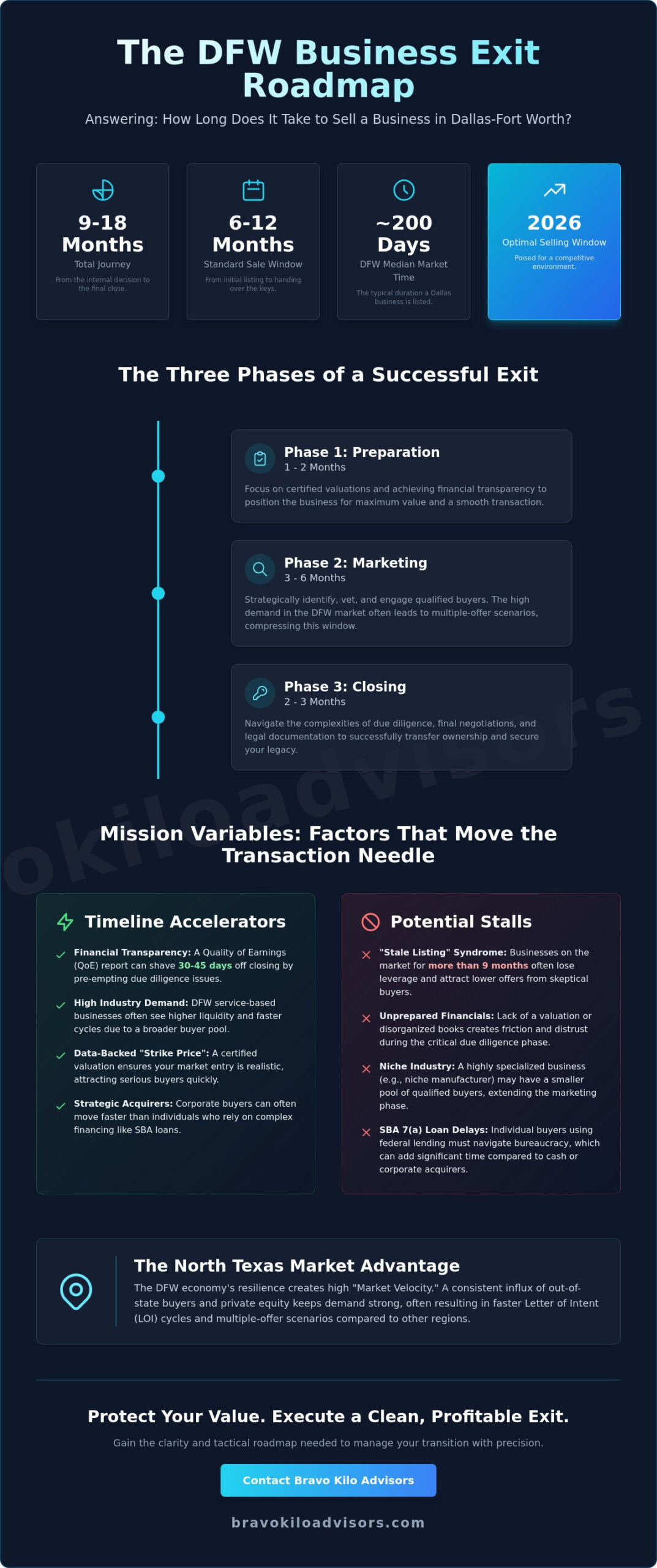
The standard window for a successful business sale in the North Texas region is currently 6 to 12 months from the initial listing to the final exchange of keys. While national averages often fluctuate, the Dallas-Fort Worth Metroplex operates on its own tactical clock. Understanding how long does it take to sell a business in DFW requires looking past generic statistics and focusing on the specific operational phases of a local transaction. For most owners, the total journey from the internal decision to exit to the actual close spans between 9 and 18 months.
To gain a deeper understanding of the factors influencing your timeline, watch this briefing on the sales process:
This timeline is not a single block of time but a sequence of mission-critical phases. The Preparation phase typically requires 1 to 2 months. This is where we focus on certified valuations and financial transparency. Once the business is positioned, the Marketing phase spans 3 to 6 months as we identify and vet qualified buyers. Finally, the Closing phase takes 2 to 3 months to navigate due diligence and final negotiations. In 2026, we are seeing these windows shift slightly as interest rate stability and aggressive local industry growth create a more competitive environment for high-quality assets.
Why the North Texas Market Dictates Your Speed
The DFW economy provides a unique cushion against national volatility, which often results in faster Letter of Intent (LOI) cycles compared to other regions. We see a consistent influx of out-of-state buyers from high-tax environments targeting businesses in Dallas, Frisco, and Fort Worth. This steady demand keeps the local market resilient and active. Market Velocity is the rate at which qualified buyers engage with DFW listings. Because North Texas remains a top-tier destination for private equity, well-prepared businesses often find themselves at the center of multiple-offer scenarios that can significantly compress the traditional marketing window.
Mission Variables: Factors That Move the Transaction Needle
Every engagement is subject to environmental variables that can either accelerate or stall your exit. In the North Texas market, industry demand plays a primary role. A service-based business in Plano often experiences higher liquidity and a faster closing cycle than a niche manufacturer in Arlington because the buyer pool for service industries is broader. The type of acquirer you target also dictates your pace. An individual buyer utilizing an SBA 7(a) loan must navigate federal lending requirements, whereas a strategic corporate acquirer may move faster but will subject your operations to much more rigorous scrutiny.
Financial Readiness and the Quality of Earnings
Financial transparency is the single most effective tool for compressing your timeline. We often recommend a pre-emptive Quality of Earnings (QoE) report. This strategic document can shave 30 to 45 days off the closing process by resolving disputes before they arise in due diligence. By clearly justifying your “add-backs” to EBITDA, you build immediate trust with sophisticated partners. If you aren’t sure where your financials stand, securing a Texas business valuation is a critical first step toward mission readiness.
The “Stale Listing” Risk in DFW
Speed is a protective measure for your equity. In DFW, businesses that remain on the market for more than 9 months often face “stale listing” syndrome. This leads to declining leverage and lower offers as buyers begin to wonder why others passed on the opportunity. To avoid this, you must set a “strike price” based on a certified business valuation. This ensures your entry into the market is backed by data rather than guesswork. When you understand how long does it take to sell a business in DFW, you can plan your exit with the precision of a controlled rollout rather than a desperate scramble. Our team provides the M&A advisory expertise needed to maintain this momentum from the initial assessment to the final resolution.
Strategy for Speed: How to Compress the Timeline
Exiting your company is not a passive waiting game. It is the execution of a final operational rollout. When owners ask how long does it take to sell a business in DFW, they often assume the timeline is entirely out of their control. In reality, your ability to maintain mission focus on daily operations prevents the value dips that often stall negotiations. A specialized business broker in Dallas, TX manages the buyer funnel to create competitive tension, ensuring that the market responds to your timeline rather than the other way around. By positioning the sale as a strategic transition rather than a desperate exit, you signal strength to sophisticated acquirers.
The Power of Pre-Sale Exit Planning
Value killers like high owner dependency or customer concentration frequently derail transactions in the eleventh hour. These issues create perceived risk that forces buyers to extend their investigation or lower their offer. We recommend conducting a tactical assessment 12 months before your desired exit date. This proactive approach allows you to address operational gaps and document processes, ensuring your professional legacy is ready for a seamless transfer. Addressing these variables early is the most effective way to ensure you fall on the shorter end of the 6 to 12 month DFW average.
Managing the Due Diligence Phase
Preparation is the best defense against deal fatigue. You should establish a secure digital Data Room before the first buyer signs an NDA to ensure there is zero lag time during the investigation phase. This level of organization demonstrates disciplined leadership and keeps the momentum moving toward a close. Due diligence is where deals go to die if the owner is unprepared. By having every financial record, lease agreement, and employee contract ready for immediate inspection, you remove the friction that typically extends the 200-day median market time in North Texas.
Securing Your Professional Legacy in North Texas
Executing a successful exit is a mission-critical operation that requires disciplined preparation. You now understand that while the median market time is approximately 200 days, the question of how long does it take to sell a business in DFW is ultimately answered by your tactical readiness. Success depends on moving from a passive stance to an active rollout. By prioritizing financial transparency and addressing value killers early, you protect your hard-earned equity from the risks of a stale listing.
Our firm brings a specialized North Texas M&A focus to every engagement. We combine a battle-tested advisory approach with certified business valuation expertise to ensure your transition is handled with precision. You don’t have to navigate these high-stakes negotiations alone. We invite you to Request a Tactical Consultation with Bravo Kilo Advisors to begin your assessment. Your hard work deserves a clean, profitable resolution that honors your professional legacy. The path to a successful close starts with a strategic step forward.
Frequently Asked Questions
Can I sell my DFW business in less than six months?
Selling in under six months is possible but requires a high level of operational readiness. This typically occurs when an owner has already completed comprehensive exit planning and maintains a digital data room before going to market. In these instances, the marketing phase is compressed because the business is positioned to clear due diligence without friction. However, most transactions in North Texas require the full standard window to ensure the legacy is protected.
Does the industry I am in affect how long it takes to sell in Texas?
Industry demand is a primary variable in determining your exit speed. Service-based companies often attract a larger pool of individual buyers and SBA-backed acquirers, which can lead to a faster LOI. Conversely, specialized manufacturing or industrial firms may face longer marketing periods due to the complexity of equipment valuations and environmental assessments. Understanding how long does it take to sell a business in DFW involves analyzing these sector-specific buyer behaviors and market liquidity.
What is the longest part of the business sale process?
The marketing phase is generally the most time-consuming segment of the timeline. It often takes three to six months to identify, vet, and secure a qualified buyer who aligns with your strategic goals. While the closing phase is shorter, it can feel more intense. If the owner hasn’t prepared for rigorous due diligence, this final stage can stall, leading to deal fatigue and potentially jeopardizing the entire transaction.
How does a business broker help speed up the sale in Dallas?
A professional intermediary accelerates the process by managing the buyer funnel and maintaining competitive tension. By vetting prospects before they reach the owner, a broker ensures that only serious, well-capitalized acquirers engage with the listing. This disciplined approach prevents wasted time on unqualified leads. Additionally, an expert advisor manages the flow of information, allowing the owner to remain focused on daily operations to prevent any pre-sale value erosion.