
Most owners believe the exit process is a search for a suitor, but it’s actually a high-stakes tactical operation that requires disciplined positioning. You’ve likely felt the frustration of unsolicited low-ball offers from unknown firms or the nagging worry that a buyer might dismantle your legacy post-sale. Finding a private equity buyer for my business isn’t about hope; it’s about executing a proven roadmap that puts you in control of the narrative and the price.
We understand the weight of this transition. It’s why we focus on a mission-first approach that prioritizes your long-term impact over a quick transaction. You’ll learn the tactical process of identifying the right partners, preparing your operations for intense scrutiny, and securing a high-value exit that protects your team. Our goal is to replace the lack of transparency in the acquisition process with a steady, methodical rollout.
This briefing covers the critical 2026 landscape, including how the January 17 SBA recertification rules and the increased 15 million dollar QSBS exclusion impact your valuation. We’ll outline how to build a competitive bidding environment so you can walk away with maximum value and a partner who provides the growth capital your business needs to scale.
Key Takeaways
- Identify whether your firm qualifies as a platform or an add-on to align with the aggressive 2026 private equity mandates.
- Conduct a preemptive Quality of Earnings (QoE) assessment to address operational risks before the formal due diligence phase begins.
- Execute a controlled strategic process for finding a private equity buyer for my business to avoid the value erosion typical of one-on-one, unsolicited negotiations.
- De-risk your operations by eliminating the “Owner Trap,” ensuring the business maintains its value and momentum after your departure.
- Use anonymous teasers to generate high-level interest in the DFW market without compromising your competitive position or internal confidentiality.
The Private Equity Landscape: Identifying the Right Target for Your Mission
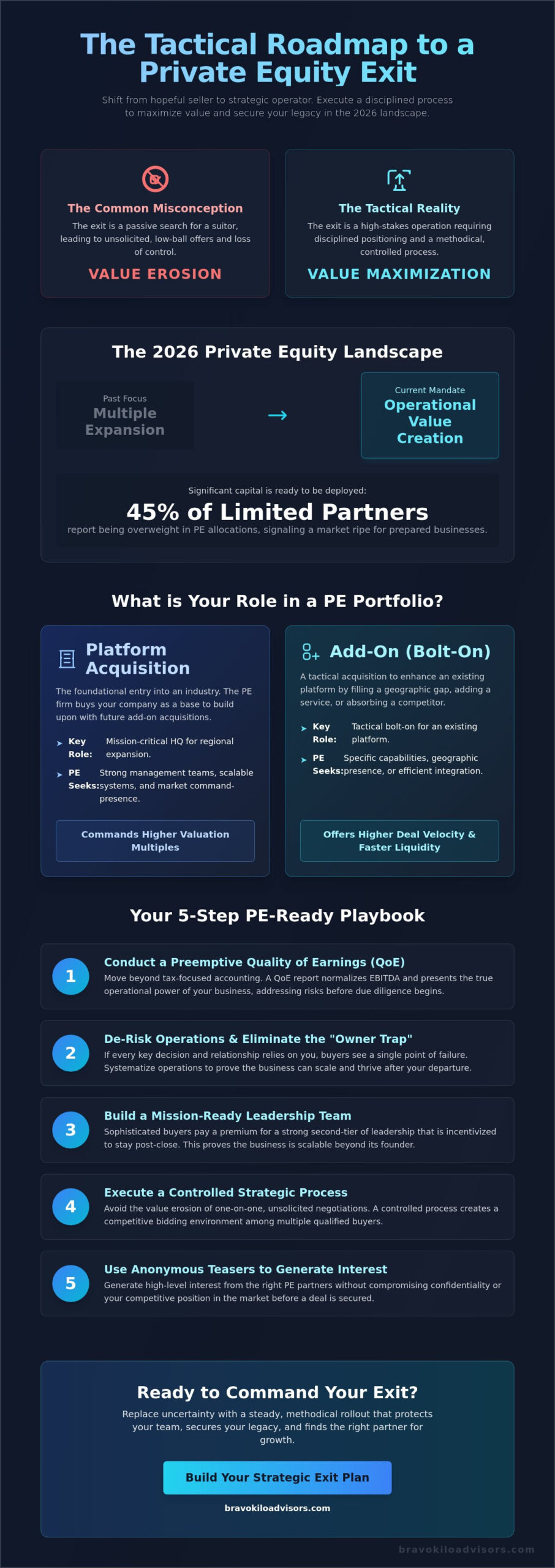
The 2026 private equity market has shifted from a reliance on multiple expansion to a disciplined focus on operational value creation. North Texas mid-market companies are currently high-priority targets for firms looking to deploy capital in stable, high-growth corridors. When you begin the process of finding a private equity buyer for my business, you must understand that these firms aren’t just looking for profit. They’re looking for specific roles your company can play within their portfolio. To establish a baseline for your strategy, it’s useful to review What is Private Equity? and how its core investment structures function.
To better understand the traditional strategies these firms use to generate returns, watch this briefing on the PE model:
Platform Acquisitions: Leading the Charge
A platform buy is a high-stakes move where a PE firm selects your company to be their foundational entry into an industry vertical. They look for strong management teams and scalable systems that can support future growth. Because you’re the “first in,” these deals often command higher valuation multiples. The firm isn’t just buying your cash flow; they’re buying a mission-critical headquarters for their regional expansion. This requires your business to have a command-presence in its market and a clear roadmap for scalability.
Add-on Acquisitions: The Tactical Bolt-on
Many DFW businesses serve as add-ons, or “bolt-ons,” for existing platforms. These are tactical acquisitions designed to fill a geographic gap or add a specific service line. While the multiples might be lower than a platform buy, the deal velocity is much higher. These transactions are often efficient and streamlined because the buyer already has an established infrastructure in place. For a seller, this can mean a faster path to liquidity and a simplified due diligence process.
Don’t assume every check is the same. Financial PE firms focus on the numbers and leverage. Strategic PE firms often bring a deep operational playbook and industry connections. Choosing the right partner depends on whether you want a silent backer or a co-pilot for your next growth phase. Always evaluate their “dry powder.” With 45% of limited partners reporting they are overweight in PE allocations as of June 2026, there is significant capital available, but you must ensure your buyer has the specific liquidity to close without delays. Professional M&A Advisory ensures you’re targeting firms with the right capital profile for your specific mission.
Tactical Preparation: Making Your Business “PE-Ready”
Preparation isn’t a suggestion; it’s a requirement for a high-value exit. Finding a private equity buyer for my business begins with a rigorous self-audit that mirrors the scrutiny of professional due diligence. In the 2026 market, the Quality of Earnings (QoE) report is the most critical document in your war room. While standard accounting focuses on tax minimization, a PE-ready business shifts to value-maximization reporting. This means identifying one-time expenses and normalizing EBITDA to show the true operational power of the company before the first inquiry arrives.
Operational de-risking is your next objective. You must eliminate the “Owner Trap.” If every major decision or client relationship relies on you, the buyer sees a single point of failure. PE firms look for a turn-key operation where systems, not individuals, drive results. As you learn how to identify and categorize potential buyers, you’ll realize they prioritize businesses that can survive the founder’s departure. Proving your infrastructure can handle the aggressive growth a PE firm will demand is the only way to secure a premium multiple.
The Management Team Briefing
A sophisticated buyer pays a premium for a second-tier leadership layer. They want to see a mission-ready team that’s incentivized to stay post-close. Identifying Key Man risks now allows you to distribute authority and prove that the business is scalable. This transition from a founder-led company to a management-led enterprise is often the difference between a standard offer and a record-breaking exit.
Certified Valuations and Exit Planning
You can’t defend a price you haven’t calculated with precision. Using certified business valuations creates a defensible floor for all future negotiations. This data-driven approach prevents you from being swayed by low-ball offers during the heat of the deal. Engaging in early Exit Planning serves as a tool for strategic growth consulting, ensuring every operational move you make today increases the enterprise value at closing.
Executing the Search: Creating a Competitive Acquisition Environment
Finding a private equity buyer for my business is not a passive activity; it’s a controlled rollout designed to force competition. Many owners fall into the trap of the “Unsolicited Offer.” While a direct inquiry feels like a compliment, it’s actually a tactical move by a buyer to avoid a competitive bidding environment. One-on-one negotiations favor the buyer’s terms and rarely result in maximum enterprise value. To maintain leverage, you must transition from being a target to being the architect of a professional search.
The process begins with the Anonymous Teaser. This one-page document generates interest in the DFW market without revealing your identity, protecting your staff and competitive position. Once a potential buyer proves their “dry powder” and signs a non-disclosure agreement, they receive the Confidential Information Memorandum (CIM). Think of the CIM as your “Mission Folder.” It shouldn’t just report the past; it must sell the future scalability and operational strength you’ve built. This document is what justifies a premium multiple during the initial expression of interest.
The Letter of Intent (LOI) is the most dangerous phase of the operation. This is where “gotchas” like aggressive working capital pegs or restrictive exclusivity periods can erode your position. You need a clear-eyed review of these deal structures to identify hidden risks before you’re locked into a period of exclusive due diligence.
The Role of the M&A Advisor
A strategic business broker in Dallas acts as your shield during the high-pressure due diligence phase. Their role is to manage the flow of information and maintain a “controlled auction” environment. By keeping multiple firms in the mix, they prevent “re-trading,” a tactic where buyers attempt to lower the price late in the process. This disciplined approach ensures the buyer remains committed to the original valuation agreed upon in the LOI.
Closing the Deal in North Texas
North Texas remains a high-demand zone in 2026, with local market trends often justifying EBITDA multiples that outpace national averages. Finalizing the transaction is about more than just the wire transfer; it’s about securing your professional legacy and ensuring your team is positioned for the growth capital the PE firm provides. Contact Bravo Kilo Advisors for a tactical assessment to ensure your exit is executed with the precision your life’s work deserves.
Securing Your Professional Legacy
The process of finding a private equity buyer for my business is a mission that demands precision and strategic patience. Success in the 2026 market depends on your ability to transition from a founder-led operation to a scalable platform that withstands intense scrutiny. By conducting a preemptive Quality of Earnings assessment and identifying your specific role within a buyer’s portfolio, you shift the leverage back to your side of the table. A controlled auction environment ensures that you don’t just receive an offer; you receive the right offer that preserves your brand and maximizes enterprise value.
Bravo Kilo Advisors brings battle-tested expertise to North Texas M&A transactions ranging from $500,000 to $50 million. Our team consists of Certified Business Valuation experts who operate on a success-based fee structure, aligning our objectives directly with your mission. We provide the strategic reliability needed to navigate high-pressure negotiations with poise and integrity. We’ve seen every possible scenario and are prepared to guide you through each tactical step of the rollout.
Request a Confidential Tactical Assessment of Your Business Value today to begin your roadmap to a successful exit. Your life’s work deserves a disciplined, high-stakes defense that ensures a secure and prosperous future.
Frequently Asked Questions
How long does it typically take to find a private equity buyer?
The timeline for finding a private equity buyer for my business typically spans six to twelve months from the initial assessment to the final wire transfer. This duration accounts for a methodical operational rollout that includes financial cleanup, the creation of the Confidential Information Memorandum, and a high-pressure due diligence phase. Rushing this process compromises your leverage and often leads to price re-trading late in the transaction.
What is the minimum revenue private equity firms look for in 2026?
In the 2026 mid-market landscape, most private equity firms target companies with at least $5 million in annual revenue for platform acquisitions. However, smaller entities with $1 million to $3 million in revenue remain attractive as tactical add-ons if they fill a specific geographic or service gap. The buyer’s focus is increasingly on the quality of earnings and operational scalability rather than just raw top-line numbers.
Will I have to stay with the business after selling to private equity?
You should expect to remain with the company for a transition period that usually lasts between one and three years. Private equity buyers prioritize a mission-ready management team to ensure continuity and execute the growth strategies outlined in the deal structure. While you might step back from daily tactical decisions, your presence during the integration phase protects the buyer’s investment and your own professional legacy.
What is the difference between a strategic buyer and a private equity buyer?
A strategic buyer is typically a competitor or industry peer seeking operational synergies to integrate your business into their existing infrastructure. In contrast, a private equity buyer is a financial sponsor that provides growth capital to scale your company as a standalone platform or bolt-on. Finding a private equity buyer for my business often allows you to retain a minority equity stake, giving you the opportunity to participate in a second liquidity event when the firm eventually exits.