
A single filing error can dismantle a decade of community impact in less than 90 days. You understand that your North Texas organization’s survival depends on more than just good intentions; it requires a disciplined financial defense. With over 20,000 active charitable entities in the Dallas-Fort Worth metroplex, the competition for donor confidence is fierce. A single compliance breach can compromise years of dedicated service and trigger immediate federal scrutiny.
Identifying a qualified non profit cpa near me is about securing a strategic partner who operates with the precision of a mission-command element. Our goal is to help you find an advisor who treats your financial integrity as a mission-critical objective. This guide outlines the specific criteria for vetting DFW-based experts who can protect your tax-exempt status and ensure your reporting is transparent for the IRS. We will walk through the process of aligning your accounting with long-term strategy, ensuring you are prepared for high-stakes valuations or organizational mergers. We focus on being advisors before brokers, ensuring your life’s work remains secure through every transition.
Key Takeaways
- Learn why standard business accounting fails to address 501(c)(3) complexities and why specialized expertise is mission-critical for North Texas organizations.
- Discover how to utilize IRS Form 990 as a strategic document to protect your financial integrity and avoid common compliance pitfalls during audit season.
- Master a tactical checklist for vetting a non profit cpa near me to ensure your advisor possesses the command presence required for high-stakes financial leadership.
- Understand the vital role of Quality of Earnings reports and organizational valuations in preparing your nonprofit for a successful merger or strategic transition.
- Identify how to align your financial operations with a “transformational before transactional” mindset to maximize the long-term value of your organization’s mission.
Why DFW Organizations Require Specialized Non Profit CPA Expertise
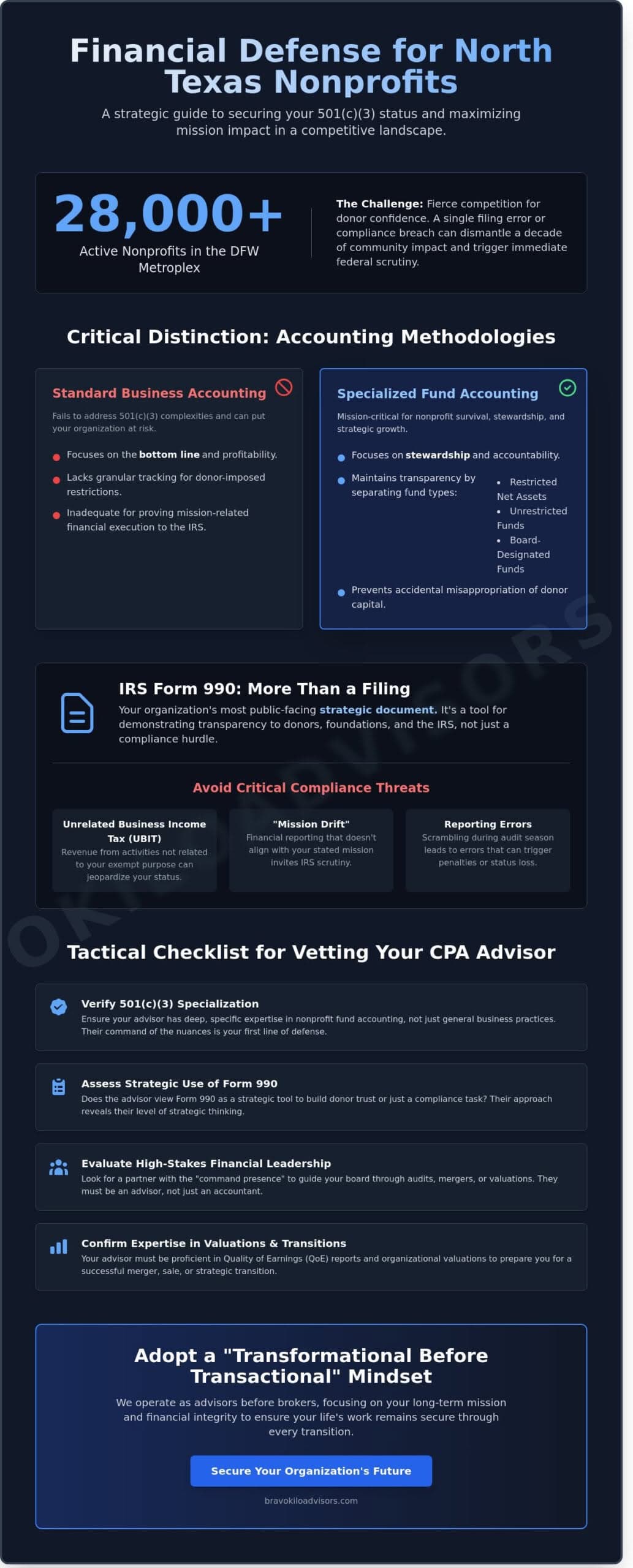
In the Dallas-Fort Worth Metroplex, more than 28,000 active nonprofit organizations operate within a high-stakes regulatory environment. Leadership teams often find that standard commercial accounting practices fail to protect their 501(c)(3) status. When you search for a non profit cpa near me, you’re seeking a tactical advisor who understands that your mission depends on financial integrity. This specialized expertise acts as a defensive perimeter for your board of directors. It ensures that every dollar is accounted for with the same precision used in a federal operation. We treat your financial reporting as a mission-critical objective, not a back-office chore.
The Distinction Between Commercial and Fund Accounting
Standard business accounting focuses on the bottom line. For North Texas nonprofits, the focus shifts to stewardship and accountability. You must track resources based on their intended use rather than their potential for profit. This requires a deep understanding of fund accounting principles to maintain transparency. By 2026, DFW donors are projected to demand even higher levels of granular reporting before committing major gifts. Tactical accounting allows you to separate restricted funds from unrestricted assets, preventing the accidental misappropriation of donor capital. This distinction is vital for maintaining the trust of your largest stakeholders.
- Restricted Net Assets: Funds that carry specific donor-imposed stipulations that must be met.
- Unrestricted Funds: Capital available for general operational use and strategic growth.
- Board-Designated Funds: Assets the board chooses to set aside for specific future projects.
Regulatory Stakes in North Texas
Texas state law and the IRS have specific reporting requirements that can jeopardize your organization if handled incorrectly. A specialized non profit cpa near me provides the command presence necessary to navigate these audits and filings. Fund accounting is a specialized discipline for tracking mission-specific revenue to ensure compliance with donor intent and legal mandates. Maintaining public trust isn’t a secondary goal; it’s the primary objective of your financial reporting. Strategic reliability in your books prevents the “mission drift” that often leads to board liability or the loss of tax-exempt status.
The 501(c)(3) Audit: Navigating Compliance and IRS Form 990
Maintaining your 501(c)(3) status requires more than good intentions. It demands a tactical approach to financial transparency. When you search for a non profit cpa near me, you need an advisor who views the annual audit as a mission-critical debrief rather than a clerical hurdle. The IRS evaluates the direct alignment between your stated mission and your financial execution. Understanding the IRS audit requirements is the first step in hardening your organization against regulatory scrutiny. We treat this process like a pre-mission briefing, ensuring every vulnerability is identified and mitigated before the external review begins.
One of the most dangerous threats to a DFW nonprofit’s mission is Unrelated Business Income Tax (UBIT). If your organization generates revenue from activities not substantially related to its exempt purpose, you risk more than just a tax bill. You risk your entire tax-exempt status. Audit-ready bookkeeping ensures you’re prepared every day of the fiscal year. This discipline prevents the frantic scramble that leads to reporting errors. This level of preparation allows you to focus on your community impact while we secure the technical perimeter.
Mastering the Form 990 Framework
The IRS Form 990 is your organization’s most public-facing strategic document. Major North Texas foundations and individual donors review these filings before committing capital. It’s a marketing tool that proves your governance and transparency disclosures are mission-ready. Your CPA must have the command-presence to handle complex 501(c)(3) schedules. We ensure every line item reinforces your credibility and reflects your commitment to the community. Transparency isn’t just a requirement; it’s a strategic advantage in a competitive philanthropic landscape.
DFW Philanthropic Standards and FASB Compliance
North Texas grant-makers evaluate your financial health based on rigorous standards. Adhering to Financial Accounting Standards Board (FASB) updates, specifically those projected for 2026, is non-negotiable for securing high-value DFW contracts. A clean audit opinion isn’t just a certificate. It’s a green light for local stakeholders to invest in your vision. These standards shift frequently, requiring a partner who stays ahead of the curve. If you’re ready to transition from reactive to proactive financial management, it’s time to find a non profit cpa near me who understands the stakes of your mission.
Vetting Your Advisor: A Tactical Checklist for DFW Leaders
Selecting a non profit cpa near me isn’t a routine administrative task. It’s a selection process for a mission-critical partner. You need an advisor with command presence. In a tactical environment, command presence is the ability to project authority and remain calm under pressure. In the boardroom, this translates to a CPA who doesn’t just report numbers but leads the financial strategy. A compliance-only accountant checks boxes and files forms. A strategic partner anticipates threats to your tax-exempt status before they manifest on your balance sheet.
The DFW philanthropic sector is dense, with over 29,000 active non-profit organizations operating in North Texas. This volume creates a complex regulatory environment. Your advisor must demonstrate a history of protecting organizations of your specific size and scope. They should act as a shield, ensuring your life’s work remains focused on the mission rather than being bogged down by avoidable audits or financial mismanagement.
The Discovery Interview: Mission-Critical Questions
During the initial briefing, move beyond basic fee structures. You’re conducting a field interview to ensure tactical alignment. Ask specifically about their experience with DFW-specific philanthropic audits. Local knowledge of how regional IRS offices handle North Texas filings can save months of administrative friction. As noted by the National Council of Nonprofits, professional oversight is vital for maintaining public trust and operational transparency.
Inquire about their approach to Unrelated Business Income Tax (UBIT). If your organization generates revenue through secondary streams, you need a precise strategy to avoid heavy penalties. If your growth strategy involves expansion, ask how they navigate the Texas Business Valuation landscape for potential mergers. A CPA who understands valuation can prevent you from overextending during an acquisition. This ensures that every dollar spent aligns with your long-term objectives.
Assessing Technical Competence and Tactical Fit
Technical proficiency is the baseline for any non profit cpa near me, but the software must match your operational tempo. Verify their experience with specialized platforms like Blackbaud or QuickBooks for Nonprofits. If they aren’t fluent in these systems, they’ll be a bottleneck rather than an asset. Check for specialized certifications such as the Certified Non-Profit Accounting Professional (CNAP) designation. This shows a commitment to the unique standards of the 501(c)(3) world.
- Communication Style: Does the advisor provide clear, concise briefings, or do they bury you in jargon?
- Peer Reviews: Ask for their most recent peer review report to verify their firm’s internal quality controls.
- Board Integration: Ensure they can present complex data to your board of directors with clarity and professional poise.
Your CPA should mirror the discipline of your own leadership. They must be prepared to navigate difficult negotiations with integrity. We prioritize being advisors before brokers. This transformational approach ensures that your financial foundation is as resilient as the mission you serve. Don’t settle for a transactional relationship when your organization’s future requires a strategic alliance.
Beyond Bookkeeping: Quality of Earnings and Organizational Valuation
Standard bookkeeping is a defensive posture. It looks backward to ensure compliance and historical accuracy. For North Texas organizations facing a merger or a leadership transition, defensive accounting isn’t enough. You need offensive financial intelligence. This is where a Quality of Earnings (QoE) report becomes the mission-critical tool for your board. When you search for a non profit cpa near me, you aren’t just looking for someone to file a Form 990. You’re seeking a tactical advisor who can defend your organization’s enterprise value during high-stakes negotiations.
The Role of QoE in Nonprofit M&A
A QoE report goes deeper than an annual audit. It validates the sustainability of your donor revenue streams by analyzing churn rates and concentration risks. If 35% of your funding comes from a single private foundation, that’s a tactical vulnerability that needs to be identified before a merger. We call these “hidden value killers.” They include issues like undocumented restricted fund usage or donor bases that haven’t been refreshed in over 48 months. When evaluating strategic growth, it’s vital to understand the difference between Synergy Business Brokers vs. Local DFW Advisors. Local advisors provide the boots-on-the-ground reconnaissance required to understand the specific philanthropic climate in Dallas and Fort Worth. For organizations considering expansion into adjacent Texas markets, working with experienced business brokers Houston professionals can provide the tactical M&A intelligence needed to protect your enterprise value during cross-market transitions.
Strategic Valuation for North Texas Nonprofits
Determining the “market value” of a mission-driven entity is complex because you don’t have traditional profit margins. However, your intellectual property, donor databases, and community contracts have immense value. A certified valuation protects the board of directors during a transition by providing a documented, objective baseline for the organization’s worth. It prevents the “fire sale” mentality that often plagues nonprofits during sudden leadership shifts. A QoE report is the tactical foundation of any nonprofit acquisition or merger.
Bridging the gap between annual tax prep and long-term exit planning requires a command-presence in the boardroom. Don’t wait for a crisis to understand what your life’s work is worth. The right non profit cpa near me will treat your financial health as a mission-critical operation, ensuring your legacy survives the transition. Our process moves beyond the transactional to focus on the transformational health of your entity. We’ve seen how poor financial clarity can sink a deal in the final stages of due diligence. We don’t let that happen to our clients.
You can schedule a strategic consultation with Bravo Kilo Advisors to begin your organizational reconnaissance today.
Strategic Alignment: How Bravo Kilo Advisors Supports DFW Transitions
Finding a non profit cpa near me is a vital first step in securing your organization’s financial integrity, but technical accounting is only one piece of the puzzle. When your nonprofit reaches a strategic crossroad, whether through a merger, a leadership transition, or a structural pivot, you need a commander in the boardroom. Bravo Kilo Advisors operates as that strategic partner. We bridge the gap between your CPA’s historical data and the future mission you intend to protect. We don’t just look at the numbers; we look at the legacy those numbers represent.
The Bravo Kilo Mission-First Strategy
We apply the same tactical precision found in law enforcement and federal service to the world of financial advisory. This isn’t about aggressive sales; it’s about disciplined protection of your life’s work. Many leaders feel exposed when they begin the exit process. We eliminate that vulnerability by providing a command presence that keeps the process on track. Our boutique approach is a deliberate choice. When you analyze the differences between Murphy Business Sales vs. Boutique Advisory, you’ll see that high-volume firms often lack the specialized focus required for mission-driven organizations. We limit our engagements so we can provide the deep, focused attention your transition requires.
Executing Your Strategic Plan
Moving from transactional accounting to transformational advisory is how you maximize the value of your mission. Your CPA provides the “what,” but Bravo Kilo provides the “how.” We help you move beyond the ledger to see the full strategic potential of your organization. This involves a multi-step process that starts with a clear-eyed assessment of your current position. Whether you need a certified valuation to understand your standing or a full M&A consultation to explore a merger, we provide the roadmap. Don’t leave your organization’s future to chance. Secure your mission with a professional DFW valuation today. We’re ready to help you lead your organization through its most important mission yet.
Securing Your Mission for the Long Term
Effective non-profit leadership in the DFW Metroplex requires more than standard accounting; it demands a tactical approach to IRS Form 990 compliance and the rigorous 501(c)(3) audit process. When you search for a non profit cpa near me, you aren’t just looking for a bookkeeper. You’re seeking a strategic partner who understands that financial transparency is the foundation of community impact. Bravo Kilo Advisors brings federal and law enforcement tactical experience to the boardroom, ensuring your organization’s valuation is backed by defensible market methodologies. We operate on a mission-first basis, utilizing success-based transaction fees for organizational exits to ensure our interests remain aligned with your goals.
Our team provides the command presence needed to navigate complex financial transitions with precision and integrity. We treat your life’s work with the respect it deserves, applying a proven roadmap to every strategic shift. Don’t leave your legacy to chance when you can rely on seasoned veterans who have navigated high-pressure environments successfully. We’re ready to help you move forward with confidence and clarity.
Mission-First Advisory: Schedule Your DFW Strategic Consultation
Frequently Asked Questions
What is the difference between a regular CPA and a nonprofit CPA?
A nonprofit CPA specializes in tax-exempt regulations and donor-restricted funds, while a regular CPA typically focuses on for-profit tax codes and equity-based accounting. The IRS mandates specific reporting for 501(c)(3) entities that standard CPAs might overlook. This includes maintaining the public support test to ensure the organization doesn’t lose its tax-exempt status under Section 509(a). Our approach ensures your mission remains compliant through rigorous oversight and tactical planning.
Do all nonprofits in Dallas require an annual audit?
Texas law doesn’t mandate an annual audit for every nonprofit, but specific revenue thresholds and grant requirements trigger this necessity. For example, the Single Audit Act requires an audit if your organization spends $750,000 or more in federal awards during a single fiscal year. Many DFW foundations also require audited financials before they’ll consider grant applications over $25,000. We view these audits as a baseline for operational transparency and strategic health.
How much does a nonprofit audit cost in the DFW area?
Audit costs in the Dallas-Fort Worth metroplex vary based on the organization’s complexity and total annual revenue. According to the Journal of Accountancy, audit fees for mid-sized nonprofits often range from $10,000 to $30,000 depending on the scope of work. You should secure multiple bids to ensure the fee structure aligns with your mission’s operational budget. We recommend choosing a partner based on their strategic reliability rather than just the lowest bid.
Can a nonprofit CPA help with IRS Form 990 preparation?
Yes, preparing IRS Form 990 is a core function of a nonprofit CPA near me. This document serves as your organization’s public face for donors, regulators, and the community. A tactical approach to the 990 ensures that your program service accomplishments are highlighted while maintaining strict compliance with the IRS filing deadline. Missing this deadline for three consecutive years results in the automatic revocation of your tax-exempt status, making this a mission-critical filing.
What is a Quality of Earnings (QoE) report for a nonprofit?
A Quality of Earnings (QoE) report assesses the sustainability and reliability of your revenue streams, such as recurring donations versus one-time grants. Unlike a standard audit that looks at historical accuracy, a QoE report analyzes future financial viability. This is a mission-critical tool during mergers because it identifies if a high percentage of funding comes from a single source. It provides the clarity needed to make disciplined, strategic decisions during high-stakes negotiations.
How do I find a nonprofit CPA near me with experience in DFW?
Finding a qualified nonprofit CPA near me involves vetting candidates through the Texas Society of CPAs (TXCPA) and local peer networks. Look for firms with a command-presence in the DFW market and a proven track record of handling organizations with similar budget sizes. You should request a list of at least three local nonprofit references to verify their performance under pressure. We believe in being Advisors before Brokers, ensuring your partnership is built on trust.
Why is fund accounting important for 501(c)(3) compliance?
Fund accounting is essential because it tracks how specific dollars are spent according to donor restrictions or grant requirements. It separates unrestricted funds from temporarily restricted or permanently restricted assets. Failure to track these accurately can lead to legal action or the loss of 501(c)(3) status. It’s the primary way to prove to the IRS and your donors that you’ve fulfilled your fiduciary duty with integrity and poise while protecting the organization’s long-term assets.
Should our nonprofit seek a valuation before merging with another entity?
You should seek a professional valuation to determine the fair market value of your assets and intellectual property before any merger. This process provides a baseline for negotiations and ensures your mission’s legacy is protected. We approach these transitions as transformational before transactional, focusing on long-term value and relationship-building. A valuation ensures the resulting entity is financially sound and capable of executing its mission-critical operations after the deal closes.