
Most Texas business owners lose a significant portion of their potential exit value before they even reach the negotiating table because they view their books through the lens of tax avoidance rather than value capture. When you prepare for an exit, the financial considerations when selling a business in Texas shift from minimizing your annual tax bill to weaponizing your EBITDA for a defensible valuation. You’ve spent years building a legacy, yet the fear of leaving money on the table or facing a grueling due diligence “colonoscopy” often keeps sophisticated founders awake at night.
The sale of your company is a mission-critical operation that requires tactical precision and a battle-tested strategy. We understand that the transition from operator to seller carries immense professional and personal weight. This briefing provides a disciplined roadmap to master the financial mechanics of your sale, ensuring you secure a high valuation and a tax-efficient exit. We will analyze EBITDA normalization, the 2026 Texas franchise tax thresholds, and the strategic deal structures that prevent “re-trading” on price during the final hours of the closing.
Key Takeaways
- Identify and eliminate “Value Killers” like co-mingled expenses by normalizing your EBITDA to reflect the true earning capacity of your operation.
- Navigate the primary financial considerations when selling a business in Texas by leveraging the state’s lack of income tax and specific 2026 franchise tax thresholds.
- Evaluate the strategic impact of asset versus stock sale structures to ensure your deal remains tax-efficient and maximizes your net proceeds.
- Commission a proactive Quality of Earnings report to provide a transparent financial roadmap that prevents re-trading and accelerates the due diligence phase.
Maximizing Enterprise Value: The Tactical Art of Financial Normalization
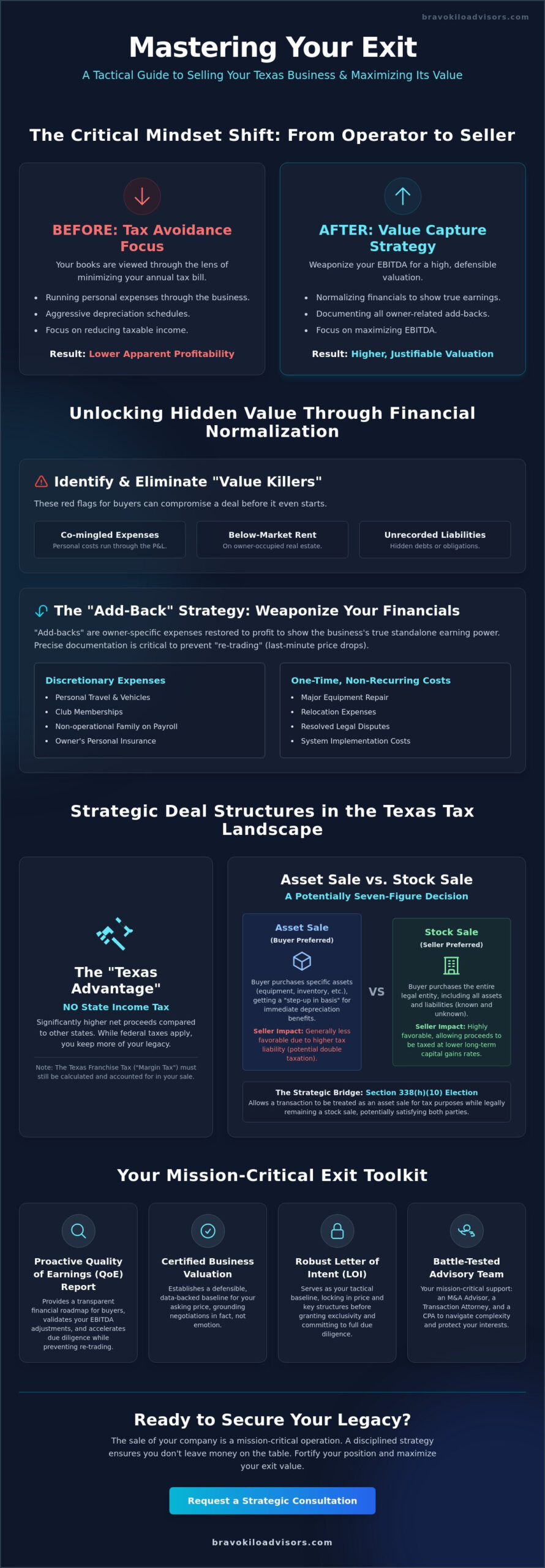
Financial normalization is the disciplined process of stripping away owner-specific expenses to reveal the true earning power of an operation. This is where the battle for valuation is won or lost. For many founders, the primary financial considerations when selling a business in Texas involve shifting from a tax-minimization mindset to a value-maximization strategy. You’ve spent years reducing your taxable income; now, we must reverse those optics to demonstrate maximum profitability.
In the DFW market, specific “Value Killers” can compromise a deal before it gains momentum. Co-mingled personal expenses, below-market rent on owner-occupied real estate, and unrecorded liabilities act as red flags for sophisticated buyers. To mitigate these risks, a certified business valuation is a mission-critical prerequisite. This assessment utilizes various business valuation methods to establish a defensible baseline. In 2026, DFW market multiples for companies in the $5M to $50M range often outpace national averages due to the region’s robust infrastructure and high demand for established mid-market entities.
The “Add-Back” Strategy: Weaponizing Your Financials
We categorize add-backs into two distinct buckets: discretionary expenses and one-time non-recurring costs. Discretionary items include personal travel, club memberships, or family members on the payroll who don’t serve an operational role. Non-recurring costs might involve relocation expenses or a resolved legal dispute. Normalization is the restoration of the business to a standalone financial state. If these add-backs aren’t documented with military precision, you face significant “re-trading” risk. This occurs when a buyer uses financial discrepancies to drop the price at the eleventh hour, citing a lack of transparency in your initial disclosures.
Working Capital Pegs and Their Impact on Your Net Proceeds
Many sellers assume a “cash-free, debt-free” deal means they keep every dollar in the bank at closing. This is a dangerous misconception. The Working Capital Peg is the specific amount of liquidity required to remain in the business post-closing to ensure operational continuity. If your current assets fall below this negotiated peg at the time of closing, the difference is deducted from your purchase price. Precision in this calculation is vital to protecting your final net proceeds and ensuring a clean exit without post-closing disputes.
Strategic Deal Structures in the Texas Tax Landscape
Texas offers a distinct tactical advantage for business owners. The absence of state income tax means your net proceeds are significantly higher than peers in coastal markets like California or New York. This “Texas Advantage” is a cornerstone of the financial considerations when selling a business in Texas. While federal obligations remain a constant, the lack of a state-level bite allows for more aggressive wealth preservation. However, you must still account for the Texas Franchise Tax. Often called the “Margin Tax,” this liability needs to be calculated with precision during an entity sale to avoid unexpected deductions at closing.
Securing favorable terms starts with a robust Letter of Intent (LOI). This document serves as your tactical baseline, locking in price and structure before you commit to the high-stakes environment of due diligence. It prevents the buyer from shifting the goalposts once you’ve granted them exclusivity. For a deeper dive into the operational timeline, review our strategic guide to North Texas M&A. If you’re unsure how your current financials will hold up under this scrutiny, our Value Enhancement Services can help fortify your position.
Asset Sale vs. Stock Sale: The $1M Difference
The structural choice between an asset or stock sale often results in a seven-figure swing in net proceeds. Buyers typically push for asset sales to achieve a “step-up in basis,” which provides immediate depreciation benefits. Sellers generally prefer stock sales to qualify for favorable long-term capital gains treatment. A Section 338(h)(10) election can act as a strategic bridge, allowing the transaction to be treated as an asset sale for tax purposes while remaining a stock sale legally. Navigating these options is essential for a successful transaction that protects your legacy.
Earn-outs and Seller Notes: Managing Risk in 2026
In 2026, bridging the “valuation gap” often requires creative financing. Seller notes demonstrate your confidence in the business’s future stability, providing the buyer with a sense of security while earning you interest. Earn-outs should be structured with objective, achievable milestones. We ensure these targets are based on metrics you control to avoid “phantom” money that never materializes. This methodical approach to deal structure ensures that the final price paid matches the enterprise value you’ve spent decades building.
Executing the Exit: Closing Costs and the Advisory Team
Closing a transaction is a high-stakes operational rollout that requires a specialized unit. We define this as the “Elite Four”: your M&A Advisor, a transaction-focused CPA, an M&A attorney, and a wealth manager. Each member plays a critical role in defending your proceeds. In the 2026 market, proactive sellers are increasingly commissioning their own Quality of Earnings (QoE) reports before ever going to market. This sell-side audit identifies potential financial landmines early, allowing you to address them on your terms rather than during a defensive negotiation. By presenting a transparent, audited financial history, you provide the buyer with a clear roadmap, which significantly reduces the time spent in due diligence.
The financial considerations when selling a business in Texas include understanding the “Success Fee” model used by elite advisory firms. This structure ensures that your interests are perfectly aligned with your advisor’s; they only win when you secure a successful closing at the right price. This is a far more disciplined approach than the transactional models seen in standard brokerage. It focuses on the long-term impact of the deal rather than just the immediate transaction.
Accounting for Closing Costs and Prorations
The final “funds flow” statement is where the mission reaches its conclusion. You must account for several closing deductions that impact your net wire:
- Advisory success fees and brokerage commissions.
- Legal retainers and transaction-specific costs.
- Tail insurance to cover post-sale liabilities.
- Texas-specific property tax prorations, which are typically settled in arrears.
Adopting a “Mission-First” mindset means prioritizing expertise over cost. The cheapest advisor often becomes the most expensive line item when they fail to defend your valuation or allow the deal to collapse. Precision in the escrow and funds flow process ensures that every dollar is accounted for before the final wire is initiated. This methodical approach protects your professional legacy from the friction of last-minute disputes.
Your Post-Sale Mission: Wealth Transition
The day the wire hits your account marks the end of one objective and the beginning of another. This transition is often as emotional as it is financial. You’re moving from being a business operator to a steward of significant capital. Ensuring your legacy remains intact requires a well-planned exit strategy that addresses both your financial future and your personal identity post-sale. To ensure your transition is handled with tactical precision, secure your legacy with a battle-tested M&A strategy from Bravo Kilo Advisors.
Securing Your Professional Legacy
Selling your business is a mission-critical operation where the final result depends on the precision of your preparation. We’ve detailed how EBITDA normalization acts as a primary defense against price reductions during due diligence. We also examined the unique Texas tax landscape, where selecting the right deal structure can preserve millions in net proceeds. These financial considerations when selling a business in Texas are complex, but they’re manageable with a disciplined roadmap and a battle-tested team by your side.
As DFW market specialists with extensive expertise in $500K to $50M transactions, Bravo Kilo Advisors provides the command presence required to navigate high-stakes negotiations. Our Certified Business Valuations ensure you enter the market with a defensible and high-value position. Your professional legacy is too important to leave to chance or poorly planned execution. Request a Confidential Strategic Assessment to begin your transition with confidence. We’re prepared to guide you through a flawless exit and secure the value you’ve spent a lifetime building.
Frequently Asked Questions
Do I pay state income tax on my business sale in Texas?
No, Texas does not impose a state-level income tax or capital gains tax on the sale of a business. This lack of a state tax burden is a significant advantage that maximizes your net proceeds compared to exits in most other states. It remains one of the most critical financial considerations when selling a business in Texas for owners focused on wealth preservation.
You must still account for the Texas Franchise Tax, which is an entity-level tax based on your business’s margin. While the state won’t tax your personal gain, the business entity itself may have a final tax obligation depending on its revenue and the timing of the closing. We recommend reviewing your 2026 franchise tax thresholds to ensure all obligations are settled before the final funds flow.
What is the average business broker fee in Dallas-Fort Worth?
Brokerage and M&A advisory fees in Dallas-Fort Worth are typically structured as success fees that align the advisor’s incentives with your final sale price. These fees are usually calculated as a percentage of the total enterprise value and often follow a tiered structure. This ensures that the professional handling your sale is motivated to defend every dollar of your valuation during negotiations.
The specific fee depends on the size and complexity of your transaction. Most elite firms avoid flat-fee models in favor of this performance-based approach. You should verify the fee structure during your initial assessment to ensure it covers the full scope of value enhancement and exit planning services required for a sophisticated mid-market deal.
How long does the financial due diligence process typically take in Texas?
The financial due diligence phase usually requires 60 to 90 days to complete after an LOI is signed. This window allows the buyer’s team to verify your EBITDA, inspect your tax records, and confirm the accuracy of your financial normalization. The duration depends heavily on the quality of your internal records and the responsiveness of your advisory team.
You can accelerate this timeline by being proactive. Commissioning a sell-side Quality of Earnings report before going to market allows you to present a “clean” set of books that pre-emptively answers buyer questions. This disciplined preparation reduces the risk of the process dragging on, which protects the deal’s momentum and prevents buyer fatigue.
Can I sell my business as a stock sale if I am an S-Corp?
Yes, S-Corp owners can execute their exit as a stock sale. This is often the preferred path for sellers because it generally results in more favorable capital gains treatment. However, buyers in the mid-market often push for asset sales to gain the “step-up” in basis for future depreciation benefits.
A common tactical middle ground is the Section 338(h)(10) election. This allows the transaction to be treated as an asset sale for federal tax purposes while remaining a stock sale for legal purposes. Navigating these options requires a command of complex deal structures to ensure you don’t inadvertently sacrifice your “Texas Advantage” through poor planning.