
What if the commission you pay isn’t a cost to be minimized, but a tactical lever used to maximize your final payout? You’ve spent years building your legacy, so the fear of overpaying for mediocre representation is a valid concern for any Texas business owner. It’s natural to feel anxious about upfront costs when results are not yet guaranteed. This strategic briefing provides a transparent breakdown of business broker fees in Texas, ensuring you understand exactly how success fees and retainers impact your total exit value.
We agree that your professional transition deserves the precision of a mission-critical operation, not a generic transaction. This guide promises to demystify current 2026 market rates and help you justify every dollar through proven ROI. We will examine the distinction between standard brokers and specialized M&A advisors, analyze the mechanics of the Lehman scale, and provide the clarity you need to select a disciplined DFW partner who protects your interests with integrity and poise. By the end of this guide, you’ll have a roadmap to navigate negotiations with confidence.
Key Takeaways
- Identify the tactical difference between success-based commissions and retainer structures to ensure your advisory team is aligned with your specific mission objectives.
- Navigate the current 2026 benchmarks for business broker fees in Texas to secure high-caliber representation without overpaying for standard transactional services.
- Uncover why “no upfront fee” models may compromise your results by prioritizing quick volume over the meticulous pursuit of maximum enterprise value.
- Evaluate the true ROI of elite M&A advisory by understanding how professional negotiation leverage can significantly outweigh the cost of the fee itself.
- Shift your mindset from viewing transaction costs as a simple expense to treating them as a strategic investment in protecting your professional legacy.
Standard Structure of Business Broker Fees in Texas
A professional Business broker operates within a structured fee framework designed to align their interests with your mission objectives. Understanding business broker fees in Texas requires looking past the final commission percentage to the specific tactical resources deployed on your behalf. This framework generally consists of performance-based success fees, strategic retainers, and specialized valuation costs. Each component serves a distinct purpose in the operational rollout of your business sale, ensuring that every phase of the process is handled with precision.
To better understand this concept, watch this helpful video:
Success Fees and the Lehman Scale
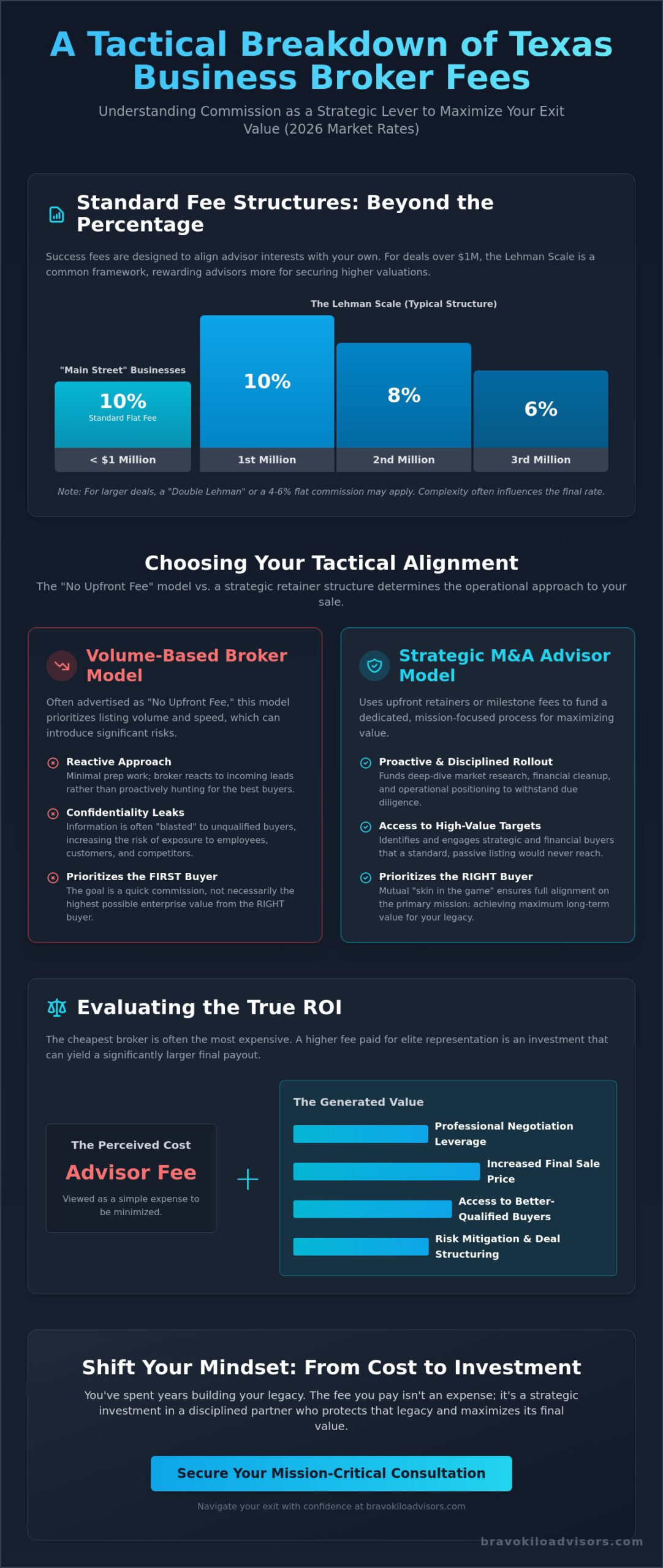
Success fees are the primary driver of alignment in the Texas M&A landscape. For “Main Street” businesses valued under $1 million, the standard success-based commission is typically 10%. As transactions move into the lower middle market, advisors often utilize a sliding scale known as the Lehman Scale. A common structure involves 10% on the first million, 8% on the second, and 6% on the third. For even larger deals, a “Double Lehman” or a flat commission of 4% to 6% may be applied. It’s important to recognize that deal complexity, not just the raw revenue, often dictates the final percentage used by a firm.
Upfront Costs: What Business Owners Need to Know
Precision starts with high-quality data. Many sophisticated owners begin their journey with certified business valuations to establish a defensible market position before hitting the market. These are typically flat-fee engagements that provide the objective intelligence needed for effective exit planning. Retainers and milestone fees also play a critical role in complex DFW transactions. These upfront commitments aren’t just administrative costs; they signal “skin in the game” for both the seller and the advisor. While some retainers are non-refundable to cover marketing and buyer outreach, others are credited against the final success fee at closing. This ensures your advisor has the dedicated resources required to build a confidential information memorandum (CIM) that attracts high-caliber buyers. Knowing how these business broker fees in Texas are allocated helps you verify that your professional legacy is being protected by a team with the focus and resources to win.
Success-Based Fees vs. Retainers: Navigating the Texas M&A Landscape
The choice between a pure commission model and a hybrid retainer structure is ultimately a choice of tactical alignment. Many volume-based firms in the North Texas market promote a “no upfront fee” promise to attract a high volume of listings. While this sounds risk-free, it often results in a reactive approach where confidentiality is managed loosely and only the most obvious buyers are contacted. This model prioritizes the first buyer rather than the right buyer. Bravo Kilo Advisors structures fees to ensure mission-focused execution, where our interests are locked to your long-term outcome. Understanding the philosophy behind business broker fees in Texas helps you avoid the traps of low-cost, high-volume providers.
The Risks of a Volume-Based Brokerage Model
“Free” listings frequently bypass the critical phase of professional prep work. Without an upfront commitment, a broker may skip the deep financial cleanup and operational positioning required to withstand rigorous due diligence. This lack of preparation often leads to leaked confidentiality in the North Texas market, as brokers blast information to unqualified leads to secure a quick win. Success-based fees protect the owner’s downside while rewarding advisor performance.
When a Retainer is a Strategic Advantage
A retainer funds the deep-dive market research necessary to distinguish between strategic buyers and financial buyers. It allows your advisor to execute a proactive rollout, identifying high-value targets that a standard listing would never reach. It’s a specialized discipline that requires a command-presence during negotiations. Investing in professional exit planning is often the most effective way to close the “value gap” before your business goes to market.
If you are currently hiring a business broker in Dallas, look for a partner who values strategic advisory over mere transaction volume. This disciplined approach ensures your professional legacy is handled with the precision it deserves. You can explore our value enhancement services to see how we prioritize long-term impact over immediate, low-value results.
Evaluating ROI: Why the ‘Cheapest’ Broker is Often the Most Expensive
Focusing solely on the percentage listed in a contract is a tactical error that overlooks the broader objective. When evaluating business broker fees in Texas, the most critical metric is your net gain at the close of escrow. A low-cost broker might save you 1% on commission while costing you 20% in enterprise value because they failed to create a competitive bidding environment. Elite M&A advisors earn their fee by managing multiple Letters of Intent (LOIs) simultaneously, forcing buyers to move toward your preferred terms. This negotiation leverage is the difference between a standard transaction and a mission-focused victory.
Deal certainty is another overlooked factor in the ROI equation. Many transactions fail during due diligence because of poor preparation or lack of command presence from the intermediary. A failed deal isn’t just a missed opportunity; it’s a significant drain on your time and resources that can damage employee morale and market reputation. Protecting your professional legacy requires an advisor who treats the transition with the precision of a high-stakes operation. They ensure the buyer remains committed while you focus on maintaining the operational health of your company.
Calculating the Real Cost of Your Exit
A DIY sale or a discount brokerage model often leaves money on the table through poor deal structuring and a lack of market reach. Strategic M&A advisory focuses on maximizing net proceeds by identifying the specific buyers who see the highest strategic value in your firm. While you should check with tax professionals regarding specific liabilities, an expert advisor helps structure the deal to minimize unnecessary friction. True ROI is measured by the net proceeds after taxes and fees, not the commission percentage.
Selecting Your DFW Advisor with Command Presence
Transparency is the foundation of trust. When interviewing a potential partner in the Dallas-Fort Worth metroplex, ask direct questions about their milestone triggers and how they justify their fee structure through specific value-add activities. You need a team that understands the local North Texas landscape and possesses the strategic reliability to lead you through difficult negotiations. Don’t settle for a transactional intermediary when you can have a seasoned consultant. Secure your legacy with a strategic valuation from Bravo Kilo Advisors to ensure your exit is handled with the integrity and poise it deserves.
Secure Your Professional Legacy with Strategic Precision
Your business is more than a set of financial statements; it is the culmination of your life’s work. Navigating business broker fees in Texas requires a shift in perspective from transactional expense to strategic investment. You now understand that the right fee structure aligns your advisor’s mission with your final payout, ensuring you don’t sacrifice enterprise value for a discount commission. True success is defined by net proceeds and the preservation of your legacy, not just the closing of a deal. By prioritizing advisory depth over simple transaction volume, you ensure your exit is executed with the precision it deserves.
Bravo Kilo Advisors provides expert M&A advisory for businesses valued between $500,000 and $50 million. We offer Certified Business Valuations with transparent fixed pricing, delivering the objective intelligence you need for a disciplined operational rollout. As North Texas market specialists with a background in tactical leadership, we possess the command presence required to navigate complex negotiations with poise. It’s time to move from uncertainty to a controlled, predictable roadmap for your exit. Schedule a confidential consultation to discuss your DFW business exit and ensure your transition is handled with the precision of a mission-critical operation. You’ve built something remarkable; let’s protect it together.
Frequently Asked Questions
Are business broker fees negotiable in Texas?
Business broker fees in Texas are negotiable and typically reflect the complexity of the specific mission. Factors such as the marketability of your enterprise, the total transaction size, and the exclusivity of the listing agreement play a role in these discussions. A seasoned advisor views this as a tactical alignment of interests rather than a rigid cost. You should ensure the final structure incentivizes the pursuit of maximum value for your professional legacy.
Who typically pays the broker fee, the buyer or the seller?
The seller typically pays the success fee as a deduction from the sale proceeds at the close of escrow. This arrangement ensures the advisor’s compensation is directly tied to the value they secure for your business. While most transactions follow this model, some complex M&A deals may involve different structures depending on the specific objectives of the stakeholders. It’s a standard operational procedure designed to align the advisor’s performance with your financial outcome.
What is a ‘Double Lehman’ fee structure?
A Double Lehman is a sliding scale commission structure used for larger, more complex transactions in the lower middle market. It typically begins at 10% on the first million dollars of the sale price, 8% on the second, 6% on the third, 4% on the fourth, and 2% on everything thereafter. This model recognizes that while larger deals require significant resources, the percentage should decrease as the enterprise value increases. It provides a balanced framework for compensating high-stakes advisory work.
What happens to the retainer if my business doesn’t sell?
Retainers are generally non-refundable because they fund the intensive upfront advisory work required for a successful rollout. This includes market research, financial cleanup, and the creation of confidential marketing materials. These fees ensure your advisor can dedicate the necessary focus and resources to your mission without being spread too thin. You should view the retainer as an investment in the strategic preparation that makes a high-value exit possible.
Are there additional closing costs besides the broker’s success fee?
You should account for several additional costs beyond the primary business broker fees in Texas. These often include escrow fees, real estate commissions if property is involved, and professional service fees for valuation or specialized consulting. As of September 1, 2025, firms acting as data brokers must also pay a $300 annual registration fee to the Secretary of State. Preparing for these logistical expenses ensures your final transition is handled with the precision and transparency you expect from an elite partner.