
Your M&A advisor’s fee isn’t just a closing cost. It’s a strategic alignment tool that ensures your mission and their incentives are identical. In the high-stakes environment of a business exit, you need the certainty that every dollar spent is actively working to increase your final valuation. You’ve spent years building your legacy, so it’s natural to feel uneasy about paying high retainers or managing complex IRS rules without a guaranteed result. This uncertainty can feel like a distraction from the primary objective of a clean, profitable transition.
This guide provides a clear framework for understanding success-based transaction fees so you can approach your exit with the confidence of a well-planned operation. We’ll break down how these performance-driven structures drive maximum enterprise value by keeping your advisory team focused on the target. We also cover the tactical advantages of the IRS 70/30 safe harbor rule, which allows you to treat 70% of success-based fees as deductible. By the end of this briefing, you’ll have a roadmap to evaluate fee structures with the precision of a seasoned negotiator.
Key Takeaways
- Learn how success-based fees align your M&A advisor’s incentives directly with your goal of achieving the highest possible enterprise value.
- Discover how DFW market fee structures are tiered to ensure that performance remains the primary driver of every negotiation.
- Gain a strategic advantage by understanding success-based transaction fees and how the IRS 70/30 safe harbor rule can significantly reduce your tax liability.
- Identify which deal components, including stock and earn-outs, are factored into the total fee calculation to ensure transparency at closing.
- Secure your professional legacy by partnering with elite consultants who treat your business exit as a mission-critical operation rather than a simple transaction.
The Strategic Logic of Success-Based Transaction Fees
A success-based fee is a contingent payment triggered solely upon the successful closing of a merger or acquisition. It represents a shift from paying for activity to paying for results. For many DFW business owners, understanding success-based transaction fees is the first step in ensuring their advisor is fully committed to the mission. This structure ensures that your advisor fights for the highest possible Enterprise Value because their compensation is directly proportional to your exit proceeds. They aren’t just observers; they are active participants in your financial victory.
Unlike flat-fee models that drain capital regardless of the outcome, the contingent model mitigates your financial risk. You only pay the bulk of the advisory cost when the objective is secured. This approach separates elite boutique advisors from high-volume, low-touch brokers who often prioritize quick closings over maximized value. By tying the fee to the final sale price, the advisor’s strategic focus remains locked on your long-term legacy. This logic mirrors the standard found in investment banking advisory fees, where performance is the only true measure of professional competence.
Advisory vs. Transactional Roles
Bravo Kilo Advisors prioritizes long-term impact over immediate results. While the success fee is the ultimate goal, the preparation phase often requires a modest retainer. These retainers aren’t just administrative costs. They fund the deep research, certified valuations, and marketing materials necessary for a mission-critical exit. This disciplined approach ensures that when we go to market, we do so from a position of tactical strength.
The Protective Empathy of Contingent Fees
The exit planning process is emotionally and operationally taxing. Success fees provide a safety net for founders during high-stakes negotiations, as they reduce the upfront financial burden. This structure demonstrates a commitment to the client’s welfare. It signals that the advisor is willing to share the risk of the engagement. Understanding success-based transaction fees allows owners to focus on running their company while their advisory team handles the tactical maneuvers required to cross the finish line.
How Success Fees are Structured in North Texas M&A
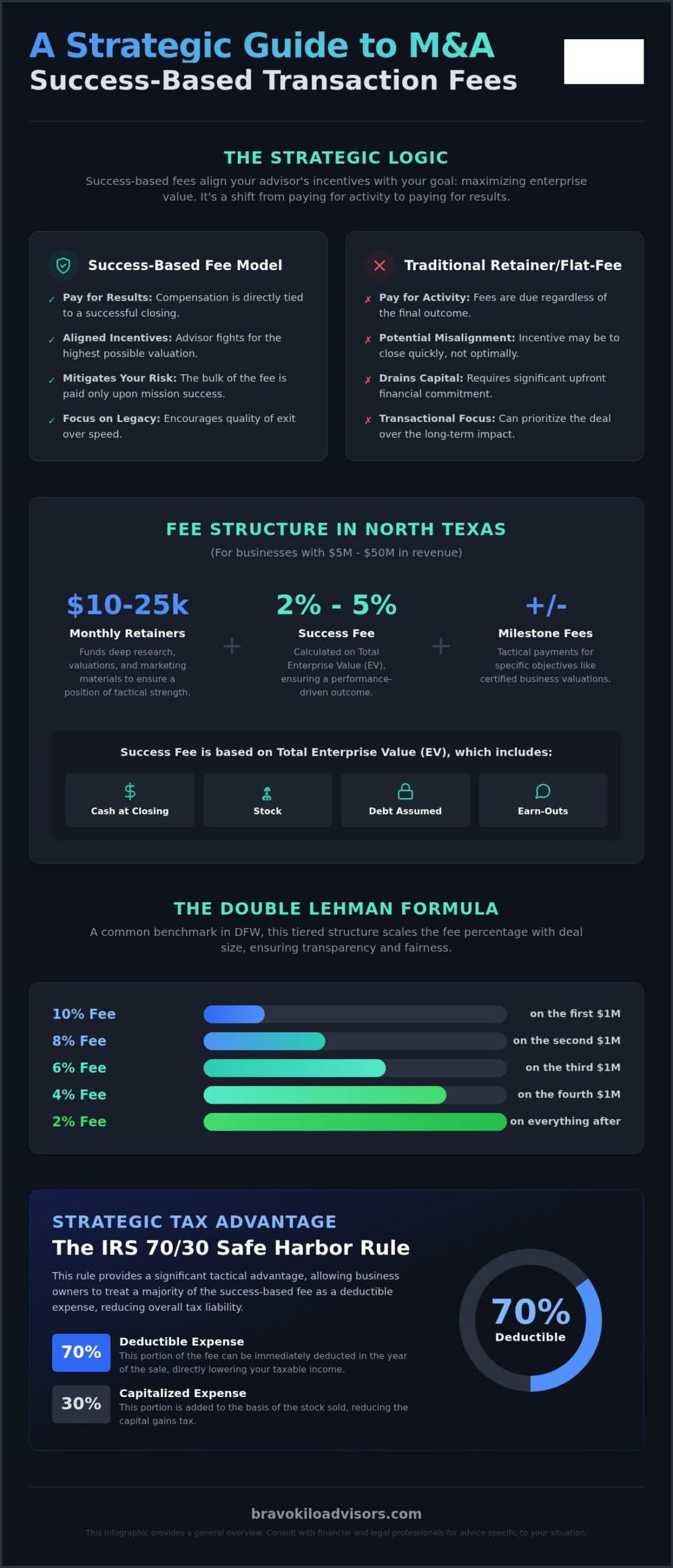
In North Texas, fee structures are designed to mirror the tactical complexity of the deal. For businesses with $5M to $50M in revenue, the standard involves a hybrid of retainers and performance-driven percentages. Understanding success-based transaction fees requires looking at the total Enterprise Value (EV). This isn’t just the cash at closing. It includes stock, debt assumed by the buyer, and contingent payments like earn-outs.
Current 2026 market data indicates that for lower-middle-market deals, monthly retainers typically range from $10,000 to $25,000. Success fees for these transactions generally fall between 2% and 5% of the total transaction value. Milestone fees provide tactical coverage for specific objectives, such as certified business valuations, which set a defensible baseline for the entire negotiation. These payments ensure the advisor can commit high-level resources to the preparation phase before the mission reaches its final stage.
The Lehman Formula and Modern Variations
The Lehman Formula is a legacy scaling method that reduces the percentage as the deal size increases. The Double Lehman, which doubles those percentages to account for modern inflation and deal complexity, remains a common benchmark in DFW. A Double Lehman is a tiered fee structure historically rooted in investment banking that applies 10% to the first million dollars of transaction value, 8% to the second, 6% to the third, 4% to the fourth, and 2% to everything thereafter. Sophisticated owners prefer this transparency because it removes hidden costs and aligns the advisor’s effort with the deal’s size.
Avoiding the ‘Broker Trap’
A standard commission is a transactional cost, but a success fee for strategic growth consulting is an investment in value creation. Brokers often seek the fastest path to a “sold” sign. Elite advisors focus on the quality of the exit and the long-term impact on the owner’s legacy. This distinction is critical when filing an IRS safe harbor election, as the nature of the services performed determines the final tax treatment. If you are evaluating your current position, a certified business valuation can provide the clarity needed to structure a fair advisory agreement.
Tax Advantages and the 70/30 Safe Harbor Rule
IRS Revenue Procedure 2011-29 provides a critical tactical advantage for sellers. This procedure establishes a “safe harbor” that simplifies the tax treatment of advisory costs, reducing the risk of a protracted dispute with the IRS. Under this rule, you can elect to treat 70% of success-based fees as non-facilitative, making them immediately deductible as ordinary business expenses. The remaining 30% is categorized as facilitative and must be capitalized as a cost of the transaction.
Understanding success-based transaction fees through this lens allows you to recover a significant portion of your advisory investment. Without this election, the IRS often presumes that the entire fee is a capital expense, which provides no immediate tax benefit. Documentation remains your primary line of defense. You must ensure that your DFW advisor and CPA maintain rigorous records that distinguish between strategic advisory services and the final execution of the deal.
Applying the Safe Harbor to Your DFW Exit
Executing this election is a multi-step process that occurs during your year-end tax filing. First, confirm that your deal qualifies as a “covered transaction,” which generally includes the acquisition of assets or stock in a trade or business. For a Dallas business sale, you must attach a specific statement to your timely filed federal income tax return. This statement must identify the transaction and state the amount of success-based fees being deducted under the 70/30 split.
Private Equity and Special Scrutiny
Selling to a private equity group requires additional caution. Recent regulatory trends, highlighted by Letter Ruling 202308010, indicate that the IRS is scrutinizing whether fees in PE-backed deals primarily benefit the target company or the selling shareholders. If the IRS determines the benefit lies with the sellers, the target company cannot claim the deduction. DFW founders should treat this as a mission-critical detail. Ensuring your fee structure is properly documented and defensible is essential when navigating high-stakes negotiations with sophisticated institutional buyers.
Secure Your Legacy with Strategic Alignment
Your business exit is a mission-critical operation that requires disciplined leadership and a proven roadmap. We’ve explored how a performance-driven fee structure ensures your advisor’s incentives are identical to your own. By understanding success-based transaction fees, you can navigate the nuances of North Texas market standards and leverage the IRS 70/30 safe harbor rule to protect your hard-earned proceeds. This strategic approach transforms a standard closing cost into a powerful tool for maximizing enterprise value.
The transition of your professional legacy is too significant to leave to chance or high-volume brokers. You deserve an elite consulting partner who brings a mission-focused attitude to every negotiation. Secure a Strategic Valuation and Exit Briefing with Bravo Kilo Advisors to begin your preparation. Our team utilizes certified business valuations and deep North Texas market specialization to ensure your transition is handled with the precision and integrity it deserves. You’ve built a remarkable company; now it’s time to execute an exit that reflects its true worth.
Frequently Asked Questions
Are success-based transaction fees tax deductible?
Yes, success-based fees are partially deductible under current IRS regulations. Revenue Procedure 2011-29 allows you to treat 70% of these costs as ordinary business expenses. The remaining 30% is treated as a facilitative cost and must be capitalized. This simplified split reduces the risk of a dispute with the IRS while providing immediate tax relief for the seller.
What is the 70/30 safe harbor for M&A fees?
The 70/30 safe harbor is an IRS election that streamlines the tax treatment of M&A advisory costs. It permits business owners to deduct 70% of their success-based fees without having to provide detailed time logs for every advisory activity. Understanding success-based transaction fees involves coordinating with your CPA to ensure this election is properly documented on your federal tax return.
How do success fees differ from traditional business broker commissions?
Success fees are performance-driven incentives that align an elite advisor’s interests with your exit goals, unlike standard broker commissions which are often purely transactional. While high-volume brokers might prioritize any closing, an M&A advisor uses the success fee to focus on maximizing your final Enterprise Value. This structure ensures that your professional legacy is handled with the precision of a mission-critical operation.
Do I still have to pay a retainer if there is a success fee?
Yes, a retainer is typically required to fund the tactical preparation required for a successful exit. This upfront commitment allows your advisory team to perform deep research and certified valuations that set a defensible baseline for negotiations. While the success fee is the primary driver at closing, the retainer ensures your firm has the resources to execute a disciplined operational rollout from the beginning of the engagement.
What happens to the success fee if the deal falls through during due diligence?
You are not obligated to pay the success fee if the transaction does not reach a final closing. This contingent structure protects the business owner from significant financial loss if a buyer retreats during due diligence. Understanding success-based transaction fees provides founders with the confidence that their advisor is only compensated when the primary objective of a successful sale is fully achieved.