
Succession is not a family conversation; it’s a strategic asset transfer that requires tactical discipline and an objective eye. You’ve spent decades building a legacy in North Texas, yet the thought of handing over the keys likely triggers more anxiety than pride. It’s natural to worry about internal conflict or whether the next generation is truly prepared for the command. Understanding how to create a succession plan for a family business is the only way to move from this state of uncertainty into a mission-critical operation that protects your professional legacy.
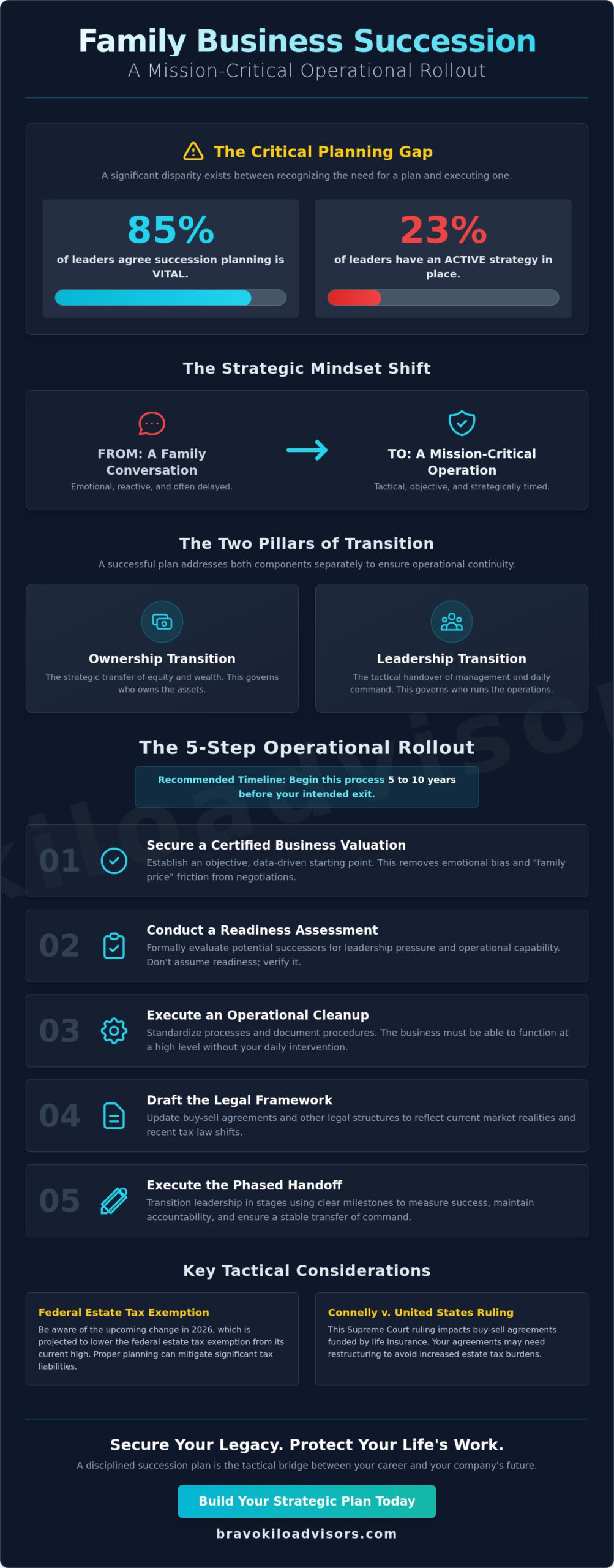
We’ve seen that while 85% of leaders agree planning is vital, only 23% have an active strategy in place. This article provides the tactical steps needed to bridge that gap and maximize your enterprise value. You’ll gain a clear roadmap for the transition, including how to navigate the $15 million federal estate tax exemption for 2026 and the impact of the Supreme Court’s ruling in Connelly v. United States on buy-sell agreements. We’ll outline a logical sequence that ensures your mission continues with precision, giving you the peace of mind that your life’s work is secure.
Key Takeaways
- Treat succession as a mission-critical operational rollout rather than a simple legal filing to ensure your legacy survives with its integrity intact.
- Master how to create a succession plan for a family business by clearly distinguishing between the transfer of equity and the handover of management responsibilities.
- Establish a baseline of reality with a certified business valuation. This objective data point removes the emotional weight of personal perception from the negotiation.
- Assess successor readiness through formal evaluations. You shouldn’t assume the next generation is prepared for the pressure of leadership without objective proof.
- Align your exit timing with the specific DFW market climate. Local M&A advisory provides the tactical edge needed to maximize your enterprise value in North Texas.
The Strategic Framework for Family Business Succession
Only about 23% of family business leaders have an active plan they are currently implementing. This gap between awareness and action often leads to operational paralysis. For most founders, the business is their greatest achievement. It’s more than a source of income; it’s a legacy. True succession planning is a mission-critical operational rollout. It requires the same level of tactical precision you used to build the company from the ground up. If you’re wondering how to create a succession plan for a family business, you must recognize that a legal filing isn’t enough to protect your mission.
To better understand this concept, watch this helpful video:
You must distinguish between ownership transition and leadership transition. They aren’t identical. Ownership involves equity and the transfer of wealth. Leadership involves management and the daily command of operations. A successful plan addresses both separately to ensure the company remains functional. Your legacy is a strategic asset. Like any high-value asset, it requires disciplined planning to prevent it from degrading during the handoff.
The primary failure point for many North Texas firms is waiting for a crisis event. A sudden health issue or unexpected departure forces a reactive scramble. This leads to accidental succession, where roles are filled by whoever is available rather than who is mission-ready. In the high-stakes DFW market, a reactive approach can destroy decades of value in weeks. You need a planned rollout that begins years before you intend to exit.
Why Your Exit Strategy is a Strategic Discipline
A formal exit strategy isn’t just about leaving; it’s about value enhancement. When you have a documented process, you increase the overall enterprise value. Potential successors or buyers see a stable, predictable machine rather than a personality-driven entity. Bravo Kilo Advisors approaches this as a specialized discipline, ensuring that every operational detail is polished before the transition. Succession planning is the tactical bridge between a founder’s career and a company’s future.
A 5-Step Operational Rollout for a Successful Transition
Moving from a conceptual idea to a functional exit requires a disciplined sequence. You shouldn’t treat this as a single event. It’s a multi-year operation. When considering how to create a succession plan for a family business, you must prioritize objective data over emotional assumptions. This process starts with a baseline of reality and ends with a controlled transfer of command. Industry trends suggest starting this process 5 to 10 years before your intended exit to navigate the complexities of family dynamics and tax implications effectively.
- Step 1: Secure a Certified Business Valuation. You can’t plan a route without knowing your starting point. Establishing an objective value is the first mission-critical step.
- Step 2: Conduct a Readiness Assessment. Evaluate potential successors with the same scrutiny you’d use for an external hire. Are they ready for the pressure of leadership?
- Step 3: Operational Cleanup. Standardize your processes. The business must be able to function without your direct intervention or daily oversight.
- Step 4: Draft the Legal Framework. Update your buy-sell agreements to reflect current market realities. Recent shifts, such as the Connelly v. United States ruling, mean you may need to restructure these agreements to avoid increased estate tax liabilities.
- Step 5: Execute the Handoff. Transition leadership in phases. Use clear milestones to measure success and maintain accountability throughout the rollout.
The Role of Objective Valuation in Family Harmony
Emotion is the primary enemy of a clean transition. Many founders struggle with the gap between their personal perception of value and the actual market price. Securing certified business valuations provides a neutral, third-party baseline. This removes the “family price” friction and ensures that every stakeholder understands the fair market value. It’s a protective measure for your relationships as much as your finances.
Training the Next Generation for Command
Leadership isn’t inherited; it’s forged. A successful transition requires a “leadership boot camp” approach. This involves more than just shadowing the founder. It requires formal mentorship and exposure to high-stakes decision-making. Utilizing a guide to family business succession can help structure this development. Engaging an objective advisor ensures that the successor receives unbiased feedback, preparing them for the realities of the DFW business climate. If you’re ready to begin this assessment, our exit planning services can provide the tactical oversight your legacy deserves.
Navigating the North Texas Transition Landscape
The DFW Metroplex is currently one of the most aggressive economic environments in the country. This rapid regional growth directly impacts your business valuation. If you’re documenting how to create a succession plan for a family business in Dallas, Fort Worth, or Frisco, you can’t ignore local market multiples. A business in North Texas often commands a premium compared to similar entities in stagnant markets. Timing your exit to coincide with these growth cycles is a tactical necessity. Bravo Kilo Advisors acts as your tactical partner, ensuring your mission remains on track through every regional shift.
M&A Advisory vs. Traditional Brokerage for Succession
Traditional business brokerage often focuses on a quick transaction. For high-stakes family legacies, this isn’t enough. You need sophisticated M&A advisory that understands the DFW culture and global valuation standards. While some owners look for basic assistance by Hiring a Business Broker in Dallas, TX, elite enterprises require a deeper level of strategic growth consulting. We prioritize long-term impact over immediate results, protecting the enterprise value you’ve spent a lifetime building.
The Final Mission: Your Post-Succession Legacy
Secure Your Legacy with Tactical Precision
Your professional legacy is a mission-critical asset that demands a disciplined exit strategy. By clearly separating ownership from leadership and establishing an objective valuation baseline, you’ve already moved ahead of the majority of business leaders who lack an active plan. The rapid expansion across the DFW Metroplex provides a unique window to maximize your enterprise value before the next phase of your journey. Mastering how to create a succession plan for a family business ensures that your transition is a controlled rollout rather than a reactive scramble.
We specialize in supporting North Texas businesses with $500k to $50M in revenue. Our battle-tested M&A advisors bring a mission-first attitude to every engagement, backed by certified valuation expertise to ensure your market price is defensible and accurate. You’ve spent decades building this company; we’re here to ensure the handoff is handled with the precision it deserves. Schedule your confidential strategic assessment with Bravo Kilo Advisors to begin your strategic roadmap today. Your mission continues, even after you step away from the command.
Frequently Asked Questions
What is the most common mistake in family business succession?
The most common mistake is failing to start the process until a crisis occurs. Reactive planning often leads to fractured family relationships and diminished enterprise value. By waiting for an emergency, you lose the tactical advantage of time. This prevents you from properly grooming a successor or cleaning up financials. A proactive rollout allows you to maintain control over the narrative and the outcome.
How long does it take to create and implement a succession plan?
A comprehensive transition typically requires a five to ten year window for full execution. This timeframe allows for the identification of successors, leadership development, and the gradual transfer of equity. When you define how to create a succession plan for a family business, you’ll see that rushing the process often results in operational instability. A methodical approach ensures that the business can survive the founder’s departure without a loss in momentum.
Who should be involved in the succession planning team?
Your planning team should consist of objective third-party advisors and key stakeholders. This includes an M&A advisor to guide the overall strategy, a CPA for financial clarity, and legal counsel for document drafting. For business owners who need to integrate their succession strategy with comprehensive estate planning and probate protection, Massingill Attorneys & Counselors at Law provides the specialized legal expertise required to secure a multi-generational legacy. Involving a neutral facilitator helps manage family dynamics and prevents personal biases from clouding professional decisions. This multidisciplinary approach ensures that every angle of the mission, from tax liability to management readiness, is covered with precision.
What happens if no family member wants to take over the business?
If a family successor isn’t viable, the mission shifts toward an external sale or hiring professional management. You must prioritize the health of the enterprise over the desire for family continuity. Selling to a strategic buyer or a private equity firm often maximizes value for the current generation. Understanding how to create a succession plan for a family business includes preparing for these alternative exit paths to ensure your legacy remains intact regardless of who leads.