
In a high-stakes legal environment, your business isn’t just a collection of assets; it’s a mission-critical operation that faces its greatest threat during a property division. The difference between a tactical defense and a total loss often hinges on a single, defensible document. You’ve likely spent years building your professional legacy. It’s natural to feel a sense of dread regarding an invasive discovery process or the fear of losing half your equity to a spouse’s aggressive valuation. We understand that you need to protect what you’ve built without letting the legal process paralyze your daily operations.
This guide will show you how to navigate the complexities of Texas community property law with a certified business valuation for divorce proceedings Dallas designed to withstand the scrutiny of a Dallas County court. You’ll learn how the 2026 updates to Texas Family Code Chapter 3 clarify the distinction between community and separate property in mixed-character assets. We’ll provide a clear roadmap for securing a valuation that uses the fair market value standard while minimizing financial disruption. From understanding the impact of the current 6.75% prime rate on your appraisal to preparing your sworn inventory, this briefing prepares you for a controlled and predictable resolution.
Key Takeaways
- Master the Texas Family Code’s “Presumption of Community Property” to ensure you properly identify and protect your separate property assets during a high-stakes transition.
- Evaluate the three primary valuation methodologies, including the Asset-Based and Market approaches, to determine which standard best protects the equity of your North Texas firm.
- Implement a mission-critical operational rollout by organizing five years of financial data to secure a certified business valuation for divorce proceedings Dallas that stands up to judicial scrutiny.
- Identify and neutralize potential “value killers” within your financial statements before they can be leveraged by opposing counsel during the invasive discovery phase.
- Establish a strategic roadmap that prioritizes long-term business continuity and minimizes operational disruption while fulfilling the court’s requirements for a sworn inventory.
Understanding Business Valuation in Dallas Divorce Proceedings
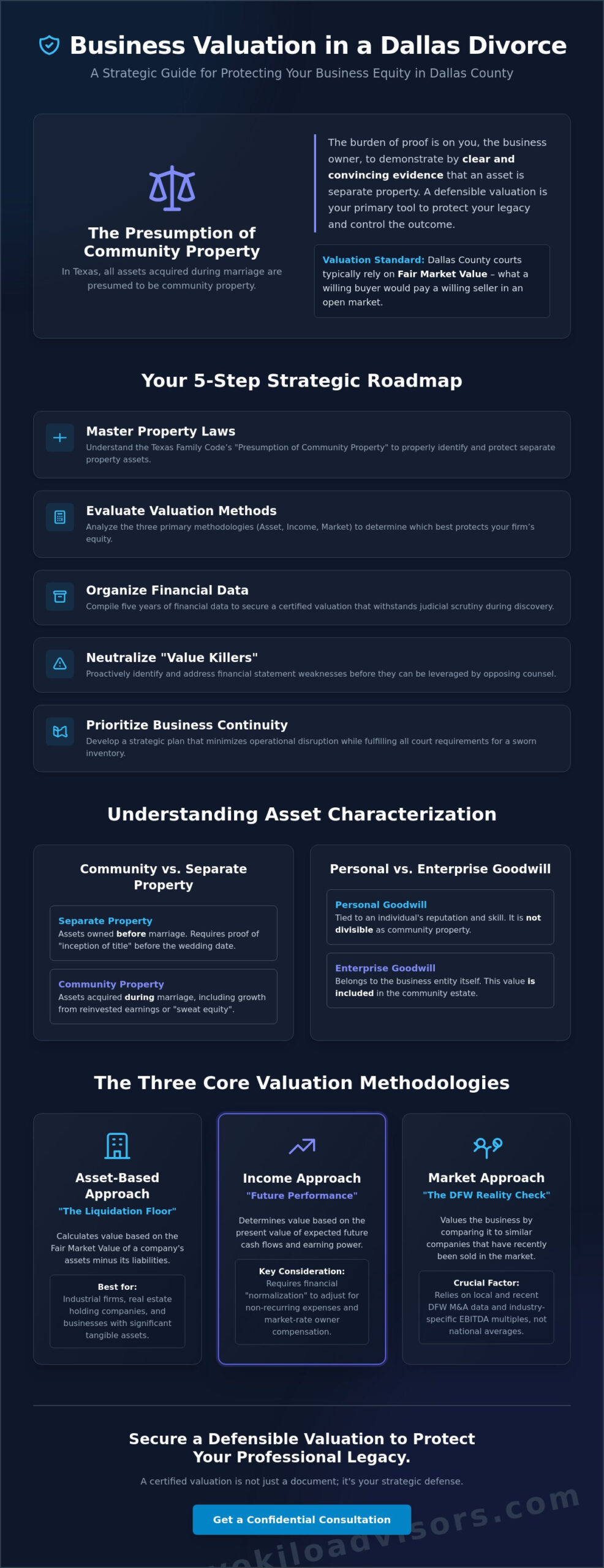
Under the Texas Family Code, a business is more than just an income stream; it’s a complex asset subject to strict characterization rules. Securing a certified business valuation for divorce proceedings Dallas provides the definitive assessment of what that asset is worth to the community estate. Texas law operates under the “Presumption of Community Property,” meaning the court assumes every asset owned by either spouse is community property unless proven otherwise by clear and convincing evidence. This legal framework puts the burden of proof squarely on the owner to protect their professional legacy.
To gain a tactical perspective on how these valuations impact your case, watch this briefing:
Most Dallas County courts rely on “Fair Market Value” as the baseline. This standard defines value as what a willing buyer would pay a willing seller in an open market. Because the 2026 DFW economy remains fluid with a 6.75% prime rate, the specific valuation date is a critical strategic variable. A shift of just 30 days in the appraisal timeline can significantly alter the final report. Professionals often utilize various business valuation methodologies to ensure the report is defensible under cross-examination.
Community vs. Separate Property in North Texas
Proving “inception of title” is the first line of defense for businesses started before the marriage. If you founded the firm prior to your wedding day, the entity itself may be separate property. The lines often blur when reinvested earnings or “sweat equity” contribute to growth during the marriage. At Bravo Kilo Advisors, we emphasize that your 2026 financial cleanup must start with a historical audit to trace every dollar back to its source.
Personal vs. Enterprise Goodwill
Texas law distinguishes between Enterprise Goodwill, which belongs to the business entity, and Personal Goodwill, which is tied to the individual’s reputation and skill. Personal Goodwill is generally excluded from the community estate because it cannot be sold or transferred. In Dallas, Personal Goodwill acts as a strategic shield for professional practices by isolating the owner’s individual value from the divisible assets of the business.
The Three Methodologies for Valuing North Texas Businesses
A defensible report relies on a rigorous triangulation of three primary methodologies. Each serves as a tactical pillar in a business valuation for divorce proceedings Dallas. The Asset-Based Approach establishes the “liquidation floor” for the entity. This method is particularly relevant for North Texas industrial firms where tangible holdings like heavy equipment or real estate represent significant value. In these cases, the valuation focuses on the fair market value of assets after all liabilities are settled.
The Income Approach shifts the focus toward future performance. It calculates the present value of expected future cash flows. This method is vital in a high-growth market like DFW, but it requires precise normalization. We adjust financial statements to reflect market-rate owner compensation and remove discretionary expenses that shouldn’t impact the entity’s true earning power. If you’re managing a complex estate, reviewing our Texas Business Valuation: A Comprehensive Guide for DFW Entrepreneurs can provide deeper technical context for these adjustments.
Market Approach: The DFW Reality Check
Theoretical accounting models often fail to capture the actual pulse of the local market. At Bravo Kilo Advisors, we leverage real-world M&A transaction data to defend our market-based valuations. In 2026, industry-specific EBITDA multiples in North Texas are heavily influenced by local economic shifts and the 6.75% prime rate. For a valuation to hold up in Dallas County, comparable sales must be local and recent. We don’t rely on national averages that ignore the unique demand within the DFW Metroplex.
The Income Approach and “Double Dipping”
A common pitfall in high-stakes divorce litigation is the “double dipping” error. This occurs when the same future income stream is used to value the business for property division and then used again to calculate spousal maintenance. A Certified Valuation Analyst (CVA) ensures these calculations are distinct and legally sound. By clearly separating enterprise value from personal earnings, we provide a report that maintains its integrity under intense cross-examination. Before you proceed with a filing, it’s wise to engage in value enhancement services to ensure your financial positioning is clear and defensible.
Strategic Preparation: Securing a Defensible Valuation in DFW
Preparation is the difference between a controlled resolution and a financial ambush. When initiating a business valuation for divorce proceedings Dallas, you must treat the preparation phase as a mission-critical operational rollout. Texas courts typically require a Sworn Inventory and Appraisement under Family Code § 6.502. This mandate necessitates gathering at least five years of tax returns, profit and loss statements, and balance sheets. Organizing these documents early allows you to identify potential “value killers,” such as inconsistent discretionary spending or unusual debt structures, before opposing counsel can exploit them during discovery.
A proactive approach also controls the cost of conflict. Utilizing a flat-fee certified business valuation provides price certainty in an environment where expert fees in Texas often range from $200 to $500 per hour. By securing a fixed-cost report, you reduce the financial drain of protracted litigation while ensuring your data is bulletproof. Adopting a mission-first attitude during this phase means prioritizing accuracy and transparency to protect your long-term professional legacy.
Discovery Phase: A Tactical Briefing
The discovery process is often invasive, but it can be managed with disciplined precision. A Dallas appraiser will immediately request detailed general ledgers, accounts receivable aging reports, and any existing buy-sell agreements. You must manage the flow of information to ensure full legal compliance without compromising your broader business strategy. If you are also considering the long-term future of your firm, reviewing our guide on hiring a business broker in Dallas, TX can help you understand how current valuation data influences future exit opportunities.
Choosing the Right Expert for Dallas Court
In a Dallas County courtroom, credentials provide the authority your case requires. A Certified Valuation Analyst (CVA) designation is non-negotiable because it signals a mastery of the complex standards required for high-stakes litigation. While a standard CPA handles historical tax data, an advisor with M&A experience understands the current 2026 market dynamics and local DFW transaction multiples. This specialized discipline ensures your valuation is not just a calculation, but a strategic asset. To protect your interests, schedule a confidential briefing with Bravo Kilo Advisors to review your specific requirements.
Protecting Your Professional Legacy Through Strategic Valuation
Your business represents years of disciplined effort and tactical planning. In the context of a Dallas County divorce, protecting that legacy requires more than just standard accounting; it demands a mission-first approach to financial transparency and legal defense. You now understand how the 2026 Texas Family Code updates impact the characterization of your assets and why a rigorous triangulation of valuation methodologies is necessary to withstand judicial scrutiny. By neutralizing value killers before discovery begins, you maintain control over the narrative and the outcome.
Achieving a defensible business valuation for divorce proceedings Dallas is the most critical step in ensuring your community estate is divided fairly. Our team of certified business valuation experts brings a specialized understanding of North Texas market dynamics and a battle-tested, M&A-backed advisory approach to every engagement. We prioritize your long-term impact over immediate results, ensuring your firm remains resilient throughout this transition. You’ve built an extraordinary enterprise, and we’re here to ensure it stays secure.
Secure a Defensible Certified Business Valuation for Your Dallas Proceeding
Frequently Asked Questions
How much does a professional business valuation cost for a divorce in Dallas?
The cost of a professional appraisal depends on the complexity of your firm’s capital structure and the depth of litigation support required. Fees are typically based on the hours necessary for forensic data analysis and preparing expert testimony for the court. While costs vary across the industry, your specific investment will depend on whether you need a summary report or a comprehensive, certified business valuation for divorce proceedings Dallas.
Can I use my company’s tax returns as the final business value?
Tax returns are rarely accepted as a final determination of value because they reflect historical book value rather than “Fair Market Value.” These documents are optimized for tax-minimization and don’t account for intangible assets like enterprise goodwill or current market demand. Texas courts generally disfavor straight book value, meaning you need a certified report to establish a defensible position that reflects the entity’s true worth.
What happens if my spouse and I have conflicting business valuations?
Conflicting reports often lead to a “battle of the experts” where a Dallas County judge or mediator must evaluate the methodologies used by each appraiser. The court may choose to accept one report over the other or appoint an independent third-party expert to provide a tie-breaking opinion. Having a valuation backed by real-world M&A transaction data and disciplined advisory standards provides a significant tactical advantage during these high-stakes negotiations.
Is my business considered community property if I started it before moving to Texas?
Businesses started in other states before moving to Texas are often classified as quasi-community property if they would have been community property had you lived in Texas at the time of inception. You’ll need to use a business valuation for divorce proceedings Dallas to trace the inception of title and provide clear evidence of the separate property’s original value. This process helps distinguish between your initial investment and any growth attributable to community efforts during the marriage.