
Your company isn’t truly an asset if it cannot survive a thirty-day absence of its founder. Many owners mistake a high-revenue job for a scalable enterprise, only to find themselves trapped in a cycle of burnout while private equity-backed competitors move into their territory. To secure a premium exit, you must pivot toward specialized growth strategies for lower middle market companies that prioritize institutional stability over individual effort.
We understand the pressure of maintaining momentum when you are the primary decision-maker for every operational detail. It’s frustrating to see revenue plateau despite your increased output. This playbook provides a disciplined roadmap to help you bridge the gap between founder-led operations and a professionalized platform. We’ll detail how to leverage the new 10 million dollar SBA cumulative loan limits and implement the tactical infrastructure needed to drive a high-value M&A offer. You will learn the exact sequence for building a business that runs independently, ensuring your professional legacy is handled with the precision of a mission-critical operation.
Key Takeaways
- Transition from a tactical doer to a strategic visionary by professionalizing your infrastructure to overcome the common growth ceiling found at the $10M revenue mark.
- Implement proven growth strategies for lower middle market companies by balancing organic “wallet share” expansion with an inorganic buy-and-build playbook.
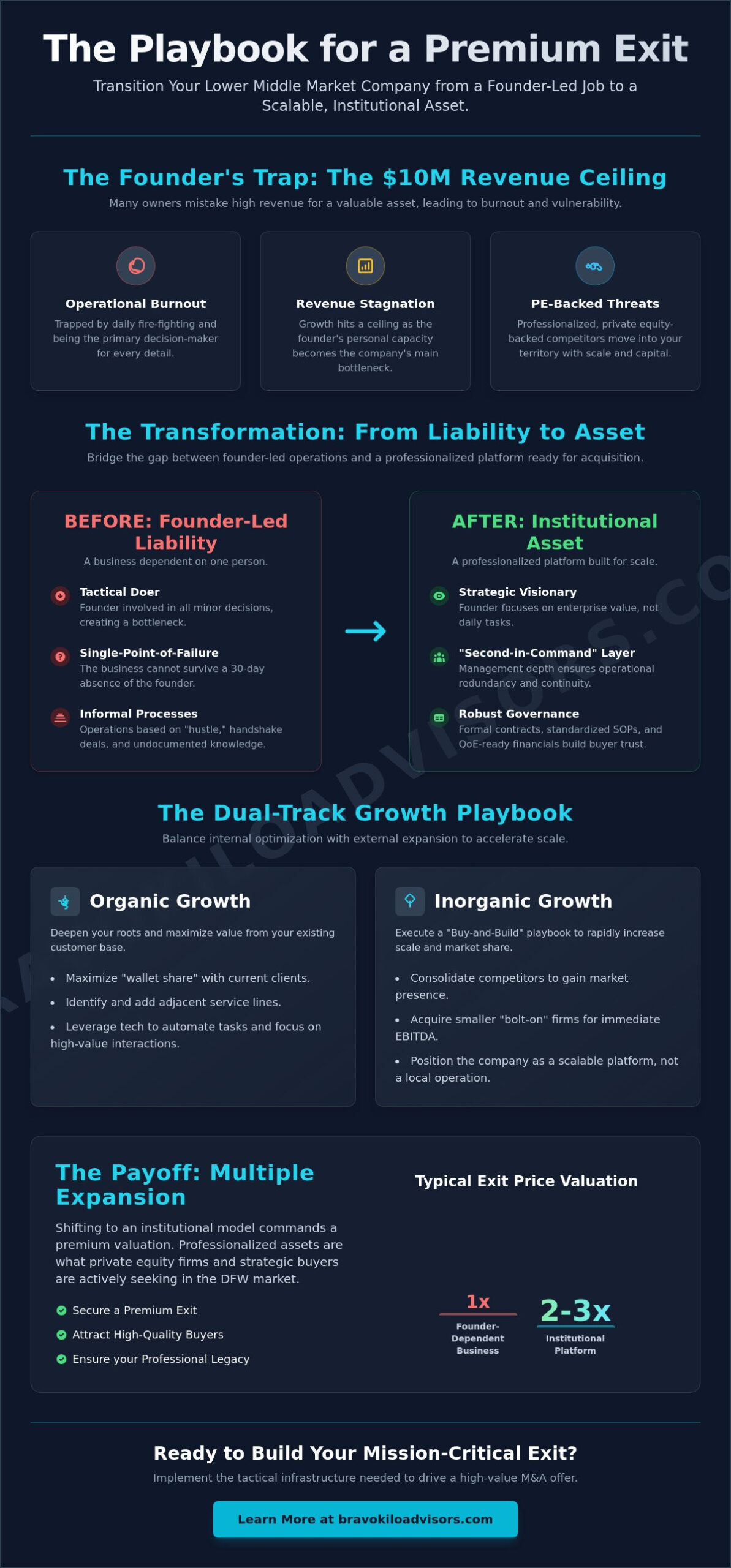
- Understand the mechanics of multiple expansion and how shifting to an institutional model can lead to exit prices 2-3x higher than founder-dependent peers.
- Capitalize on the 2026 DFW M&A market trends, where private equity dry powder remains concentrated on high-quality, professionalized North Texas assets.
- Shift your focus from daily operational fire-fighting to enterprise value enhancement to ensure your business is ready for a mission-critical, premium exit.
The Professionalization Framework: Moving Beyond Founder-Led Growth
Most middle-market companies reach a plateau where the founder’s personal capacity becomes the primary limiting factor. At the $10 million revenue mark, the sheer “hustle” that built the business often starts to break it. You’re no longer just running a company; you’re managing a complex system that requires a different tactical approach. This is the ceiling where founder-led tactics stop working and institutional discipline must take over.
To better understand how these shifts impact valuation and acquisition, watch this helpful video:
Success at this stage demands a “Command Presence” shift. You must transition from a tactical doer to a strategic visionary. This evolution isn’t just about leadership style; it’s a structural necessity. When you remove yourself from every minor decision, you empower your team to operate with the precision of a mission-critical unit. This transition is essential for any effective growth strategies for lower middle market companies focused on long-term value.
Professionalization also requires institutional-grade financial reporting. Buyers and investors look for Quality of Earnings (QoE) readiness long before an exit is on the table. You need transparent, GAAP-compliant data that proves your revenue isn’t just a result of your personal relationships. This data-driven transparency builds the trust necessary for high-level professional negotiations and ensures your financials can withstand the scrutiny of a due diligence team.
Finally, you must eliminate single-point-of-failure risks. A business that depends entirely on its owner is a liability, not an asset. Building a “Second-in-Command” layer provides the operational redundancy needed to ensure the business runs without you. This management depth is exactly what private equity firms look for when they’re hunting for scalable platforms that can grow beyond their current footprint.
De-Risking the Enterprise Through Governance
Your professional legacy deserves the protection of robust governance. This begins by transitioning from informal handshake deals to documented, enforceable contracts. It creates a predictable environment for both employees and customers. Additionally, establishing an advisory board provides the external accountability and specialized expertise that founder-led businesses often lack, offering a calm, battle-tested perspective on strategic decisions.
Operationally, you must standardize your processes. Developing clear SOPs ensures consistency across all your DFW locations. When your operations are documented and repeatable, you create a sense of momentum that is controlled and predictable. This methodical approach is what transforms a local business into an institutional asset ready for a premium exit.
Tactical Growth Strategies: Organic vs. Inorganic Expansion
Scaling a business in the Lower middle market requires a dual-track approach. Organic growth focuses on maximizing “wallet share” within your established North Texas customer base. You achieve this by identifying adjacent service lines that complement your core mission. It’s about deepening roots rather than just spreading wide. In 2026, this process is accelerated by digital transformation. Modern tech stacks now automate high-friction administrative tasks, allowing your team to focus on high-value client interactions rather than data entry.
Inorganic growth offers a more aggressive path through a “buy-and-build” playbook. This strategy involves consolidating competitors to rapidly increase scale and market presence. When evaluating growth strategies for lower middle market companies, many founders overlook the power of tactical acquisitions. By acquiring smaller firms, you can add immediate EBITDA and expand your footprint across the DFW metroplex. Implementing these growth strategies for lower middle market companies ensures your company is viewed as a scalable platform rather than a localized operation.
The Buy-and-Build Strategy for LMM Founders
Identifying “bolt-on” acquisitions requires a disciplined vetting process. You need targets that integrate seamlessly into your existing operations without disrupting the mission. This is where strategic growth consulting becomes a vital asset. Expert guidance helps you avoid the common “integration trap.” Most LMM mergers fail because of cultural misalignment rather than financial shortfall. We ensure that every acquisition is mission-compatible before the first signature is dry.
Optimizing the Sales Engine
Your growth is capped as long as the founder remains the primary salesperson. You must transition to a repeatable, metric-driven sales department. This shift allows you to leverage CRM data to predict revenue with high accuracy. Institutional buyers value predictability. When you can justify higher valuation multiples through data-backed sales forecasts, you move from being a “risky” small business to a reliable platform asset. This methodical transition is a core component of our value enhancement services.
Positioning for Maximum Value in the 2026 DFW M&A Market
Multiple expansion is the ultimate objective of professionalization. By shifting from a founder-dependent model to an institutional asset, you can command exit prices 2-3x higher than your peers. This is particularly true for Lower middle market companies operating in the North Texas corridor. In 2026, the Dallas-Fort Worth region remains a primary target for private equity firms. Over 80% of PE dealmakers report optimism regarding deal volume this year, indicating a massive amount of dry powder ready for deployment into stable, scalable platforms.
Effective growth strategies for lower middle market companies treat exit planning as a continuous growth lever rather than a final event. You want your business to be “bought, not sold.” This means the infrastructure is so robust that buyers approach you with premium offers before you even list. Your current performance is secondary to your future scalability. A buyer isn’t just purchasing your past cash flow; they’re investing in the mission-critical systems you’ve built to sustain that flow without your daily involvement.
The Role of Certified Business Valuations
A certified business valuation acts as your mission’s ultimate scorecard. It provides a baseline that moves beyond guesswork, allowing you to identify “value killers” on your balance sheet long before you reach a Letter of Intent (LOI). By conducting these valuations annually, you can track how your growth strategies for lower middle market companies are impacting your actual enterprise value in real-time. This disciplined approach ensures there are no surprises during the high-pressure environment of due diligence.
Strategic Positioning for Private Equity
In 2026, sophisticated buyers prioritize recurrent revenue, low churn rates, and clean, accessible data. You must craft a narrative that highlights your company as a “Platform” rather than a “Practice.” A practice relies on the owner’s skill; a platform relies on a repeatable system. When you present a business backed by institutional-grade reporting and a capable second-in-command layer, you reduce the buyer’s perceived risk. This transparency allows you to navigate negotiations with integrity and poise, securing the professional legacy you’ve worked decades to build.
Ready to assess your mission readiness? Request a tactical valuation from Bravo Kilo Advisors.
Operationalizing Your Exit Mission
Transitioning from a founder-led business to an institutional asset requires a shift in mindset and a disciplined execution of the playbook we’ve outlined. You’ve seen how professionalizing your infrastructure and balancing organic expansion with tactical acquisitions can drive multiple expansion. In the high-stakes 2026 DFW market, buyers are hunting for platforms that operate with the precision of a mission-critical unit. Implementing these growth strategies for lower middle market companies ensures your business is ready when a premium offer arrives.
Our team brings specialized experience to North Texas M&A transactions ranging from $500,000 to $50 million. With Certified Business Valuators on staff and a success-based advisory model, we prioritize your long-term impact over immediate transactions. We are prepared to navigate the complexities of your transition with the integrity your legacy deserves. Schedule a Strategic Growth Consultation with Bravo Kilo Advisors to begin your assessment. Your mission is our priority, and we’re ready to help you secure the outcome you’ve earned.
Frequently Asked Questions
What is considered a lower middle market company in 2026?
A lower middle market company in 2026 is generally defined by annual revenues ranging from $5 million to $50 million. These businesses have moved past the initial startup phase but haven’t yet reached the scale of large mid-market entities. They represent a critical tier where professionalized leadership and scalable systems become the primary drivers of enterprise value during a transition.
How do growth strategies differ between small businesses and LMM companies?
Small business growth often relies on the founder’s personal hustle and individual sales effort. In contrast, growth strategies for lower middle market companies focus on building a repeatable, metric-driven infrastructure. The goal shifts from owner-dependent revenue to institutional scalability. You’re no longer just growing a job; you’re building a platform that can survive and thrive without your daily tactical involvement.
Why is professionalization the most important growth lever for LMM founders?
Professionalization is the ultimate de-risking tool for potential buyers. If a business cannot function without its owner, it’s a liability rather than an asset. By implementing SOPs, management layers, and transparent reporting, you eliminate single-point-of-failure risks. This shift allows for multiple expansion, often leading to exit prices that are significantly higher than those of unorganized competitors.
Can an LMM company grow through acquisition without taking on excessive debt?
You can pursue inorganic growth without compromising your financial stability by leveraging the 2026 SBA cumulative loan limits of $10 million. Smart growth strategies for lower middle market companies also utilize seller notes and performance-based earn-outs. These tactical structures allow you to consolidate competitors and add immediate EBITDA while keeping your balance sheet lean and mission-ready for a future exit.
How does a North Texas location impact my company’s growth and exit potential?
The DFW metroplex is a primary hub for private equity dry powder in 2026. North Texas companies benefit from a business-friendly environment and high migration rates, making them attractive “platform” targets for institutional investors. This localized demand creates a competitive environment where well-prepared businesses can command premium multiples compared to similar firms in less active markets.
When should I engage a strategic growth consultant versus a traditional business broker?
Engage a strategic growth consultant when your objective is value enhancement and long-term impact before the sale. Traditional brokers are primarily transactional and focus on the exit itself. A consultant provides the battle-tested guidance needed to professionalize your operations and fix “value killers” years before you go to market. This proactive approach ensures your professional legacy is handled with precision.