
Confidentiality is not a legal document; it is a tactical operation that requires a buffer between you and the market. You’ve spent years building your legacy, and the fear that a leak could trigger key employee turnover or give competitors ammunition is a heavy burden to carry. It’s natural to feel anxious about who to trust with your sensitive financials when the stakes are this high. Understanding how to maintain confidentiality when selling a business is the only way to protect your market value in an era where global M&A activity reached 4.8 trillion dollars in 2025. You need more than just a standard non-disclosure agreement to secure your interests during a sensitive transition.
We understand that a high-level exit requires the precision of a mission-critical operation. This guide provides the tactical framework you need to protect your trade secrets and employee morale throughout the process. You will learn our proven plan for phased disclosure and see how a disciplined intermediary maintains a blind market presence to keep your identity secure. We will show you how to move through the sale process with confidence, ensuring your professional legacy remains intact through every stage of the negotiation.
Key Takeaways
- Strategic control of information prevents the “Value Leak” that often leads to employee desertion and customer churn during a transition.
- Implementing a phased disclosure strategy is the most effective way to learn how to maintain confidentiality when selling a business while vetting buyer intent.
- The use of a “Blind Profile” allows you to market your opportunity to a qualified audience without exposing your identity to competitors or the public.
- Professional intermediaries serve as a tactical buffer to manage high-stakes communications and maintain a mission-critical level of operational security.
- Developing a pre-planned contingency strategy ensures you can control the narrative and protect your market value in the event of an unexpected disclosure.
The High Stakes of Secrecy: Why Confidentiality Dictates Your Exit Value
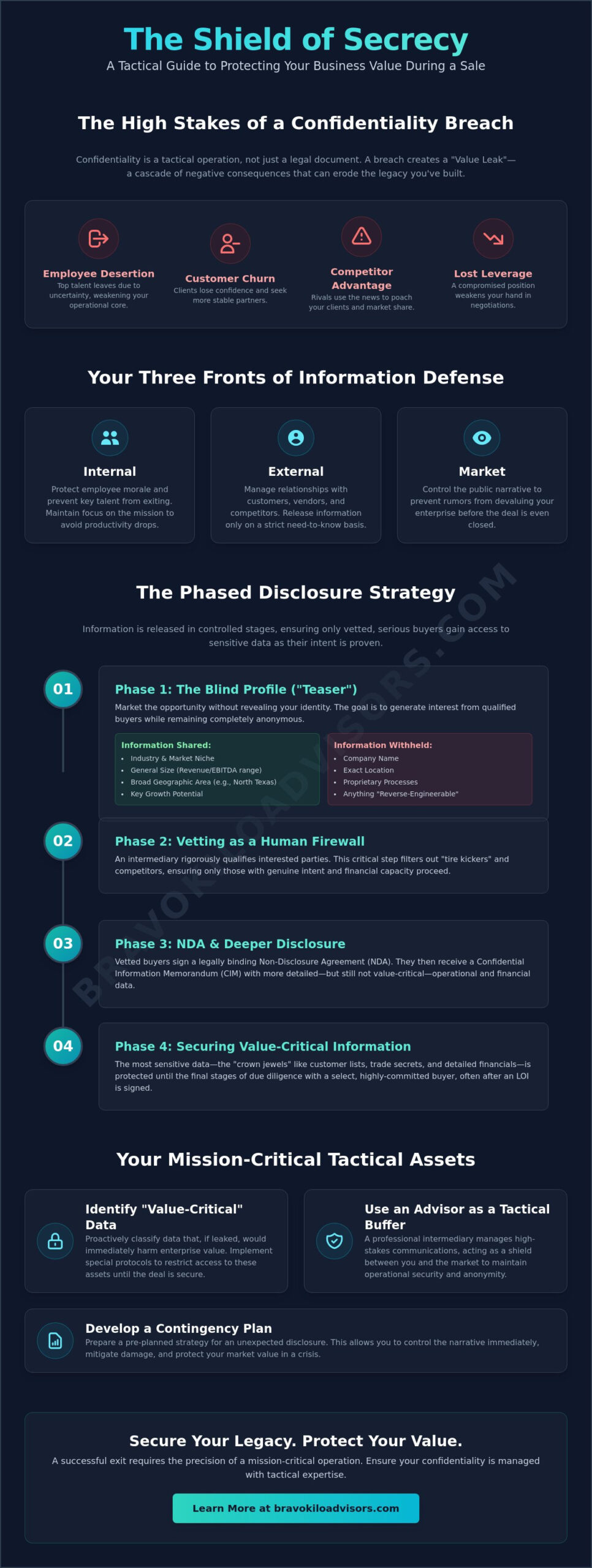
In the high-stakes environment of M&A, confidentiality is the strategic control of information to prevent premature disclosure to your stakeholders. It’s the primary line of defense protecting your life’s work from external interference. If you don’t understand how to maintain confidentiality when selling a business, you risk a “Value Leak” that can be impossible to plug once it starts. A breach in secrecy often leads to immediate employee desertion and customer churn, as uncertainty creates a vacuum that your rivals are happy to fill.
Protecting your competitive edge means preventing North Texas competitors from using your intent to sell as a weapon in their own sales tactics. If a rival knows you’re exiting, they may approach your top accounts with claims of instability or future service disruptions. Maintaining a tight seal also preserves your leverage during negotiations. By keeping multiple buyers in the dark about each other’s identities, you sustain a competitive bidding environment that drives the final price upward.
To better understand this concept, watch this helpful video:
A key component of this defense is the Non-Disclosure Agreement (NDA), which provides the legal framework for your information security. However, legal documents are only one part of a larger tactical rollout. You must also manage how your business is perceived by the broader investment community to ensure your market position remains strong throughout the transition. This requires a command-presence that balances transparency with strategic silence.
The Three Fronts of Information Defense
- Internal: You must keep the mission focused among your employees and management. If the staff feels the ground shifting, productivity drops and talent begins to look for the exit.
- External: This involves managing relationships with customers, vendors, and local competitors. You need a buffer to ensure these parties only receive information on a need-to-know basis.
- Market: Controlling the narrative in the broader market prevents rumors from devaluing your enterprise before you’ve even reached the closing table.
Identifying Your ‘Value-Critical’ Information
Not all data is created equal. You must determine which trade secrets and financial records require the highest level of encryption and restricted access. Value-Critical Information is the data that, if leaked, would immediately reduce the enterprise value. By identifying these assets early, you can implement specific protocols to ensure they’re only shared with vetted, serious parties at the appropriate stage of the operation. This methodical approach ensures that your most sensitive intellectual property stays protected until the deal is secured.
Tactical Safeguards: A Phased Approach to Information Disclosure
Maintaining a strategic advantage requires a methodical operational rollout. You don’t reveal your position all at once. Instead, you employ a phased approach to information disclosure. This ensures that only mission-ready parties gain access to your enterprise data. Learning how to maintain confidentiality when selling a business involves setting up specific checkpoints that a buyer must clear before you move to the next level of transparency. Secrecy is a process, not a promise.
The Blind Profile: Marketing Without a Name
The first step is the Blind Profile, commonly known as the “Teaser.” This document describes your business by industry, general size, and growth potential without making it “reverse-engineerable.” For a firm in the DFW area, we might highlight market share in North Texas and specific EBITDA margins while omitting the exact city or niche proprietary processes. The goal is to balance intrigue with absolute anonymity. You want to attract serious interest while ensuring your identity remains shielded from savvy competitors who might recognize your operational footprint.
Vetting: The Human Firewall
Vetting acts as your human firewall. You must distinguish between “tire kickers” and “mission-ready” buyers early in the engagement. A verified proof of funds is the ultimate confidentiality filter; it ensures the party has the financial capacity to execute the mission before they see a single line of your financials. Bravo Kilo Advisors manages this firewall, protecting your time and your legacy from unqualified inquiries. If you want to ensure your exit remains secure, engaging an intermediary to handle these initial screenings is a critical tactical move.
Once a buyer clears the firewall, you transition to a custom Non-Disclosure Agreement. Don’t rely on boilerplate forms that offer generic protections. Your legal safeguards should be mission-specific, addressing the unique vulnerabilities of your industry and the specific data you’re about to share. Finally, implement phased due diligence. You release sensitive data in controlled stages only as the buyer hits specific commitment milestones. This methodical release of information ensures that even if a deal stalls, the most sensitive parts of your operation remain protected.
Controlling the Narrative: The Advisor as Your Tactical Buffer
Direct owner-to-buyer contact is a high-risk maneuver in the early stages of an M&A transaction. When you engage directly, you risk revealing emotional tells or operational details that a sophisticated buyer can use to erode your valuation. An advisor acts as a tactical buffer, filtering every inquiry and maintaining a methodical, steady pace. This professional distance prevents the sense of urgency or panic that can derail a deal. It ensures that you stay focused on running your enterprise while the sale process moves forward with military precision.
Timing the announcement to your staff is one of the most sensitive phases of the operation. Disclosing the sale too early often triggers a “Value Leak” where key talent begins to seek more stable ground. It’s rarely advisable to inform the broader team before a Letter of Intent (LOI) is signed. In many cases, the announcement is held until the deal is nearly closed. This discipline protects your employee morale and ensures that your internal mission remains the priority until the handover is certain. Understanding how to maintain confidentiality when selling a business means knowing exactly when to speak and when to remain silent.
Contingency Planning for the North Texas Market
The DFW business community is tight-knit; rumors can spread through local industry circles before a single document is signed. You must develop a pre-approved script for unexpected inquiries from local competitors or vendors. This script should be neutral and deflective, ensuring that all external communication flows through a single, disciplined point of contact. If you are considering Hiring a Business Broker in Dallas, TX, ensure they have the command-presence to manage these local pressures without compromising your anonymity.
The Final Handover: Transitioning Confidentiality to the New Owner
As you reach the closing table, your focus shifts to the post-sale environment. You must ensure that the final purchase agreement includes robust post-closing confidentiality clauses to protect your trade secrets and client lists long after the keys are handed over. With new state-level data privacy laws effective as of January 1, 2026, this level of detail is now a core compliance requirement. A disciplined exit planning process protects the legacy of the founder by ensuring that the transition occurs with the same integrity and precision that built the enterprise.
Executing a Secure Exit Strategy
Securing your professional legacy requires more than a simple agreement; it demands a tactical rollout that anticipates every potential leak. You now understand how to maintain confidentiality when selling a business through a phased disclosure framework and the use of a blind market presence. These strategic safeguards prevent value erosion and ensure your internal team remains focused on the mission while you navigate the complexities of the M&A landscape. By controlling the flow of information, you maintain the leverage necessary to drive a successful bidding environment.
Our advisors bring specialized experience in the high-stakes North Texas market and a mission-first attitude to every transition. We provide a proven roadmap for quiet exits, acting as your tactical buffer against competitors and unqualified inquiries. We are prepared to lead you through this transition with the poise and integrity your life’s work requires. We prioritize your long-term impact, ensuring that the transition is as disciplined and successful as the growth of your firm.
Secure your legacy with a confidential consultation from Bravo Kilo Advisors.
You’ve built an enterprise worth protecting. We are ready to help you secure it.
Frequently Asked Questions
Is an NDA enough to protect my business during a sale?
A Non-Disclosure Agreement is a critical legal deterrent, but it’s not a complete security solution. It provides a framework for legal recourse after a breach occurs; however, it cannot physically stop information from leaking once it’s been shared. Effective confidentiality requires operational barriers, such as phased disclosure and strict buyer vetting, to ensure that sensitive data is only released when a buyer has demonstrated significant commitment.
When should I tell my employees that I am selling the business?
You should generally wait until a Letter of Intent (LOI) is signed or even until the deal is nearly closed before informing the broader workforce. Disclosing your intent too early creates a vacuum of uncertainty that often leads to top talent seeking more stable opportunities. We recommend a need to know approach, only involving key management personnel who are essential to the due diligence process under strict secrecy protocols.
How do I prevent my competitors from finding out I’m on the market?
Using an intermediary to manage a blind market presence is the most effective way to keep your identity hidden from rivals. This strategy allows you to market the opportunity based on financial performance and industry metrics without revealing your company’s name or exact location. By filtering all inquiries through a third party, you ensure that local competitors never gain direct access to your intent to sell until you are ready to disclose it.
What happens if a buyer breaches the confidentiality agreement?
If a buyer breaches a confidentiality agreement, you have the right to seek legal remedies, including injunctive relief or monetary damages. This is why a custom NDA is superior to boilerplate forms; it defines specific protections for your trade secrets. While legal action is a fallback, our priority is always prevention through tactical information control, ensuring that the most sensitive data is never exposed to high-risk parties.
Should I use a ‘blind profile’ even if my business is well-known in Dallas?
A blind profile is even more critical for well-known Dallas firms to prevent savvy market participants from reverse-engineering your identity. We focus on describing the enterprise through broad regional metrics and operational scale rather than specific local landmarks or unique niche identifiers. This tactical approach is essential for anyone learning how to maintain confidentiality when selling a business in a tight-knit professional community where rumors can devalue an asset overnight.
Can I sell my business without anyone finding out until after the closing?
Selling a business without public disclosure until after the closing is the standard objective for a professional M&A operation. By utilizing a blind marketing phase and keeping the circle of informed individuals extremely small, you can finalize the transaction before the market or your employees are aware of the change. This methodical approach ensures a stable transition, protecting both your market value and how to maintain confidentiality when selling a business throughout the entire lifecycle of the deal.