
In the high-stakes environment of the Texas middle market, the highest offer on your desk isn’t always the one that puts the most capital in your pocket. You’ve spent years building your legacy, and it’s natural to feel a sense of urgency when faced with complex earn-outs or the threat of a deal-killing due diligence process. We understand that this transition is one of the most significant operations of your professional life. This guide focuses on the tactical realities of negotiating the sale of a business in Texas in 2026, providing the strategic frameworks you need to defend your valuation and secure a clean exit. With private equity firms accounting for 59% of transactions in the $5 million to $50 million range last year, you’re likely facing sophisticated buyers who understand every lever of the deal. We’ll outline how to master local market dynamics, leverage the 2026 franchise tax thresholds, and structure your transaction to minimize post-closing liability. This is your roadmap to maximizing enterprise value while ensuring your employees and your legacy remain protected.
Key Takeaways
- Establish a defensible market value by utilizing professional valuations as your primary tactical tool for defending enterprise worth.
- Prioritize favorable deal structures over top-line price to ensure you maximize the actual cash received at the closing table.
- Identify and neutralize binding traps within Letters of Intent that could compromise your leverage when negotiating the sale of a business in Texas.
- Defend your valuation during the due diligence phase by managing information flow to prevent buyers from attempting to retrade the deal.
- Ensure a mission-critical transition that protects your professional legacy and minimizes post-closing liabilities through disciplined exit planning.
Establishing Your Strategic Baseline: Valuation and Market Readiness
Success in negotiating the sale of a business in Texas begins long before you sit across from a potential buyer. With private equity firms accounting for 59% of transactions in the $5 million to $50 million range, the opposition is highly disciplined. You need a baseline that’s grounded in hard data, not optimism. A professional texas business valuation serves as your primary defensive shield. It transforms your asking price from a subjective wish into a defensible market value. By applying rigorous business valuation methodologies, you identify exactly where your enterprise stands in the 2026 landscape.
To better understand how price and value interact during a deal, watch this helpful video:
Before the first offer arrives, you must address Value Killers. These include messy financial records or heavy owner dependency. Buyers look for these vulnerabilities to justify retrading or lowering the price during due diligence. You should also define your Walk-Away number. Knowing your absolute minimum ensures you maintain control of the mission. This level of preparation is essential when negotiating the sale of a business in Texas in a selective market.
The Role of EBITDA Multiples in North Texas
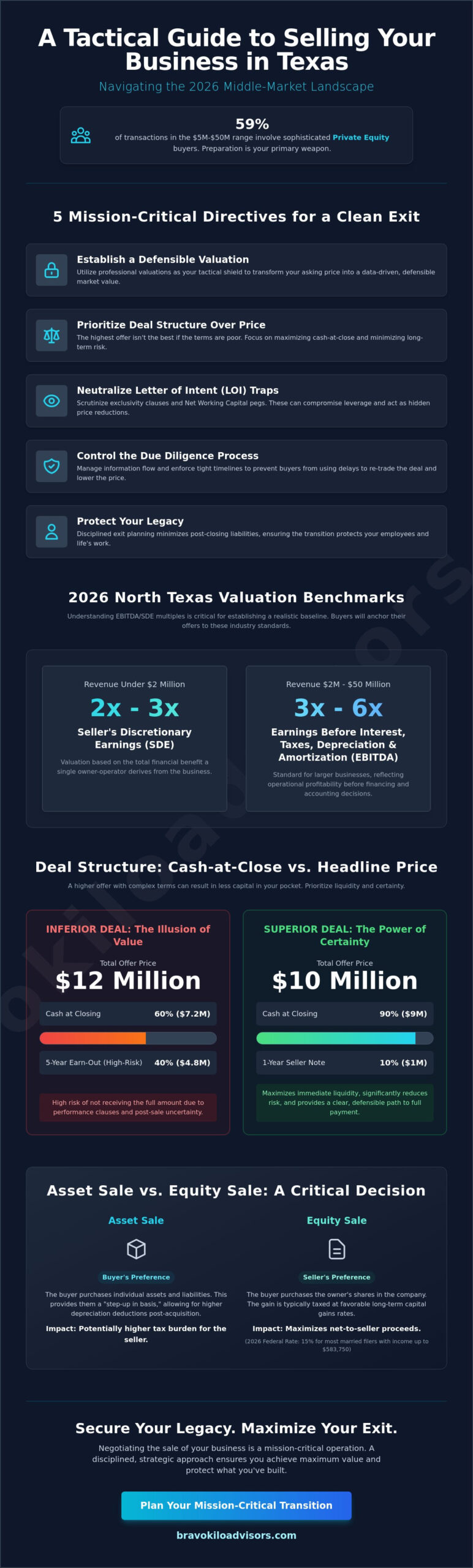
In 2026, DFW industry benchmarks are specific. Businesses with revenue between $2 million and $50 million are typically valued at 3 to 6 times EBITDA. If your revenue is under $2 million, you’re likely looking at 2 to 3 times Seller’s Discretionary Earnings (SDE). We boost your value by normalizing earnings. This process involves adding back one-time costs and personal expenses that won’t continue under new ownership. It’s a tactical move that directly increases your baseline negotiation position.
Assembling Your Tactical Advisory Team
You shouldn’t lead the negotiation of your own legacy. The emotional weight is too high. A proper tactical team includes M&A advisors, CPAs, and legal counsel working in synergy. While we handle the strategic planning and buyer interactions, your CPA ensures financial transparency. This disciplined approach allows you to focus on running the business while we focus on the mission-critical objective: securing maximum enterprise value.
Tactical Negotiation: Moving Beyond Top-Line Price to Deal Structure
Negotiating the sale of a business in Texas requires moving past the vanity of the top-line number. Many owners get blinded by a high offer only to realize later that the terms make the deal untenable. You’ve got to focus on the structure. A lower price with 90% cash at closing is often superior to a higher price that relies on a five-year earn-out or aggressive seller financing. Using effective negotiation strategies means prioritizing liquidity and certainty over theoretical upside.
The Letter of Intent (LOI) is your first major engagement. While most of it is non-binding, exclusivity and confidentiality clauses are enforceable in Texas. You also need to watch the Net Working Capital (NWC) peg. This is the amount of liquidity you’re required to leave in the business accounts. If the buyer sets this peg too high, it acts as a hidden price reduction that can cost you millions at the wire. Balancing risk with upside potential requires a disciplined review of every earn-out trigger and seller note.
Asset vs. Equity Sales in Texas
Your “net-to-seller” depends heavily on the deal structure. Buyers usually prefer asset sales because they get a “step-up in basis” for future depreciation. As a seller, you likely prefer an equity sale to qualify for long-term capital gains tax rates. In 2026, these federal rates remain 15% for most married filers with taxable income up to $583,750. Negotiating the allocation of the purchase price is critical for your final tax efficiency and total enterprise value.
The Power of Exclusivity and Timelines
Exclusivity is a major bargaining chip. When you grant a “no-shop” clause, you’re taking your business off the market. In exchange, you should demand a tight timeline for due diligence. This maintains a tactical rhythm and prevents the buyer from using time as a weapon to “retrade” the price. Our Texas business brokers specialize in managing these timelines to keep the buyer focused on the mission. Maintaining this rhythm is a core component of successfully negotiating the sale of a business in Texas without losing leverage. If you’re feeling overwhelmed by these structural complexities, professional M&A advisory can help you maintain command of the process.
Defending the Deal: Due Diligence and Mission Completion
Due diligence is the most intrusive phase of the operation. We often refer to it as the ‘Proctology Exam’ because buyers will scrutinize every ledger, contract, and employee record. Managing the flow of information is vital to maintaining your leverage. If you release sensitive data too early, you provide the buyer with ammunition to find minor discrepancies. We use a secure virtual data room to release documents in a logical, controlled sequence. This ensures you remain in command of the narrative while negotiating the sale of a business in Texas.
To bulletproof your financials, we often utilize a sell-side Quality of Earnings (QoE) report. This third-party analysis validates the EBITDA baseline we established during the valuation phase. It makes it significantly harder for a buyer to attempt ‘retrading.’ Retrading is a tactical move where a buyer tries to lower the price late in the process based on diligence findings. Your response must be firm and data-driven. If a buyer identifies a legitimate risk, we offer a surgical adjustment rather than a wholesale price reduction. Holding the line during these final hours is what separates a successful exit from a compromised one.
Managing the Emotional Weight of the Exit
Maintaining a ‘Command Presence’ is essential when negotiations become personal or heated. Buyers sometimes use high-pressure tactics to see if a seller will buckle under the emotional weight of the transition. We act as your tactical shield, absorbing the friction so you can stay focused on the objective. Protecting employee and client confidentiality remains mission-critical until the final signatures are secured. A premature leak can destabilize your operations and give the buyer an excuse to devalue the enterprise.
The Final Push: Closing and Transition
The definitive purchase agreement is the final milestone. This document outlines the final adjustments, escrow holdbacks, and specific indemnifications. In Texas, escrow agents serve as neutral third parties to ensure the secure transfer of funds and title. Once the wire is confirmed, your post-closing obligations begin. These typically involve a structured transition period to protect the legacy you’ve built. Hiring a business broker in Dallas provides the specialized experience needed to navigate these high-pressure closing requirements. Successfully negotiating the sale of a business in Texas is a complex mission, but with a disciplined framework, you can secure the enterprise value you deserve.
Secure Your Professional Legacy through Strategic Execution
Successfully negotiating the sale of a business in Texas isn’t about luck; it’s about disciplined preparation and tactical defense. You’ve seen how a certified valuation sets the baseline and why deal structure is the true measure of a successful exit. By anticipating buyer tactics like retrading and managing the information flow during due diligence, you maintain control of the mission from initial assessment to final resolution. This process requires a steady hand and a proven roadmap to ensure no value is left on the table.
At Bravo Kilo Advisors, we specialize in North Texas M&A for enterprises in the $1M to $50M range. Our team of certified business valuation experts brings a mission-first, tactical advisory approach to every engagement. We don’t just facilitate transactions; we protect your legacy with the precision of a mission-critical operation. Secure your legacy with a battle-tested M&A strategy from Bravo Kilo Advisors. You’ve spent years building your business with integrity. We’re here to ensure you navigate this final transition with poise and secure the enterprise value you truly deserve.
Frequently Asked Questions
Is a Letter of Intent (LOI) legally binding in Texas?
Most provisions in a Texas LOI are non-binding, but confidentiality and exclusivity clauses are typically enforceable. These “no-shop” periods prevent you from negotiating with other buyers for a set duration, usually 45 to 90 days. You must ensure the document explicitly identifies which sections are binding to avoid being locked into a deal structure that doesn’t meet your mission objectives.
How long does it typically take to negotiate and close a business sale in DFW?
The standard timeline for negotiating the sale of a business in Texas generally spans six to nine months. This duration accounts for the initial valuation, the marketing phase to identify qualified buyers, and the rigorous due diligence process. Highly prepared sellers with clean financials can sometimes reach the closing table faster, while complex deal structures may extend the operation into a year or more.
What is ‘retrading’ and how can I prevent it during due diligence?
Retrading is a tactical move where a buyer attempts to reduce the purchase price after the LOI is signed by citing risks discovered during due diligence. You can prevent this by conducting a sell-side Quality of Earnings report before the buyer starts their investigation. By identifying and disclosing potential issues early, you remove the buyer’s leverage to chip away at your enterprise value late in the process.
Should I accept an earn-out as part of my business sale negotiation?
You should only accept an earn-out if the guaranteed cash at closing satisfies your primary financial goals and the future targets are objectively measurable. Earn-outs are often used to bridge a valuation gap, but they shift the risk of future performance back onto your shoulders. It’s vital to define exactly how “performance” is calculated to ensure the buyer doesn’t use accounting maneuvers to avoid payment.