
A business valuation isn’t just another box to check on your lender’s list; it’s the tactical foundation of your entire transition. In the fast-moving “Y’all Street” economy of Dallas-Fort Worth, an inaccurate report doesn’t just delay your loan. It can dismantle years of hard-earned equity in a single afternoon. You likely feel the pressure of the SBA SOP 50 10 requirements and the fear that a low appraisal might kill your deal before it even starts. It’s a high-stakes environment where confusion over compliance often leads to unnecessary friction and lost momentum.
This guide provides the strategic clarity you need to secure a business valuation for SBA loan in Dallas that is both defensible and compliant. We’ve designed this briefing to help you manage North Texas acquisitions or exits with the precision of a mission-critical operation. You’ll learn the specific 2026 SBA thresholds, why the income approach is vital for local market accuracy, and how to satisfy your lender’s requirements without sacrificing your business’s true value. We’ll outline a methodical path to ensure your loan approval process remains steady, predictable, and successful.
Key Takeaways
- Identify the specific financial triggers and SBA SOP 50 10 compliance standards that mandate a third-party report in the current North Texas market.
- Master the five-step tactical rollout required to secure a certified business valuation for SBA loan in Dallas that withstands rigorous lender scrutiny.
- Learn how to organize mission-critical intelligence, from interim financials to asset lists, to maintain momentum throughout the loan approval process.
- Discover how a defensible valuation provides the strategic context necessary to protect your professional legacy during a high-stakes business transition.
SBA Business Valuation Requirements in the North Texas Market
A business valuation for SBA loan in Dallas is more than a administrative hurdle; it is a defensive perimeter for your capital. It serves as a formal, defensible assessment of a business’s fair market value, strictly governed by SBA Standard Operating Procedures (SOP) 50 10. In the 2026 economic landscape, DFW lenders have intensified their scrutiny of these reports. With the Texas Stock Exchange now in full operation and Dallas ranking second in the U.S. for financial services jobs, the local “Y’all Street” environment demands a level of precision that national, generalized reports cannot match. A properly executed valuation acts as a critical risk mitigation tool, ensuring the buyer doesn’t overpay while protecting the lender’s collateral position.
To better understand this concept, watch this helpful video:
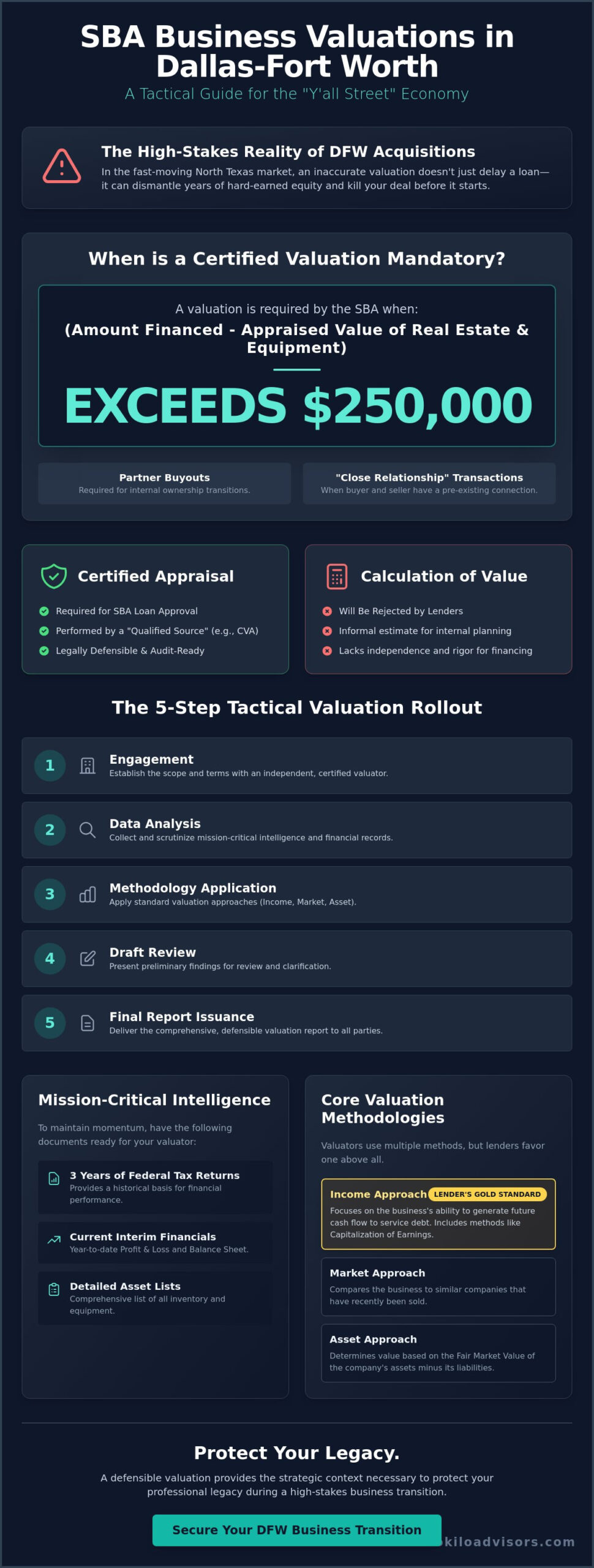
There is a sharp distinction between a “calculation of value” and a “certified appraisal.” A calculation is an informal estimate often used for internal planning, but it will not satisfy SBA compliance. For a loan to move toward closing, the SBA requires a report from a “qualified source,” typically a Certified Valuation Analyst (CVA). This professional must utilize standardized business valuation methods to provide a conclusion of value that is both objective and audit-ready. Using an uncertified report is a tactical error that leads to immediate rejection by the lender’s underwriting team.
Mandatory Triggers: When Does the SBA Require a Certified Valuation?
The SBA mandates a third-party business valuation whenever the amount financed, minus the appraised value of real estate and equipment, exceeds $250,000. In the current DFW market, where industrial leasing hit a record 18.5 million square feet in Q1 2026, very few commercial transactions fall below this threshold. You will also trigger this requirement during partner buyouts or any transaction involving a “close relationship” between buyer and seller. While SBA 7(a) loans for working capital focus heavily on cash flow, SBA 504 loans for real estate require a specialized approach that balances the business’s operating value against its hard assets.
To ensure your application meets these rigorous financial benchmarks, Koval Investments provides strategic credit repair and 0% interest funding solutions that can help optimize your profile before the lender’s final review.
The Role of Goodwill in Dallas Business Acquisitions
In high-growth sectors like advanced manufacturing and life sciences, “Blue Sky” or goodwill often represents the majority of the transaction’s value. SBA lenders in North Texas view these intangible assets through a lens of sustainability. They want to see that the goodwill is tied to the business’s systems and brand, not just the outgoing owner’s personal relationships. For a business valuation for SBA loan in Dallas to be successful, it must clearly articulate how this goodwill translates into future cash flow, especially as local job growth continues to outpace national averages.
The SBA Valuation Process: Standards, Methods, and Credentials
Executing a business valuation for SBA loan in Dallas requires a disciplined, multi-step rollout. This process isn’t a mere calculation; it’s an objective interrogation of a company’s financial health. To remain defensible, the valuator must maintain an “independent” status, meaning they have no financial interest in the transaction’s outcome. This independence ensures that the final report stands up to the rigorous audit standards of federal underwriters. For larger DFW transactions in 2026, lenders often expect a Quality of Earnings (QoE) analysis alongside the valuation to verify that the reported income is sustainable and free of accounting anomalies.
The process begins with the collection of mission-critical intelligence. You’ll need to provide three years of federal tax returns, current interim financial statements, and a detailed list of inventory and equipment. Once this data is secured, the valuator moves through a tactical five-step sequence: engagement, data analysis, methodology application, draft review, and final report issuance. Maintaining this methodical rhythm is the only way to ensure the loan approval process stays on schedule without last-minute requests for additional documentation.
Common Valuation Methodologies: Income, Market, and Asset Approaches
Lenders typically view the Income Approach, specifically the Capitalization of Earnings or Discounted Cash Flow method, as the gold standard. This method focuses on the business’s ability to generate future cash flow to service the debt. We also utilize the Market Approach to validate these numbers, comparing your business against recent North Texas transaction data. In Dallas, Seller’s Discretionary Earnings (SDE) multiples generally range from 1.5x to 5.0x, depending on the industry’s stability. While the Asset-Based approach is less common for healthy firms, it becomes a necessary fallback for capital-intensive operations or distressed scenarios as outlined in the SBA Standard Operating Procedures.
Qualified Valuator Credentials: Who Can Sign the Report?
The SBA is specific about who constitutes a “qualified source.” The report must be signed by an appraiser holding recognized designations such as Certified Valuation Analyst (CVA), Accredited in Business Valuation (ABV), or Accredited Senior Appraiser (ASA). Relying on an uncertified broker’s opinion is a high-risk move that often leads to deal-killing delays. A certified business valuation provides the command presence needed to clear lender review quickly. When a report carries the weight of professional credentials, it signals to the bank that the numbers are backed by disciplined, ethical standards rather than transactional bias.
Securing Your DFW Business Transition with Bravo Kilo Advisors
Bravo Kilo Advisors treats every engagement like a mission-critical operation. We don’t just hand over a PDF; we provide the strategic context that North Texas entrepreneurs need to defend their professional legacy. In a market as competitive as Dallas, where corporate relocations and a 22 percent growth in financial services continue to drive demand, your valuation needs to be more than a set of calculations. It must be a tactical asset that withstands the most rigorous lender interrogation. Our process ensures that every conclusion is backed by market data and disciplined analysis.
Integrating a business valuation for SBA loan in Dallas into your broader exit planning or acquisition strategy ensures that you aren’t flying blind. By Understanding Business Valuation drivers, you can identify exactly which levers to pull to maximize your market position before the deal reaches the finish line. Our commitment is to provide disciplined, mission-first advisory that prioritizes long-term impact over immediate transactional wins. We act as your elite consultants, navigating the complexities of high-level negotiations with integrity and poise.
Flat-Fee Certified Valuations for SBA Loans
Transparency is a core tenet of our operational rhythm. We offer a flat-fee structure for professional Texas business valuation reports. This eliminates the uncertainty of escalating costs during the sensitive due diligence phase. You can expect a final briefing that serves as a comprehensive, defensible market value report, ready for immediate submission to your SBA lender. This report provides the “command presence” necessary to move through underwriting without the frantic energy often associated with uncertified assessments.
Strategic Growth and Value Enhancement in North Texas
Your valuation is the baseline for future strategic growth consulting. Whether you are acquiring a competitor in the DFW life sciences sector or preparing to exit a manufacturing firm, knowing your true market value allows for precision planning. We help you position your business for a successful mission outcome. By identifying value gaps early, we ensure that your business transition is handled with the precision and focus your professional legacy deserves. We remain focused on the objective: a smooth, predictable path to your next professional chapter.
Executing Your Strategic Transition in North Texas
Securing a compliant business valuation for SBA loan in Dallas is a critical maneuver that requires precision and a command of local market dynamics. You’ve seen how the $250,000 threshold and the shift toward Quality of Earnings analysis have redefined the underwriting landscape in 2026. Successfully navigating these requirements isn’t just about satisfying a lender’s checklist; it’s about protecting the professional legacy you’ve built in the DFW metroplex. A defensible, certified report ensures that your acquisition or exit remains on a predictable path toward victory.
Our team brings battle-tested advisory to every engagement, handling complex deals up to $50 million with the focus of a mission-critical operation. We hold the necessary CVA and ABV credentials to provide the high-stakes authority your lender demands. We don’t just provide numbers; we deliver the strategic clarity needed to secure your future. Secure your mission-critical business valuation with Bravo Kilo Advisors today. Your transition deserves the discipline and expertise of a partner who understands the weight of your professional journey. Let’s ensure your mission is a success.
Frequently Asked Questions
Do I really need a certified valuation for an SBA loan under $250,000?
The SBA typically only mandates a third party valuation when the loan amount, minus real estate and equipment value, exceeds $250,000. However, transactions involving partner buyouts or “close relationships” between buyers and sellers often trigger this requirement regardless of the deal size. Even for smaller loans, your lender may exercise their discretion to request a certified report to mitigate risk. It’s best to confirm the specific mission parameters with your financial institution early in the process.
How long does the SBA business valuation process typically take in Dallas?
A certified business valuation for SBA loan in Dallas usually requires 10 to 15 business days once all mission critical documents are secured. This timeline depends heavily on the speed of data collection, including three years of tax returns and interim financials. Delays often occur when documentation is incomplete or inconsistent. We recommend starting this phase as soon as the letter of intent is signed to maintain the momentum of your transaction.
Can a low business valuation kill my SBA loan application?
A valuation that comes in below the purchase price can stall or terminate a deal if the lender determines the collateral is insufficient. This is why a defensible, well reasoned report is vital for your acquisition strategy. If the value is low, you may need to renegotiate the purchase price or increase your equity injection to bridge the gap. Our objective is to provide a report that accurately reflects market value while satisfying the SBA’s rigorous underwriting standards.
What is the difference between a business broker’s estimate and a certified valuation?
A broker’s estimate is a transactional tool used to set a listing price, whereas a certified valuation is a formal, defensible document required for compliance. Brokers often use a Broker Opinion of Value (BOV) based on general market trends. In contrast, a certified report is signed by a credentialed analyst using standardized methodologies. SBA lenders won’t accept a broker’s estimate; they require the command presence and objectivity of a qualified third party appraiser.