
The structure of your exit is a tactical maneuver that dictates who keeps the risk and who keeps the cash at the closing table. Deciding on an asset sale vs stock sale for Texas business entities is not a mere administrative detail. It is a high-stakes decision with long-term consequences for your net proceeds. You’ve spent years building a legacy in North Texas, and the last thing you want is for that effort to be eroded by avoidable double taxation or lingering tail liabilities.
We understand that the complexity of M&A terminology can feel like a minefield when you’re trying to secure your financial future. This guide provides the strategic clarity you need to master these tactical differences, ensuring you maximize your cash at closing while protecting your transition. We’ll break down the 2026 tax landscape, analyze the impact of the $2,650,000 Texas franchise tax threshold, and outline a proven roadmap for realizing your maximum enterprise value with a clean, decisive break.
Key Takeaways
- Distinguish between hand-picking specific assets and transferring your entire corporate entity to ensure the deal structure supports your desired level of post-sale liability.
- Analyze the specific tax consequences of an asset sale vs stock sale for Texas business owners to prevent double taxation from eroding your hard-earned net proceeds.
- Recognize why buyers prioritize the “step-up” in basis and how you can leverage their future depreciation benefits to negotiate a higher enterprise value.
- Master the tactical application of the 338(h)(10) election to bridge the gap between conflicting buyer and seller objectives during high-stakes negotiations.
- Prepare for the demands of different buyer profiles by aligning your operational history with the preferred acquisition structures of private equity and strategic acquirers.
The Tactical Difference: Defining Asset vs. Stock Sales for Texas Owners
Every business exit is a tactical operation. The specific structure you choose dictates who carries the liability and who captures the ultimate value at the closing table. When evaluating an asset sale vs stock sale for Texas business entities, you are essentially choosing between a surgical extraction of value and a complete transfer of command. In an asset sale, the buyer hand-picks specific equipment, inventory, and goodwill while leaving the corporate shell behind. This allows the buyer to avoid the “skeletons” of your company’s past, but it often leaves the seller with the task of winding down the remaining entity.
Conversely, a stock sale involves the buyer stepping into your shoes. They acquire the entire entity, including its history, contracts, and potential liabilities. For North Texas owners, this distinction is the primary factor in determining your final net-at-close figure. Buyers and sellers almost always have opposing structural preferences because their mission objectives differ. Sellers typically want a clean break and capital gains treatment, while buyers want to minimize risk and maximize future tax deductions.
The Mechanics of an Asset Sale in the Lone Star State
This structure requires a precise identification of “Specified Assets” versus “Excluded Assets” within the purchase agreement. It’s a common maneuver in the DFW middle market because it offers the buyer a “clean slate” advantage. Because the entity itself does not change hands, Texas Secretary of State filings differ from a standard merger. The buyer creates a new entity to house the acquired assets, which can simplify their post-acquisition integration but adds complexity to the seller’s exit checklist. This structure is often used when a buyer wants to avoid specific legacy issues or when the business has significant “tail” liabilities that the buyer refuses to assume.
The Continuity of a Stock Sale
A stock sale transfers ownership interests, such as shares or membership units, without disrupting daily operations. This is the preferred route in mergers and acquisitions where preserving valuable contracts, permits, or licenses is mission-critical. Strategic acquirers in the Dallas-Fort Worth area frequently opt for this path to maintain seamless momentum. Recent 2025 amendments to the Texas Business Organizations Code (TBOC) have further streamlined this process. These updates codified the “business judgment rule” and expanded liability protections for corporate officers. These legislative shifts make Texas an even more attractive jurisdiction for entity-level transfers, provided the buyer is satisfied with the results of their due diligence.
Financial Maneuvers: Comparing Tax Impacts and Liability Shields
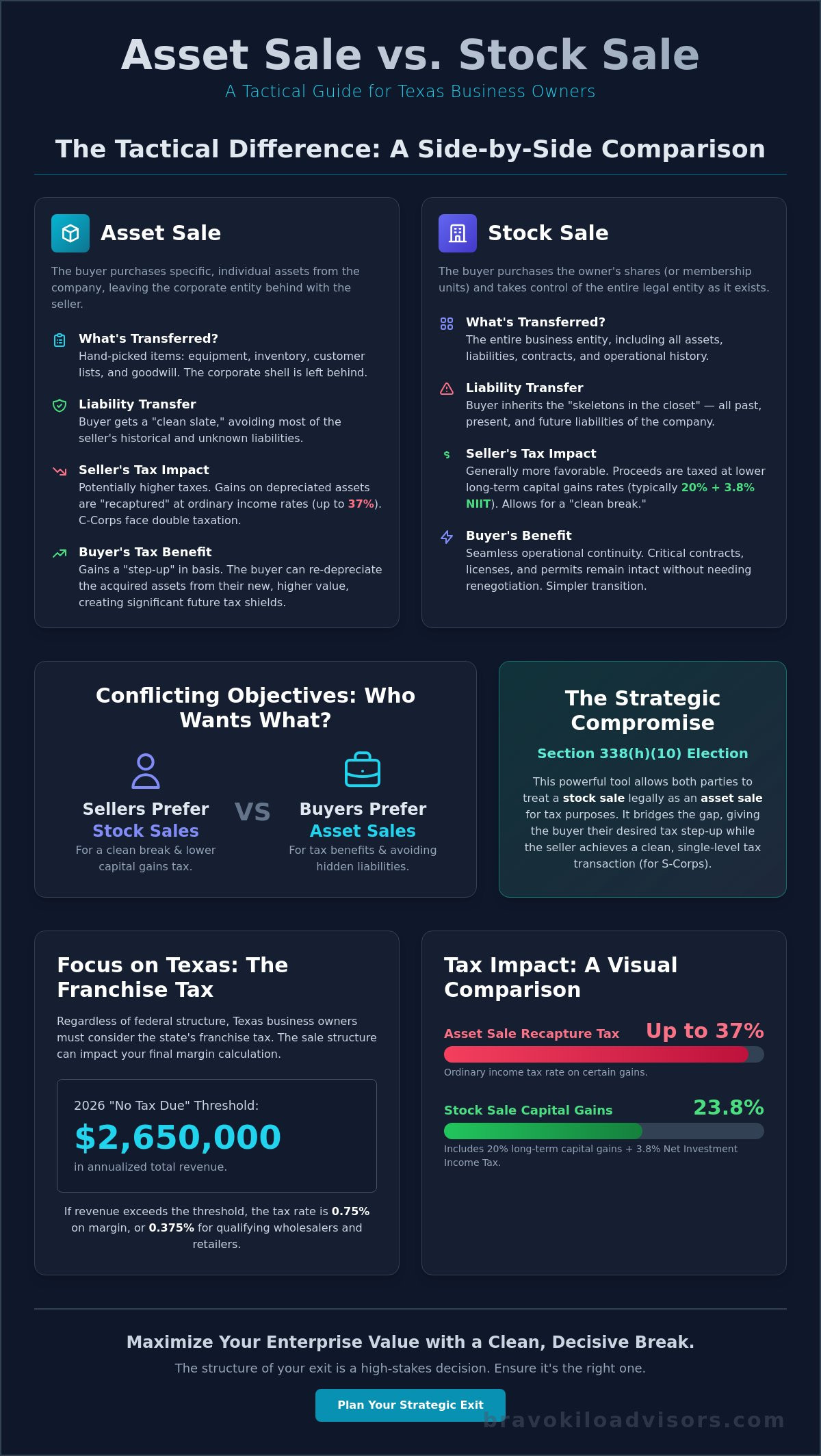
Financial outcomes are rarely about the top-line number alone. They’re about what you keep after the mission is complete. When weighing an asset sale vs stock sale for Texas business operations, the financial delta often comes down to tax erosion. In an asset sale, buyers often pay a premium because they receive a “step-up” in basis. This allows them to re-depreciate assets at their current fair market value, creating significant future tax shields. For the seller, however, this structure can trigger “recapture” taxes at ordinary income rates, which in 2026 can reach as high as 37% for specific asset classes.
Understanding these Asset Sale vs. Stock Sale: Key Differences is essential for protecting your net proceeds. Texas owners must also account for the Texas Franchise Tax, which remains a factor regardless of federal status. For 2026, the “no tax due” threshold is $2,650,000 in annualized total revenue. If your entity exceeds this, the structure of your sale will impact your final margin calculation and the resulting 0.75% tax rate, or 0.375% for retail and wholesale businesses.
The Seller’s Tax Strategy
The “Tax Gap” represents the difference between the gross purchase price and your actual net-at-close. A higher offer for an asset sale might result in less cash in your pocket than a lower-priced stock sale due to federal long-term capital gains rates, which for high-income filers in 2026 sit at 20% plus the 3.8% Net Investment Income Tax. Utilizing a professional Texas business valuation is a critical defensive step to justify your preferred deal structure during negotiations. While S-corporations generally avoid double taxation by passing gains through to shareholders, C-corporations in an asset sale face taxation at both the corporate level and the individual level upon distribution.
Shielding Your Legacy from Liability
Asset sales act as a primary defensive shield. They allow you to extract value while leaving most “tail” liabilities with the original corporate entity. However, Texas courts sometimes apply successor liability theories if the transaction is deemed a “de facto” merger or a mere continuation of the seller. To mitigate this, many sophisticated DFW deals now utilize Representations and Warranties (R&W) insurance. This tool transfers the risk of unintentional breaches to an insurer, allowing for a cleaner exit and more secure proceeds. If you’re ready to evaluate your specific exit options, our M&A Advisory team can help you model these scenarios with precision.
Strategic Selection: Which Structure Wins in the North Texas Market?
Selecting the right path depends heavily on the profile of your potential acquirer. Private equity firms generally demand asset sales to secure the tax benefits of depreciation, while strategic buyers may prioritize stock sales to ensure operational continuity. When navigating the choice between an asset sale vs stock sale for Texas business owners, you must also consider the “338(h)(10) election.” This tactical middle ground allows the transaction to be treated as a stock sale for legal purposes while being taxed as an asset sale. It is a complex maneuver that can bridge the gap when a buyer insists on a “step-up” in basis, but the seller requires a simplified legal transfer.
Operational red tape often dictates the pace of a deal in the DFW area. Stock sales typically involve less friction with vendors and landlords because the corporate entity remains intact. In contrast, asset sales require the assignment of individual contracts, which can trigger “change of control” clauses. According to Texas law on asset sales, specific franchise tax implications can also shift depending on how the entity’s margin is calculated post-sale. A seasoned business broker in Dallas, TX ensures these structural nuances are leveraged to protect your enterprise value rather than becoming obstacles.
Assessing Deal Complexity and Speed
Contract assignability is a hidden hurdle in many North Texas transactions. If your business holds government or healthcare contracts, an asset sale may trigger a lengthy re-certification process that delays your exit. Employee transitions also differ significantly. In an asset sale, the buyer must technically “re-hire” your staff, which can create anxiety and cultural friction. A stock sale avoids this disruption, allowing for a seamless transition of the mission-critical personnel who drive your company’s value.
Finalizing Your Exit Strategy
You must integrate your preferred structure into your Texas exit strategy long before an Letter of Intent (LOI) arrives. Waiting until the negotiation phase to address the asset sale vs stock sale for Texas business dilemma leaves you vulnerable to “re-trading” by the buyer. Maintaining a command presence at the table requires knowing exactly which liabilities you are willing to retain and which tax hits you can absorb. To ensure your legacy is protected and your proceeds are maximized, contact Bravo Kilo Advisors for a strategic assessment of your deal structure today.
Mastering the Final Maneuver of Your Business Transition
Your business is the result of years of disciplined effort. Protecting that legacy requires a command of the structural nuances that define a successful exit. Whether you prioritize the liability shield of an asset transfer or the operational continuity of a stock acquisition, the decision on an asset sale vs stock sale for Texas business must be made with tactical precision. Each structure presents unique challenges for your final net proceeds, from depreciation recapture to Texas franchise tax calculations. Success is not just about the gross offer; it’s about the cash you keep when the mission is complete.
Bravo Kilo Advisors brings a mission-first approach to every engagement. We specialize in DFW middle-market transactions ranging from $500,000 to $50,000,000. By utilizing Certified Business Valuations, we establish a defensible market position that withstands the pressure of intense negotiations. Secure your legacy with a strategic M&A assessment from Bravo Kilo Advisors to ensure your transition is handled with the integrity and expertise it deserves. You’ve done the hard work of building a company; now it’s time to execute a clean and profitable resolution.
Frequently Asked Questions
Is an asset sale or a stock sale better for a seller in Texas?
Stock sales are generally better for sellers because they minimize tax erosion and provide a definitive break from the company’s historical liabilities. This structure allows you to treat the entire gain as a long-term capital gain, which is taxed at a maximum federal rate of 20% for high earners in 2026. Asset sales often trigger higher taxes due to depreciation recapture, which can be taxed at ordinary income rates up to 37%.
Do I pay Texas Franchise Tax on a business sale?
Most Texas entities must file a franchise tax report during the year of a sale. For 2026, your business owes no franchise tax if its annualized total revenue is at or below $2,650,000. If your revenue exceeds this threshold, you’ll pay a standard rate of 0.75%, or 0.375% for retail and wholesale businesses, based on the entity’s margin. The sale structure directly impacts how this final margin is calculated.
What happens to my employees in an asset sale vs. a stock sale?
In a stock sale, the employer-employee relationship remains unchanged because the buyer acquires the existing corporate entity. Asset sales are more operationally complex; the buyer technically re-hires the staff after the seller terminates their employment. This requires new employment agreements, I-9 verifications, and benefits enrollments. Managing this transition with a command presence is vital to prevent key personnel from departing during the handover.
Can I change from an asset sale to a stock sale during negotiations?
You can change the deal structure, but it usually results in a significant re-valuation of the purchase price. Shifting the asset sale vs stock sale for Texas business strategy late in the mission requires precise financial modeling to offset the buyer’s lost tax benefits. Buyers typically demand a price discount in a stock sale to compensate for the fact they cannot “step-up” the basis of the assets for future depreciation.