
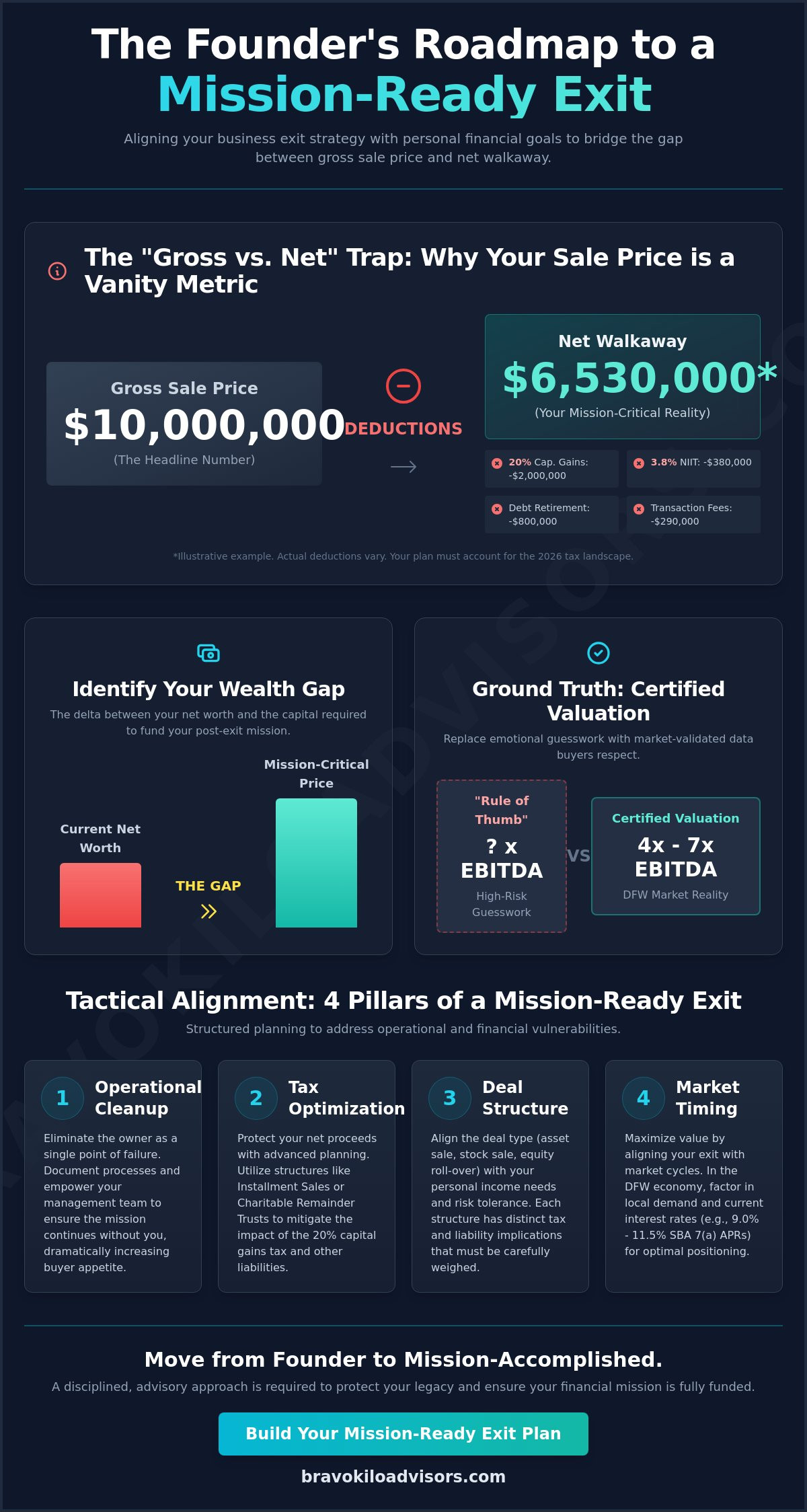
Your gross sale price is a vanity metric that often hides a mission-critical failure. If you haven’t accounted for the 2026 long-term capital gains rate of 20% or the 3.8% Net Investment Income Tax, that impressive headline number can quickly dissolve. You’ve spent years building a company, yet the fear of leaving money on the table or miscalculating your net walkaway remains a persistent source of pressure. It’s a common challenge for founders who realize that enterprise value and personal needs aren’t always in sync.
Success requires a shift from a transactional mindset to a disciplined, advisory approach. By aligning business exit strategy with personal financial goals, you can bridge the gap between what your business is worth and what your future life requires. This briefing provides a roadmap for a tax-efficient exit that protects your legacy and ensures your financial mission is fully funded. We’ll examine how current 4 to 7x EBITDA multiples impact your trajectory and provide the tactical steps needed to move from a gross valuation to a secure, long-term reality.
Key Takeaways
- Define your wealth gap by calculating the exact capital required to fund your post-exit mission and legacy.
- Identify how a professional valuation serves as the mandatory first step in building a mission-ready transition plan.
- Master the process of aligning business exit strategy with personal financial goals to bridge the gap between gross sale price and net walkaway.
- Learn tactical operational cleanup strategies that eliminate the owner as a single point of failure, significantly increasing buyer appetite.
- Understand the role of an M&A advisor in coordinating your advisory team to ensure a controlled and predictable rollout.
The Wealth Gap: Identifying Your Personal Financial Mission Objective
Many founders operate under a tactical fog, assuming their enterprise value will automatically cover their lifestyle. This is a dangerous assumption that often leads to mission failure. The Wealth Gap is the specific delta between your current liquid net worth and the total capital required to fund your post-exit mission. Aligning business exit strategy with personal financial goals starts by identifying this objective with surgical precision before you ever engage a buyer.
Don’t fall into the “Gross vs. Net” trap. A high headline sale price is meaningless if it doesn’t meet your net walkaway requirements. After accounting for the 2026 long-term capital gains tax of 20 percent, the 3.8 percent Net Investment Income Tax, debt retirement, and transaction fees, your actual proceeds may be significantly lower than expected. You must establish a “Mission-Critical Price,” which is the non-negotiable floor required to sustain your family legacy and future objectives without compromise.
To better understand this concept, watch this helpful video:
The Role of Certified Valuations in Mission Planning
“Rule of thumb” estimates are a tactical failure in high-stakes M&A negotiations. In the DFW Metroplex, market multiples currently range from 4 to 7x EBITDA for most lower-middle-market industries, but these figures shift based on your specific operational health. A certified Texas business valuation provides the ground truth needed for comprehensive exit planning. An objective valuation is the only defensible starting point because it replaces emotional guesswork with market-validated data that buyers will actually respect.
Calculating Your Post-Exit Burn Rate
You must translate your projected enterprise value into sustainable annual income. Using a standard framework like the 4 percent rule, a $5 million net walkaway provides $200,000 in annual liquidity. In the 2026 economic landscape, your plan must account for persistent inflation and rising healthcare costs. This ensures your capital remains resilient against market volatility while supporting your lifestyle for thirty years or more.
Tactical Alignment: 4 Pillars of a Mission-Ready Exit Strategy
Achieving a successful transition requires more than just finding a buyer. It demands a structured exit plan that addresses both operational and financial vulnerabilities. Aligning business exit strategy with personal financial goals ensures that every tactical decision made inside the business serves your final mission objective.
- Step 1: Operational Cleanup. Buyers discount businesses where the owner is the single point of failure. You must document processes and empower a management team to ensure the mission continues without you.
- Step 2: Tax Optimization. Protecting your net proceeds requires advanced planning. Utilizing structures like Installment Sales or Charitable Remainder Trusts can mitigate the impact of the 20% capital gains rate.
- Step 3: Deal Structure Alignment. Choosing between an asset sale, stock sale, or equity roll-over depends on your personal income needs. Each has distinct tax and liability implications.
- Step 4: Market Timing. The DFW economy remains a high-demand environment. Aligning your exit with local market cycles and current interest rates, such as the 9.0% to 11.5% APR seen on SBA 7(a) loans in May 2026, is critical for maximizing value.
Maximizing Enterprise Value Through Strategic Growth
Value killers often hide in plain sight within your financial statements. Inconsistent margins or high customer concentration can erode your multiple during due diligence. When you identify a shortfall in your wealth gap, strategic growth consulting can help bridge that delta. Focused value enhancement initiatives can add significant enterprise value in as little as 18 to 24 months. If your current valuation doesn’t meet your mission objective, you may need a tactical pivot before going to market.
Choosing the Right Buyer for Your Legacy
Strategic buyers may offer the highest price, but Private Equity firms might provide better terms for your existing team. You must evaluate the emotional impact of staying on post-sale. A three-year earn-out might provide more total capital, but it could conflict with your personal freedom goals. Selecting the right partner is about more than the check; it’s about ensuring your legacy remains intact after you’ve completed the transition.
Execution Strategy: Moving from Founder to Mission-Accomplished
Execution is the phase where strategy meets the hard reality of the market. An M&A advisor acts as your tactical lead during this process; they coordinate the efforts of your legal, tax, and financial teams to ensure no detail is overlooked. This unified front is essential for aligning business exit strategy with personal financial goals. Without a central point of command, individual advisors may work at cross-purposes, which often leads to tax inefficiencies or deal structures that fail to support your long-term mission.
The Bravo Kilo approach treats your exit as a high-stakes operational rollout. We prioritize mission-first advisory over simple transactional brokerage. This involves ensuring your buy-sell agreements and estate plans are perfectly synchronized with the final deal structure. For example, with the 2026 federal estate tax exemption set at $15 million per individual, your exit must be structured to leverage these thresholds before the transition is finalized. A failure to synchronize these elements can result in significant capital leakage that compromises your legacy.
Beyond the spreadsheets, you must prepare for the emotional weight of the transition. Many founders experience an identity crisis once the mission is accomplished. Moving from a position of daily command to a post-exit life requires as much mental preparation as the financial side of the deal. We provide the steady, methodical guidance needed to navigate these professional transitions with integrity and poise.
Assembling Your Elite Advisory Team
The “Big Three” consists of your M&A advisor, your CPA, and your Wealth Manager. These professionals must remain in constant communication to protect your net walkaway. You must avoid the “Transactional Trap,” where advisors prioritize the closing of the deal over your long-term financial health. True success is measured by the impact of the capital on your life after the ink has dried, not just the speed of the transaction.
The 12-Month Countdown
A successful rollout in the North Texas market requires a steady, methodical pace. The best time to plan an exit is when you don’t yet need to sell.
- Months 12-10: Secure a certified valuation and identify your specific wealth gap.
- Months 9-7: Execute operational cleanups and finalize tax optimization strategies to protect the net.
- Months 6-4: Prepare marketing materials and begin confidential buyer identification and screening.
- Months 3-0: Manage the due diligence process and synchronize estate planning with the expected proceeds.
Securing Your Post-Exit Mission Objective
You have identified the wealth gap and established the four pillars of tactical alignment. Now, the focus shifts to the final rollout. Aligning business exit strategy with personal financial goals is more than a financial calculation; it is a mission-critical operation designed to protect your professional legacy. By moving from a founder mindset to a mission-accomplished reality, you ensure that your net walkaway matches your future requirements.
Bravo Kilo Advisors provides battle-tested M&A advisory specifically for North Texas founders navigating $500k to $50M enterprise value transactions. We utilize Certified Business Valuations to provide a defensible market position, ensuring your business is ready for the scrutiny of sophisticated buyers. Our approach prioritizes your long-term impact over immediate, transactional results. Don’t leave your final transition to chance or uncoordinated advice.
Secure your legacy with a strategic exit briefing from Bravo Kilo Advisors. Your next objective is within reach; let’s execute the plan together.
Frequently Asked Questions
How far in advance should I start aligning my exit strategy with my financial goals?
You should begin the alignment process three to five years before your desired exit date. This lead time is essential for a controlled transition. It allows you to execute value enhancement services that bridge any identified wealth gap. Aligning business exit strategy with personal financial goals early ensures you can time the market rather than reacting to it. It provides the runway needed to maximize your multiple before the final rollout begins.
What is the most common mistake DFW business owners make during an exit?
The most frequent error is conflating the gross sale price with the net walkaway amount. DFW owners often overlook the impact of debt retirement and transaction fees on their final liquidity. Without a certified valuation, many enter negotiations with an inflated sense of value. This lack of precision often leads to a failure in meeting the mission-critical price required for their post-exit lifestyle. It’s a tactical failure that jeopardizes your long-term retirement security.
Can I sell my business if I still have a significant “Wealth Gap”?
You can sell with an existing wealth gap, but it necessitates a tactical pivot. If the current enterprise value doesn’t meet your financial mission, you may choose to roll over equity into the new entity or utilize strategic growth consulting to increase value before closing. Selling without addressing this delta risks a shortfall in your long-term capital needs. It’s vital to know your net walkaway before signing any letter of intent to ensure the mission succeeds.
How do taxes impact my personal financial goals in a Texas business sale?
While Texas has no state income tax, federal obligations significantly impact your proceeds. In 2026, the long-term capital gains rate reaches 20 percent for income over $545,500; this is often accompanied by a 3.8 percent Net Investment Income Tax surtax. Aligning business exit strategy with personal financial goals requires accounting for these outflows during the deal structuring phase. Proper planning ensures you don’t lose nearly a quarter of your enterprise value to unmanaged tax liabilities.