
Your competitors in the North Texas industrial corridor are likely monitoring your movements more closely than you realize. In a market where electronics manufacturing can command multiples up to 11.5x EBITDA, the risk of a leaked sale or an undervalued appraisal isn’t just a headache; it’s a threat to your life’s work. Successfully navigating how to sell a manufacturing company in Fort Worth requires a tactical approach that prioritizes confidentiality and operational precision over simple transactions. You’ve built a legacy on the shop floor, and you deserve a roadmap that respects the emotional and financial weight of this transition.
You likely feel that your specialized machinery and proprietary IP are worth more than a standard spreadsheet suggests. We agree that North Texas manufacturers deserve a resiliency premium for their integrated automation and domestic supply chains. This 2026 guide provides the strategic framework you need to maximize enterprise value while protecting your workforce. We’ll examine current EBITDA multiples for specific sub-sectors, the impact of Senate Bill 2411 on officer liability protections, and the methodical steps required to execute a clean exit that secures your future and your legacy.
Key Takeaways
- Establish your “Mission Baseline” by identifying how proximity to the DFW Airport and Alliance logistics hubs creates a distinct “Fort Worth Premium” for buyers.
- Execute a “Clean Sweep” of your financials to move from tax-minimization accounting to the GAAP standards required for high-level M&A negotiations.
- Master the tactical protocols for how to sell a manufacturing company in Fort Worth without compromising your reputation or alerting local competitors.
- Differentiate between strategic and financial buyers to ensure your chosen partner aligns with your specific goals for yield and workforce continuity.
- Protect your professional legacy by ensuring the “Tactical Terms” within your Letter of Intent effectively mitigate post-closing liabilities.
Valuing Your Fort Worth Manufacturer in the 2026 Industrial Landscape
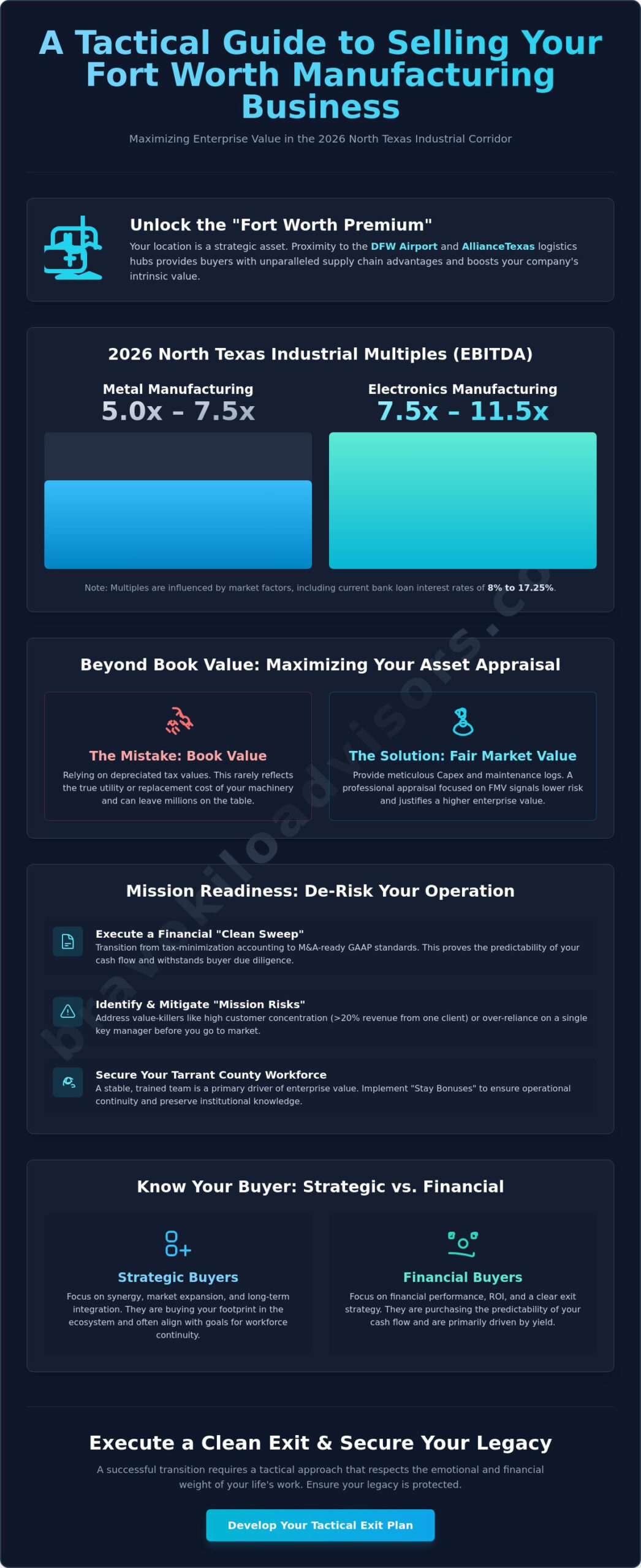
Establishing the “Mission Baseline” for your exit begins with a cold, hard look at current market data. In the North Texas industrial corridor, your company isn’t just a collection of machines; it’s a strategic asset located in one of the most aggressive growth zones in the country. Understanding how to sell a manufacturing company in Fort Worth requires you to look beyond your balance sheet to the “Fort Worth Premium.” This premium is driven by your proximity to the AllianceTexas logistics hub and DFW International Airport, which provides buyers with unparalleled supply chain advantages. Strategic buyers aren’t just buying your cash flow. They’re buying your footprint in the Tarrant County industrial ecosystem.
You must distinguish between your physical asset value and your enterprise value. While your machinery has a liquidation price, your enterprise value is built on your recurring contracts, proprietary IP, and operational systems. A Certified Business Valuation is the only defensible starting point for a Tarrant County industrial sale, providing a rigorous analysis that stands up to the scrutiny of sophisticated buyers. It moves the conversation from “what you think it’s worth” to “what the market will pay.”
Local Industrial Multiples and Market Trends
As of May 2026, we’re seeing high demand for specialized manufacturing. Metal manufacturing firms are currently commanding multiples between 5.0x and 7.5x EBITDA, while electronics manufacturers are seeing 7.5x to 11.5x EBITDA. These figures are influenced by the current interest rate environment, where traditional bank loans range from 8% to 17.25%. Utilizing established business valuation methods ensures you aren’t leaving money on the table. For a deeper dive into regional specifics, our guide on Texas Business Valuation explains how Tarrant County property tax trends can impact your net operating income and final sale price.
The Role of Specialized Equipment in Appraisal
Book value is often the enemy of a successful manufacturing exit. It rarely reflects the true utility or replacement cost of your floor assets. To justify a higher asking price, you need to provide meticulous Capex and maintenance logs for every CNC machine, press, or assembly line. Buyers in 2026 prioritize “resiliency,” and well-maintained, automated equipment suggests a lower risk profile. Professional appraisals should focus on Fair Market Value rather than depreciated tax values to ensure your machinery contributes its full weight to the enterprise value.
Operational Readiness: Positioning Your Shop for a Tactical Exit
Preparation is the difference between a successful mission and a failed extraction. When you begin the process of learning how to sell a manufacturing company in Fort Worth, your first objective is a “Clean Sweep” of your financial records. Most industrial owners operate with tax-minimization accounting, which is effective for daily operations but detrimental during a sale. You must transition to M&A-ready GAAP standards to ensure your margins withstand a buyer’s due diligence. A buyer isn’t just purchasing equipment, they are purchasing the predictability of your cash flow.
Beyond the numbers, you must identify and mitigate “Mission Risks” that could sink a deal. High customer concentration, where a single client accounts for more than 20% of your revenue, or a heavy reliance on one key shop manager, are common value killers. Addressing these vulnerabilities early through Value Enhancement Services allows you to present a resilient, self-sustaining operation. This level of discipline is essential when following a comprehensive guide to selling your business, as it builds the buyer’s confidence in your company’s future performance.
The Fort Worth Labor Factor
Your skilled Tarrant County workforce is an appreciating asset. In the 2026 labor market, private equity firms view a stable, trained team as a primary driver of enterprise value. We recommend implementing “Stay Bonuses” or specific retention agreements for your critical floor leads. These tactical measures ensure operational continuity during the transition period and signal to the buyer that the institutional knowledge of the shop will remain intact after the keys change hands.
Confidentiality Protocols in North Texas
Maintaining absolute silence in the tight-knit Fort Worth industrial community is a high-stakes requirement. We utilize a “Blind Profile” approach to market your plant, focusing on capabilities and financials without revealing your exact name or location. This prevents competitors from poaching your clients or employees during the sensitive negotiation phase. Every potential suitor must be rigorously vetted to ensure they are serious stakeholders rather than “tire-kickers” from a rival shop seeking intelligence on your operations. This methodical vetting process is a core component of how to sell a manufacturing company in Fort Worth with your legacy and reputation protected.
Executing the Mission: Vetting Buyers and Closing the Deal
The final phase of your exit is where the most disciplined operations can falter without a clear command structure. Understanding how to sell a manufacturing company in Fort Worth means recognizing that the highest bidder isn’t always the best partner for your legacy. You’ll encounter two primary classes of suitors: Strategic Buyers and Financial Buyers. While Strategic Buyers often pay a premium to absorb your DFW footprint or specialized capabilities; Financial Buyers, such as private equity firms, focus on yield and operational scalability. Each requires a different negotiation posture.
The Letter of Intent (LOI) serves as your tactical blueprint for the remainder of the engagement. It’s during this phase that we negotiate the “Tactical Terms” to protect you from post-closing liabilities. You must treat the subsequent due diligence period like a pre-deployment military inspection. By proactively preparing Phase I environmental reports and equipment certifications, you eliminate the “Mission Risks” that typically stall deals in the final hours. Bravo Kilo Advisors provides the command presence necessary to navigate the final 10% of the transaction; this is the critical zone where most unguided deals collapse due to fatigue or loss of momentum.
Strategic vs. Financial Buyers in DFW
A strategic buyer might pay a significant premium for a Fort Worth plant that holds a Tier-1 aerospace contract, as the synergy value often outweighs the standalone cash flow. Vetting these competitors requires a sophisticated touch to prevent them from gaining sensitive intelligence without a commitment. For a deeper look at selecting the right partner for this process, see our guide on Hiring a Business Broker in Dallas, TX. We ensure that every suitor is qualified before they ever see your proprietary data.
The Final Approach: Closing and Transition
Closing an industrial sale in Tarrant County involves specific logistics, including escrow and title considerations for heavy industrial real estate. We manage these details with precision to ensure a predictable rollout. Finally, your succession plan must be finalized to ensure the mission continues. This ensures your workforce is protected and your legacy as a North Texas industrial leader remains intact long after you’ve exited the field.
Securing Your Industrial Legacy in North Texas
You’ve spent years hardening your operations and building a workforce that defines the Tarrant County industrial landscape. Transitioning out of that role is a high-stakes mission that demands precision and absolute confidentiality. By establishing a defensible valuation through the “Fort Worth Premium” and executing a financial “Clean Sweep,” you position your company as a resilient asset ready for acquisition. Navigating how to sell a manufacturing company in Fort Worth is about protecting your legacy while maximizing the enterprise value you’ve worked decades to build.
Bravo Kilo Advisors brings a command presence to your exit strategy. We provide specialized expertise in DFW industrial M&A and Certified Business Valuations tailored to specialized manufacturing sectors. Our mission-first approach is backed by success-based transaction fees, ensuring our objectives are perfectly aligned with your final resolution. Don’t leave your transition to chance or unproven intermediaries. Schedule a Tactical Assessment for Your Fort Worth Manufacturer today. You’ve led your company with discipline; let’s ensure your exit is executed with the same level of professional excellence.
Frequently Asked Questions
How long does it take to sell a manufacturing company in Fort Worth?
The standard timeline for a successful exit ranges from six to twelve months from the initial market launch to the final wire transfer. However, the most effective deployments require a preparation phase of twelve to twenty-four months to address operational vulnerabilities. This lead time allows you to optimize your financials and ensure your shop is positioned to withstand the rigors of a buyer’s deep-dive inspection.
What is the average EBITDA multiple for Texas manufacturers in 2026?
Current 2026 data indicates that valuation multiples are highly dependent on your specific sub-sector and revenue scale. For companies with revenue between $5 million and $75 million, typical multiples range from 5.5x to 10.0x EBITDA. Specifically, metal manufacturing firms currently command ranges between 5.0x and 7.5x; electronics manufacturing can reach 7.5x to 11.5x. These resiliency premiums reflect the high demand for automated, domestic supply chains.
Do I need to tell my employees I am selling my Fort Worth plant?
Confidentiality is a mission-critical requirement when learning how to sell a manufacturing company in Fort Worth. You should not disclose the sale to your general workforce until the definitive purchase agreement is signed and the closing is imminent. Early disclosure often triggers a flight to safety where your best talent seeks more stable employment. This can destabilize the operation and give a buyer leverage to renegotiate the purchase price.
Can I sell my manufacturing business without the real estate?
You can absolutely decouple your business operations from your physical facility. Many owners choose to sell the operating company while retaining the Tarrant County real estate, creating a long-term lease agreement that provides steady rental income after the exit. This approach can broaden your buyer pool, as some financial buyers prefer an asset-light model; meanwhile, you maintain a stake in the appreciating North Texas industrial market.