
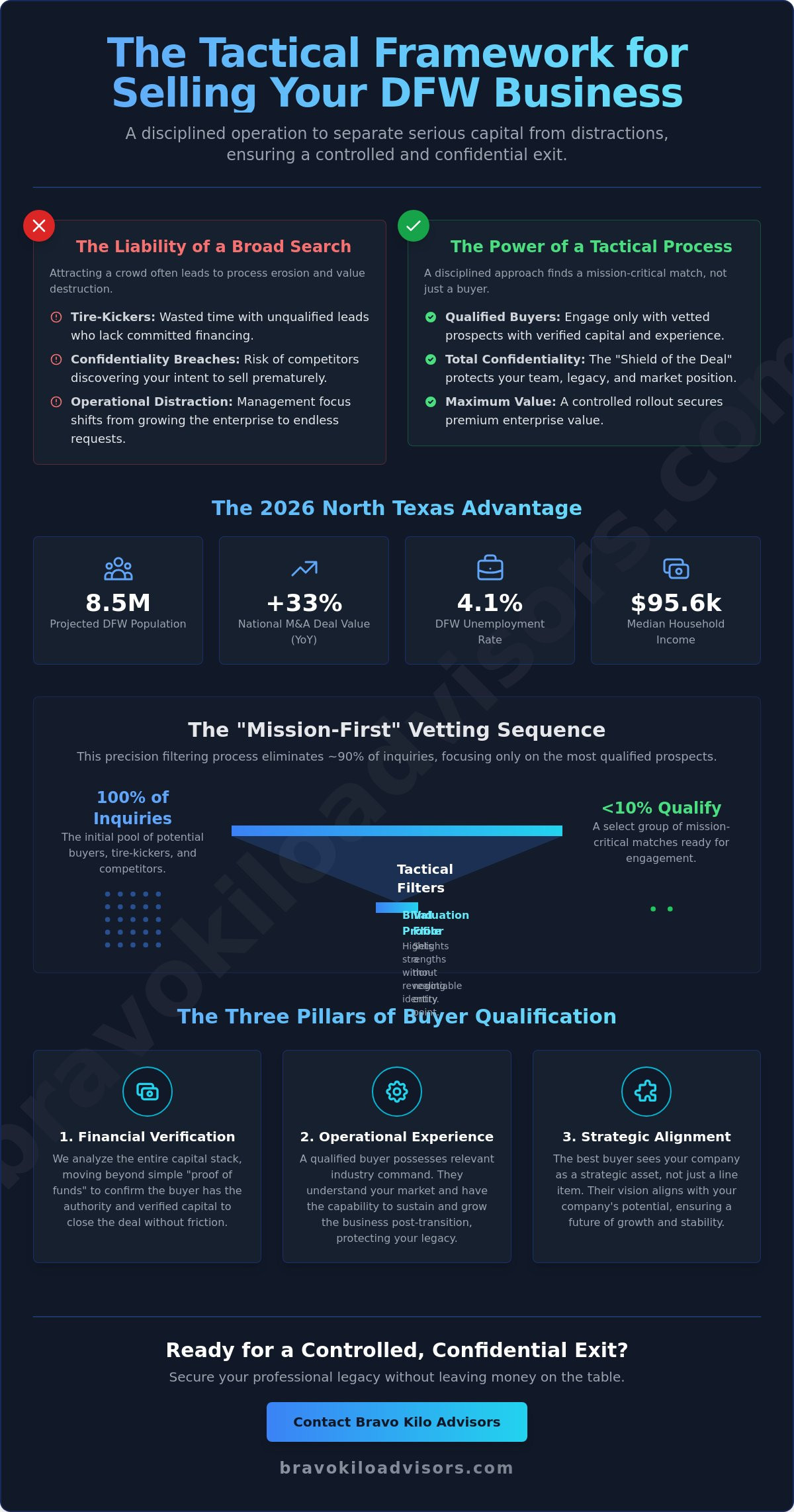
Most business owners believe the goal of a sale is to attract as many bidders as possible, but in the high-stakes North Texas market, a broad search is often your greatest liability. When you begin the process of finding qualified buyers for my DFW business, you aren’t looking for a crowd; you’re looking for a mission-critical match who understands your industry and respects what you’ve built. With the DFW population reaching 8.5 million in early 2026 and national M&A deal values up 33 percent year over year, the noise in the marketplace has never been louder. It’s natural to worry about tire-kickers wasting your time or the risk of a competitor discovering your intent before a deal is finalized.
You’ve earned the right to a quiet, professional transition that prioritizes security over spectacle. This article delivers a tactical framework for vetting prospects and securing your professional legacy without leaving money on the table. We’ll walk through a disciplined, step-by-step operation designed to separate serious capital from the distractions. You’ll learn how to maintain total confidentiality while positioning your company for maximum enterprise value, ensuring your exit is a controlled success rather than a chaotic auction.
Key Takeaways
- Identify why the 2026 North Texas market remains a primary objective for sophisticated private equity and strategic acquirers.
- Execute a tactical vetting sequence for finding qualified buyers for my DFW business that eliminates distractions and prioritizes mission-critical matches.
- Deploy the “Shield of the Deal” to maintain absolute confidentiality and protect your team’s morale throughout the negotiation.
- Implement a methodical, controlled rollout process that secures maximum enterprise value while maintaining a steady, predictable rhythm.
The DFW Buyer Landscape: Identifying the Mission-Critical Match
In the current North Texas economy, finding qualified buyers for my DFW business requires more than just a listing; it demands a tactical assessment of intent and capability. A truly qualified buyer isn’t just someone with a high net worth. They must possess verified capital, relevant operational experience, and a strategic alignment that ensures the business thrives after you exit. Without these three pillars, a deal is likely to stall during due diligence, or worse, fail after the keys change hands. You need a partner who views your business as a strategic asset, not just a line item on a balance sheet.
The 2026 landscape for Mergers and acquisitions (M&A) is characterized by a significant rebound, with total U.S. deal values increasing 33 percent over the previous year. In the Dallas-Fort Worth metro area, which now supports over 8.5 million residents, the competition for resilient companies is intense. This surge in activity makes it vital to distinguish between financial buyers, such as private equity firms looking for platform acquisitions, and strategic buyers who seek to integrate your operations into their existing conglomerates. A broad-net approach often leads to confidentiality breaches, exposing your intent to competitors before you’ve secured a single serious offer.
To better understand the mechanics of identifying the right purchaser, watch this helpful video:
Why “Anyone with a Checkbook” is a Liability
Tire-kickers are the primary threat to a controlled sale. These are often individuals or small groups who lack committed financing or the authority to close. Engaging with them creates hidden costs, primarily through the erosion of operational value as management is distracted by endless information requests. Every hour spent justifying your margins to an unqualified lead is an hour taken away from growing the enterprise. Selling to a buyer who lacks the operational command to sustain the business creates a legacy risk that can destroy years of hard work in a matter of months.
The 2026 North Texas Advantage
The DFW economy remains one of the most resilient in the nation, supported by a 4.1 percent unemployment rate and a median household income of $95,589. This stability attracts serious acquirers to hubs like Frisco, Plano, and Fort Worth. While national multiples are recovering, the local pro-business environment and lack of state-level capital gains tax make DFW targets especially lucrative. Sophisticated buyers recognize that regional growth isn’t just a trend; it’s a structural advantage that justifies premium enterprise values for owners who follow a disciplined M&A advisory process.
A Tactical Framework for Qualifying Buyers: Beyond the Financials
Finding qualified buyers for my DFW business is not a matter of volume; it’s a matter of precision. At Bravo Kilo, we utilize a “Mission-First” vetting sequence that filters out approximately 90 percent of inquiries before they ever see the name of your company. This process shifts the focus from a chaotic transactional auction to a disciplined advisory engagement. We begin with a Blind Profile, a tactical document that highlights the strengths and financials of your enterprise without revealing its identity. This allows us to perform initial reconnaissance on potential acquirers while maintaining your total operational security. You don’t need a crowd; you need the right match.
Establishing a firm entry point is equally critical for protecting your time. By leveraging a Texas business valuation, you set a non-negotiable floor for buyer entry. This prevents low-ball offers from uneducated bidders and ensures that every party at the table respects the true enterprise value. If you’re unsure of your current market standing, our team can provide strategic growth consulting to fortify your position before outreach begins.
The Three Pillars of Buyer Qualification
A buyer’s checkbook is only one part of the equation. We evaluate every prospect against three specific criteria to ensure they’re fit for the mission:
- Financial Verification: We look past simple “proof of funds” to analyze the capital stack. We need to know the ratio of debt to equity to ensure the deal won’t collapse under SBA 7(a) interest rates, which can reach up to 13.5 percent as of May 2026.
- Operational Command: Does the buyer have the leadership experience to manage your specific workforce? We assess their ability to sustain your professional legacy without causing internal friction.
- Strategic Intent: We uncover the “Why” behind the acquisition. Understanding their long-term objectives prevents a post-sale culture clash that could damage the reputation you spent decades building.
Vetting the “Search Fund” and Private Equity
Dealing with individual searchers requires a different tactical approach than engaging with established private equity platforms. Individual searchers often bring high energy but may lack the “dry powder” or immediate closing reliability of a PE firm. You must ask direct questions about their previous close-rates and the specific source of their equity. This level of scrutiny ensures you’re partnering with a serious stakeholder who possesses the resources to cross the finish line with integrity.
Confidentiality and Command: Navigating the DFW Market with Bravo Kilo
Confidentiality is the tactical shield of any successful transition. If word of a sale leaks to the wrong parties, you risk cratering employee morale or giving competitors an opening to poach your client base. Finding qualified buyers for my DFW business isn’t a public event; it’s a silent operation. We utilize a “Controlled Rollout” strategy to ensure that your intent remains secure while we identify high-intent prospects. This methodical approach protects the enterprise value you’ve spent years building, allowing you to maintain operational focus while the search proceeds behind the scenes.
Positioning your company as a premium asset is a prerequisite for attracting elite acquirers. Before the search begins, we often deploy strategic growth consulting to fortify your financial narrative and operational structure. This preparation ensures that when we do engage with the market, your business stands out as a mission-critical acquisition rather than a bargain opportunity. It’s about commanding the room before you ever step into it.
The Bravo Kilo Engagement Process
- Initial Assessment: We begin by defining your mission objectives, including your desired exit timeline and post-sale involvement.
- Tactical Positioning: Our team crafts a narrative that highlights your competitive advantages in the North Texas market, attracting serious capital.
- The Closing Phase: We manage the final negotiations with a steady hand, ensuring every detail aligns with your professional standards and ethical requirements.
Your Professional Legacy is Mission-Critical
There’s a fundamental difference between a transactional broker and a strategic advisor. In the DFW lower-middle market, many intermediaries focus on a quick close. We prioritize the long-term impact of the deal, ensuring the buyer is equipped to sustain your legacy. If you’re ready to move from the planning phase to active execution, hiring a business broker in Dallas, TX with an advisory mindset is your next logical step. Your exit is too important to leave to chance. You can contact Bravo Kilo Advisors today for a confidential briefing on your exit options.
Secure Your Mission’s Final Objective
Success in the North Texas market requires a transition from operational management to strategic exit execution. You’ve built a significant enterprise; now you must protect it with the same discipline that fueled its growth. We have outlined why finding qualified buyers for my DFW business demands a rigorous vetting sequence and a commitment to total confidentiality. By prioritizing an advisory relationship over a simple transaction, you ensure that your legacy remains intact while achieving maximum enterprise value. Your exit is mission-critical.
Bravo Kilo Advisors brings a mission-first attitude to the DFW lower-middle market, specifically serving businesses valued between $500,000 and $50 million. Our battle-tested advisors utilize Certified Business Valuations to establish a defensible market position that repels bargain hunters and attracts serious capital. We provide the strategic reliability needed to navigate high-stakes negotiations with poise. It’s time to move toward a resolution that reflects your years of service and dedication. Secure your professional legacy with a confidential Bravo Kilo briefing. You’ve done the hard work of building the business; let us lead the operation to bring it to a successful close.
Frequently Asked Questions
How do I know if a buyer in DFW is actually qualified to buy my business?
A buyer is qualified when they demonstrate verified liquid capital, a committed capital stack, and relevant leadership experience. We verify their “dry powder” and previous transaction history to ensure they can navigate SBA 7(a) variable rates, which range from 10.5 percent to 13 percent as of May 2026. This tactical screening is the first step in finding qualified buyers for my DFW business without wasting operational time on tire-kickers who lack the authority to close.
What is a ‘Blind Profile’ and how does it protect my confidentiality in North Texas?
A Blind Profile is a tactical summary that highlights your company’s financial performance and market position without disclosing its name or exact address. It acts as a primary shield. This document allows us to gauge buyer interest while keeping your identity secure from employees, customers, and competitors. It ensures that only vetted parties who have passed initial reconnaissance gain access to your proprietary operational data.
Should I sign an NDA with every buyer who inquires about my DFW company?
You should require a signed Non-Disclosure Agreement (NDA) from every prospect, but only after they pass an initial vetting phase. Signing an NDA is a prerequisite for receiving detailed financial records. It shouldn’t be the only layer of protection in your search. We use these agreements as a legal baseline to maintain order and ensure every interaction remains a controlled operation with clear boundaries and high ethical standards.
What is the difference between a financial buyer and a strategic buyer for my Dallas business?
Financial buyers, such as private equity firms or search funds, prioritize return on investment and often look for platform companies to grow. Strategic buyers are typically competitors or industry conglomerates seeking synergies to expand their existing market share in the Dallas-Fort Worth area. Understanding this distinction is vital when finding qualified buyers for my DFW business, as it dictates the long-term impact on your professional legacy and the final enterprise value.