
What if the most dangerous phase of your exit isn’t finding a buyer, but the sixty days after you sign the Letter of Intent? Most sellers view this period as a passive audit, but in 2026, it’s a high-stakes tactical defense of your enterprise value. You’ve spent years building your legacy, and the thought of a buyer digging through your records to justify a valuation “haircut” is a legitimate concern. We understand the pressure of protecting your data while managing this administrative burden. This guide provides a battle-tested due diligence checklist for selling a business designed to help you maintain your original offer price and ensure a clean, organized exit.
We provide the strategic reliability required to navigate this investigation with precision. You’ll learn how to organize a mission-critical data room and manage complex 2026 shifts, such as the SBA rules for set-aside contracts taking effect in January and new FinCEN reporting requirements. This briefing outlines a disciplined, step-by-step process to ensure your professional legacy is handled with the poise and integrity it deserves. We’ve seen every scenario and are prepared to guide you through these negotiations with a mission-first attitude.
Key Takeaways
- Shift your mindset from enduring a passive audit to executing an offensive strategy that validates your enterprise value and protects your legacy.
- Deploy a mission-critical due diligence checklist for selling a business to secure corporate records and prove ownership before the first buyer meeting.
- Learn how to present financial documentation as a clear narrative of cash flow reality rather than just a collection of static spreadsheets.
- Establish a Virtual Data Room as your tactical operations center to control the timing and depth of information disclosure throughout the investigation.
- Maintain your original Letter of Intent price by projecting a command presence that neutralizes buyer objections and minimizes post-closing liability.
The Strategic Framework: Why Sellers Must Lead Due Diligence
Success in a high-stakes sale isn’t about surviving the investigation. It’s about leading it. We view due diligence as a value-validation exercise where you take the offensive. By preparing your due diligence checklist for selling a business early, you establish a command presence. This tactical posture ensures that when a buyer begins their deep dive, they find a fortified position rather than a disorganized retreat. You aren’t just answering questions; you’re confirming the enterprise value you’ve spent years building.
In the North Texas market, transparency acts as your greatest tactical advantage. Buyers here are sophisticated and well-capitalized, but they’re also risk-averse. If you identify “Value Killers” before their team does, you control the narrative. This proactive approach prevents the dreaded valuation “haircut” that often occurs when a buyer discovers a liability you should’ve neutralized months ago. Maintaining your Letter of Intent (LOI) price requires a disciplined presentation of facts that leaves no room for doubt.
To better understand the phases of this process from a buyer’s perspective, watch this helpful video:
Financial Integrity and Quality of Earnings (QoE)
Standard tax returns are rarely enough for a sophisticated buyer. They want to see the underlying reality of your cash flow. This process begins with a professional Texas business valuation to set a baseline for the entire due diligence checklist for selling a business. We focus on normalizing EBITDA by highlighting one-time expenses and owner add-backs. This ensures the buyer understands the true earning power of the company without the noise of personal or non-recurring costs.
Operational Readiness and Scalability
Your business must pass the “Owner-Extraction Test.” A buyer needs to know the operation won’t collapse the moment you walk out the door. In the DFW market, Standard Operating Procedures (SOPs) are viewed as primary assets. Clear, documented processes prove that your company is a scalable machine rather than a personality-driven job. This operational discipline reassures the buyer that their investment is secure, which is essential for a smooth transition and a clean exit.
The Mission-Critical Due Diligence Checklist for 2026
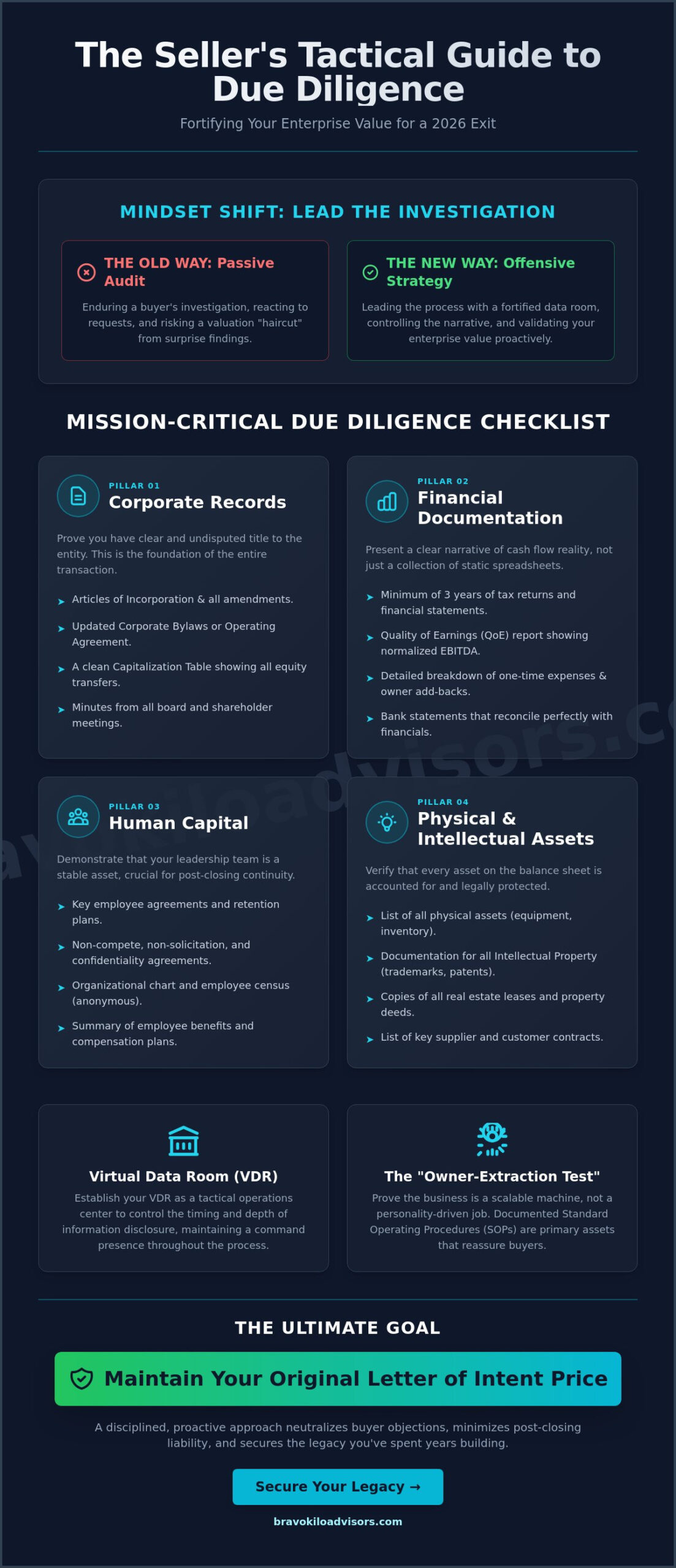
Execution is where the mission succeeds or fails. A comprehensive due diligence checklist for selling a business serves as your operational roadmap, ensuring no flank is left exposed to buyer scrutiny. We prioritize a methodical approach to documentation that reinforces your enterprise value through four primary pillars.
- Corporate Records: You must prove clear title to the entity. This includes articles of incorporation, updated bylaws, and a clean capitalization table showing all equity transfers.
- Financial Documentation: Buyers look for a minimum of three years of records. With the federal corporate income tax rate at 21% for C-corporations in 2026, your reporting must be precise and reconcile perfectly with bank statements.
- Human Capital: Texas is an at-will state, but key employee retention is vital for continuity. We review employment agreements and non-compete clauses to ensure your leadership team remains a stable asset post-closing.
- Physical and Intellectual Assets: Every piece of equipment and every trademark must be accounted for. Buyers will verify that your IP is legally protected and that physical inventory matches the figures on your balance sheet.
Adopting an due diligence checklist from a reputable source provides a baseline, but local nuances often determine the final sale price. If you’re unsure how your current documentation stacks up against buyer expectations, our strategic growth consulting can help identify gaps before they become deal-breaking liabilities.
Legal and Regulatory Compliance in Texas
A buyer’s team will verify your standing with the Texas Secretary of State and the Comptroller. You’ll need a Certificate of Account Status to prove you’re current on franchise taxes. In the DFW market, specific local permits and zoning requirements can stall a deal if they aren’t addressed early. We ensure all material contracts, particularly commercial leases, are assignable to the new owner to prevent a broken link in the chain of command.
Customer and Market Position
Customer concentration is a frequent deal-killer. If more than 20% of your revenue comes from a single client, buyers perceive a high-risk profile. We analyze your sales pipeline against 2026 market growth projections in North Texas to prove your business is positioned for expansion. This data-driven approach demonstrates that your revenue isn’t just stable; it’s scalable within the current economic climate.
Executing the Data Room: Precision in Information Delivery
The Virtual Data Room (VDR) serves as your secure, tactical operations center. It’s the environment where your due diligence checklist for selling a business becomes a live operation. We don’t view the VDR as a simple storage site. It’s a tool for narrative control. By organizing documents with precision, you demonstrate a level of professionalism that reinforces the buyer’s confidence in your asking price.
Staging information is a critical defensive maneuver. You don’t reveal your “Secret Sauce” or proprietary trade secrets on Day 1. We release data in tiers, ensuring that sensitive intellectual property is only disclosed once the buyer has cleared specific hurdles of intent. The typical due diligence period for business acquisitions is 30 to 60 days. Maintaining momentum during this window is vital. There’s a documented correlation between response speed and closing success; delays are often interpreted as signs of hidden liabilities.
Managing this flow requires specialized oversight. A business broker in Dallas, TX acts as your lead coordinator, filtering requests and protecting your time. We ensure that the right information reaches the right person at the right time. This disciplined approach prevents the overwhelming administrative burden from distracting you from the primary objective: running your company at peak performance.
Organizing for Maximum Market Value
Your folder structure should mirror the buyer’s investigative path. Logic and order suggest a well-managed business. We use a standardized indexing system that allows the buyer’s team to locate mission-critical data without friction. Redacting sensitive details is a standard protocol to protect the privacy of your DFW employees and customers until the final stages of the transaction.
The Final Push: From Diligence to Asset Purchase Agreement (APA)
The transition from investigation to the Asset Purchase Agreement (APA) requires tactical finesse. We use the findings from the due diligence process to negotiate favorable “Representations and Warranties.” This minimizes your post-closing liability. The final confirmatory phase is a high-speed verification of facts already presented. It’s the last checkpoint before the mission is successfully completed and your legacy is secured.
Securing Your Exit with Tactical Precision
Transitioning from building a company to successfully exiting one is a mission-critical operation that requires disciplined execution. By utilizing a due diligence checklist for selling a business, you move from a defensive posture to a position of strategic command. You’ve learned how to validate your enterprise value through rigorous financial normalization and how to control information flow within a secure data room. These steps are essential to maintaining your original offer price and minimizing post-closing liabilities.
Bravo Kilo Advisors provides the seasoned expertise necessary to navigate these high-stakes negotiations. As Certified Business Valuation experts with experience advising on transactions from $500k to $50M, we bring a mission-first M&A approach to every client engagement. We prioritize your long-term impact over immediate transactional results, ensuring your professional legacy is handled with the precision it deserves. Our team has seen every possible scenario and stands ready to guide you toward a predictable, successful resolution.
The path to a clean exit begins with a well-planned operational rollout. Secure your legacy with a strategic exit assessment from Bravo Kilo Advisors. You’ve built something extraordinary; let’s ensure your final transition is executed with the same level of excellence.
Frequently Asked Questions
How long does the due diligence process typically take for a Texas business?
The typical due diligence period for business acquisitions is 30 to 60 days. This timeline depends on the complexity of your operation and the buyer’s financing structure. Transactions involving SBA 7(a) loans in 2026 may face more rigorous underwriting due to current variable rates ranging from 9.75% to 13.25%. Maintaining a prepared data room is the most effective way to prevent delays and keep the process within this standard window.
Can a buyer change the price of the business during due diligence?
A buyer can attempt to renegotiate the purchase price if the investigation reveals undisclosed liabilities or financial discrepancies. This tactic, often called a valuation haircut, occurs when the reality of the business doesn’t match your initial representations. Utilizing a comprehensive due diligence checklist for selling a business before going to market allows you to identify and neutralize these issues early. By presenting a validated history, you maintain the leverage needed to defend your original Letter of Intent price.
What are the most common “deal killers” found during the checklist review?
The most frequent deal killers include high customer concentration, unreconciled financial statements, and failure of the Owner-Extraction test. If a single client accounts for more than 20% of your revenue, buyers perceive a high-risk profile that can lead to a withdrawal of the offer. Additionally, the new SBA regulations taking effect January 17, 2026, regarding small business set-aside contracts can significantly decrease value if the buyer doesn’t qualify as a small entity. Identifying these risks early is vital for a successful resolution.
Should I tell my employees I am in the due diligence phase of a sale?
Confidentiality is your primary defense; therefore, you should generally wait until the deal is nearly certain before informing the broader staff. Premature disclosure often causes unnecessary panic and may lead to the loss of key personnel during a critical transition phase. We recommend a need-to-know basis, involving only essential management necessary to fulfill the due diligence checklist for selling a business requirements. Protecting your professional legacy requires a disciplined approach to information security until the final Asset Purchase Agreement is signed.