
What if the company you’ve spent the last 15 years building isn’t actually a sellable asset, but a high-stakes job that will collapse the moment you step away? It’s a harsh reality for many leaders, as data from the Exit Planning Institute reveals that 80% of small businesses never actually reach the closing table. You’ve likely felt the weight of uncertainty regarding your true market value or the fear that a single confidentiality leak could compromise your entire operation. Effective exit planning for small business owners in Texas requires more than just a broker; it demands a tactical strategy to protect your legacy and your bottom line.
We understand that your business is your life’s work, and we approach your transition with the precision of a mission-critical operation. This guide provides a clear roadmap to transform your North Texas company from a daily grind into a high-value asset ready for a controlled exit. We’ll walk through the specific steps to maximize your valuation and navigate due diligence with the command-presence of a veteran operative. By focusing on being transformational before transactional, we ensure your hard work pays off exactly as you’ve planned.
Key Takeaways
- Shift your perspective from daily operations to asset maximization by deploying a strategic framework tailored for the competitive North Texas market.
- Secure a professional business valuation to establish your tactical baseline and begin the operational cleanup required to professionalize your internal systems.
- Neutralize hidden “value killers” like revenue concentration and disorganized bookkeeping that threaten the integrity of your exit planning for small business owners in Texas.
- Execute a 5-phase mission roadmap designed to enhance your company’s market position and prepare your “briefing” for high-stakes due diligence.
- Understand the critical advantage of partnering with battle-tested advisors who prioritize transformational value and calm command over simple transactional deal-making.
What is Exit Planning for DFW Small Business Owners?
Exit planning isn’t a single event or a “for sale” sign posted on a whim. It’s a deliberate, multi-year operational strategy designed to maximize enterprise value while ensuring a clean handover. To understand the foundational components, we start with the basic definition of What is Exit Planning, which focuses on the preparation for the transfer of ownership of a company. In our briefing room, we view exit planning for small business owners in Texas as a tactical necessity. You wouldn’t enter a high-stakes operation without a clear extraction plan; your business deserves the same discipline.
The DFW market is currently one of the most competitive M&A environments in the United States. With over 152,000 new residents arriving in the metroplex in 2023 alone, the pool of buyers has shifted. We’ve moved beyond simple asset sales. Today, an exit is a mission-critical maneuver. We distinguish between “selling a business” and “executing a strategic exit.” Selling is often a reactive response to burnout or market shifts. A strategic exit is a proactive, controlled rollout that dictates terms to the market rather than accepting what’s offered.
Adopting a mission-first mindset requires a lead time of 24 to 36 months. This window allows us to harden your financials and optimize operations. It’s about moving from a transactional mindset to a transformational one. We don’t just want a closing; we want a legacy that remains intact after you’ve stepped away.
The Core Objectives of a Tactical Exit
Our primary objective is maximizing your after-tax proceeds. It’s not about the top-line number; it’s about what stays in your pocket after the 20% to 37% federal tax hits. We also focus on closing the Transaction Gap. This is the 20% to 30% difference often found between what an owner thinks their business is worth and what the market actually pays. By protecting the team in Dallas/Fort Worth, we ensure business continuity that keeps the local economy strong and your reputation secure.
Why North Texas is a Unique Exit Environment
North Texas is currently experiencing a massive corporate relocation trend. With 24 Fortune 500 companies now headquartered in DFW, the buyer pool includes sophisticated private equity groups and institutional investors looking for “bolt-on” acquisitions. Regional strengths in HVAC, logistics, and tech services command premiums here, often trading at 1x to 2x higher multiples than in slower-growth states. We use the local economic stability of the 4th largest metro area in the U.S. as a leverage point in every negotiation. This is why exit planning for small business owners in Texas requires a specialized, regional intelligence approach.
The Mission-Critical Components of a Texas Exit Strategy
Successful exit planning for small business owners in Texas requires a shift from daily survival to long-term tactical preparation. You can’t lead a successful extraction without a clear map of the terrain. Most owners wait until they’re exhausted to plan their departure, but waiting until the point of burnout often results in a 20% to 30% discount on the final sale price. We treat your exit as a mission-critical operation where precision is the only acceptable standard.
- Financial Precision: Moving from tax-minimization books to buyer-ready reporting. Most CPAs focus on reducing your tax liability, but buyers want to see maximized, verifiable EBITDA.
- Strategic Positioning: We identify synergistic buyers within the North Texas market who value your specific customer base or proprietary tech more than a standard financial buyer would.
- Contingency Planning: This is your “Plan B.” We account for the “5 Ds” (Death, Disability, Divorce, Distress, and Disagreement) to ensure your legacy remains intact regardless of market shifts.
Establishing Your Tactical Baseline with Valuation
“Rule of thumb” guesses, such as a flat 3x multiple, fail in sophisticated M&A transactions. In high-growth corridors like Frisco and Dallas, a 15% variance in valuation accuracy can represent hundreds of thousands of dollars left on the table. A Certified Business Valuation provides a defensible baseline that stands up to the scrutiny of aggressive buy-side due diligence. At Bravo Kilo Advisors, we use valuation as a diagnostic tool rather than just a price tag. It reveals the “value gaps” in your current structure, allowing us to fix them before we go to market. Experts at the U.S. Chamber of Commerce suggest that you develop a business exit plan well in advance to ensure these gaps are closed before the first letter of intent arrives.
Professionalizing Your DFW Operations
Standard Operating Procedures (SOPs) function as value-multipliers. When your processes are documented, you’re selling a machine, not a job. You must build a “Command Team” that handles daily fires without your intervention. If your cell phone rings every time a client has a question, your business has low “transferable value.” Transferable value is the ability for a business to thrive under new command without the original founder’s presence. By professionalizing your systems now, you reduce owner dependency and make your company an elite target for acquisition. If you’re unsure where your current operational readiness stands, you can assess your transition potential with a preliminary strategy session.
Identifying and Neutralizing ‘Value Killers’ in Your Business
In a tactical operation, an overlooked vulnerability can compromise the entire mission. The same logic applies to exit planning for small business owners in Texas. You’ve spent decades building equity, but certain internal liabilities can act as “Value Killers” that extract wealth during the final negotiation. According to the 2023 DFW M&A Market Report, businesses with high risk profiles saw a 22% reduction in their final sale price compared to stabilized peers.
Customer concentration is a primary threat. If a single DFW client accounts for 80% of your revenue, you don’t own a scalable enterprise; you own a high-risk contract. Buyers view this as a single point of failure. They’ll often slash your valuation multiple by 1.5x to account for the risk that the client might walk after the transition. Key man risk presents a similar danger. If you’re the “face of the business” and the only one who can close a deal, the company has zero value without you in the chair. You must transition these relationships to your leadership team at least 18 months before a sale.
Physical and digital liabilities also trigger price re-negotiations. A $50,000 deferred roof repair or an outdated cybersecurity protocol often leads to a $150,000 price reduction at the closing table. Buyers use these “surprises” during due diligence to chip away at your leverage. Understanding How to Create an Exit Plan for Your Business requires identifying these gaps before the buyer’s auditors find them for you.
Tactical Financial Cleanup
Clean data is your best defensive tool. Buyers perform forensic reviews of your past 36 months of performance. “Creative” bookkeeping or mixing personal expenses with business operations destroys buyer trust instantly. We focus on “Add-backs” to normalize your EBITDA, ensuring that one-time expenses don’t artificially lower your valuation. You need three years of professional, tax-aligned financials to survive a Texas M&A audit. For a deeper dive, review our guide on the 5 Hidden Value Killers that stall DFW deals.
Operational Risk Mitigation
Stability drives the multiple. You must diversify your client base across the Metroplex to ensure no single industry or neighborhood dictates your survival. Secure long-term contracts with your top five suppliers to prove supply chain resilience. If your operations are based in high-growth corridors like Frisco or Plano, ensure your lease agreements are fully transferable. About 40% of deals in North Texas hit a bottleneck because of restrictive “change of control” clauses in commercial leases. Neutralize these legal landmines early to maintain a position of strength during exit planning for small business owners in Texas.
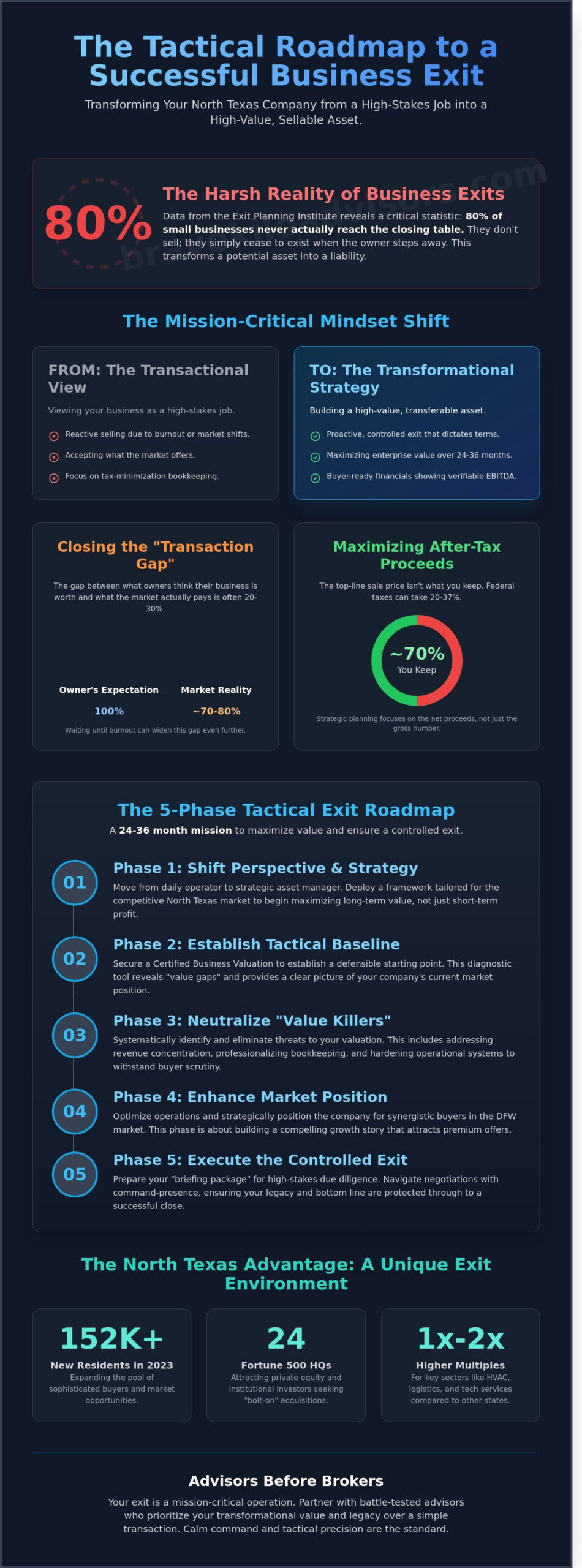
The 5-Phase Tactical Roadmap for a Successful DFW Exit
Executing a business sale requires more than a handshake; it demands a disciplined, five-phase operational rollout. We approach exit planning for small business owners in Texas as a mission-critical objective where precision is the only path to success. This roadmap ensures you don’t just leave your business, but you exit with your legacy and financial goals intact.
- Phase 1: Discovery & Valuation: We assess the current state of the mission by establishing a baseline value using current market multiples for the North Texas region.
- Phase 2: Value Enhancement: Our team identifies operational leaks and professionalizes your financial “briefing” to maximize buyer interest.
- Phase 3: Market Readiness: We prepare the Confidential Information Memorandum (CIM), a comprehensive document that presents your business as a high-value, low-risk asset.
- Phase 4: Tactical Negotiation: We vet potential buyers to ensure they have the financial “dry powder” and cultural fit to take the helm.
- Phase 5: Mission Close: We navigate the final 90 days of due diligence and secure the funding for your payout.
Phase 1 & 2: Preparing the Asset
In 72% of our initial consultations, we identify a significant “gap analysis” between an owner’s current valuation and their desired exit goal. We implement strategic growth consulting to boost margins by at least 15% before going to market. This preparation turns a standard business into a premium acquisition target. A Quality of Earnings report is the ultimate defensive measure for sellers; it provides a third-party audit of your EBITDA, preventing buyers from renegotiating the price downward during the final stages of the deal.
Phase 3 to 5: Executing the Transaction
Confidentiality is our primary directive within the DFW business community. We use blind profiles to protect your identity until a buyer is fully vetted and signs a non-disclosure agreement. When the deal moves into the high-pressure Due Diligence phase, we act as your tactical shield. This 60-day window is where most deals fail due to “deal fatigue” or buyer cold feet. We manage the data room and keep the momentum steady. The final handover isn’t just a signature. It’s a transition plan that ensures the new owner can maintain the 98% customer retention rate you’ve worked years to build.
Don’t leave your life’s work to chance. Secure your mission-critical exit strategy with advisors who prioritize your transformation over the transaction.
Advisors Before Brokers: Why Your Choice of Partner Matters
A standard business broker often operates with a transactional mindset. Their primary objective is the close, the commission, and the exit. For a founder, this approach is insufficient. You need a transformational advisor who treats your business transition like a mission-critical operation. Effective exit planning for small business owners in Texas demands more than a spreadsheet; it requires a partner who understands that your legacy is built on decades of discipline and community impact. We don’t just move paper; we protect the mission you’ve spent your life building.
Bravo Kilo Advisors brings a tactical perspective to the boardroom. Our team leverages experience from federal service and law enforcement to maintain a calm, assertive presence during intense negotiations. When a private equity group or a strategic buyer attempts to pressure you into unfavorable terms during the final stages of due diligence, we provide the strategic shield you need. We’ve managed high-pressure environments where the stakes were life and death. We apply that same level of focus to protecting your net proceeds and your reputation.
The Bravo Kilo Difference
Our “Advisors before Brokers” mantra means we prioritize your long-term outcome over a quick sale. We serve the North Texas market from our Frisco headquarters, giving us a front-row seat to the 4.2% annual job growth and shifting commercial real estate values in the DFW Metroplex. We don’t just look at your EBITDA; we analyze how local labor trends and regional competition affect your specific valuation. Our tactical precision ensures that every document in the due diligence room is categorized and ready for inspection. This leaves no room for buyer leverage or last-minute price reductions.
Taking the First Step
The best time to start your strategy was 36 months ago; the second best time is today. Whether you plan to exit in six months or five years, early preparation prevents value erosion. Securing a professional strategy for exit planning for small business owners in Texas is the only way to guarantee your company survives your departure. We offer a confidential, no-obligation discovery call to assess your current operational readiness. This isn’t a sales pitch. It’s a briefing. We’ll identify the gaps in your current structure and outline a roadmap to maximize your final check. Secure your legacy with a tactical exit plan from Bravo Kilo Advisors and ensure your life’s work ends on your terms.
Secure Your Legacy with Tactical Precision
Your business represents a lifetime of disciplined execution. Successfully navigating exit planning for small business owners in Texas requires the same level of strategic rigor you used to build it. You’ve identified the specific value killers that can erode your company’s worth and recognized why a 5-phase tactical roadmap is essential for a clean extraction. At Bravo Kilo Advisors, we focus exclusively on the DFW market, bringing a mission-first mindset to every boardroom.
Our Managing Director applies over 15 years of federal and tactical law enforcement experience to protect your interests during high-stakes negotiations. We utilize certified business valuation expertise to ensure your exit is based on hard data rather than guesswork. We operate as advisors before brokers because we prioritize transformational outcomes over simple transactions. Your final mission deserves the precision of a battle-tested strategy. It’s time to move forward with confidence.
Schedule Your Confidential Tactical Assessment
Frequently Asked Questions
When should I start exit planning for my Texas business?
You should initiate your strategy at least 36 to 60 months before your intended departure. This timeframe is essential for exit planning for small business owners in Texas to maximize enterprise value. Early preparation allows us to identify operational gaps and implement tactical improvements. Waiting until you’re ready to leave reduces your leverage and can result in a 30% lower valuation during final negotiations.
How much does a certified business valuation cost in DFW?
A certified business valuation in the DFW metroplex typically costs between $3,500 and $12,000 depending on the size of your operation. For companies with annual revenues under $2 million, costs stay on the lower end of that range. This investment provides a defensible baseline for negotiations. We treat this as the intelligence-gathering phase of your mission, ensuring every asset is accounted for before we engage the market.
Can I sell my business in Dallas without anyone knowing it’s for sale?
Confidentiality is a mission-critical requirement that we protect through multi-layered vetting processes. We don’t list your company name on public forums; instead, we use blind teasers that mask your identity. Before any sensitive data is shared, 100% of prospective buyers must sign a binding Non-Disclosure Agreement. This tactical approach ensures your employees, competitors, and customers remain unaware of the transition until the deal reaches the closing phase.
What is the difference between an M&A advisor and a business broker?
The primary difference lies in the complexity of the deal and the level of strategic guidance provided. Business brokers typically manage high-volume, smaller transactions, while M&A advisors handle mid-market deals often exceeding $5 million. We operate as advisors before brokers, focusing on transformational outcomes rather than just closing a transaction. Our team brings tactical experience to the boardroom to navigate the intricate due diligence and legal hurdles of larger sales.
How do I increase the value of my business before selling in Fort Worth?
You increase value by reducing owner dependency and securing a 15% to 20% year-over-year growth rate. Buyers look for businesses where the founder isn’t the sole point of failure. If one client represents more than 10% of your total revenue, you must diversify that risk immediately. Strengthening your management team ensures the mission continues successfully after you depart, which directly justifies a higher multiple during the valuation process.
What are ‘add-backs’ and how do they affect my business sale price?
Add-backs are expenses like a $15,000 one-time equipment repair or personal travel costs that are added back to your net income. These adjustments reflect the true cash flow available to a new owner. By identifying these items, we normalize your financial statements to increase the Seller’s Discretionary Earnings. This process is vital because a $50,000 add-back can increase your final sale price by $200,000 or more based on current market multiples.
Do I need an exit plan if I’m passing the business to a family member?
Yes, because 70% of family business transitions fail without a documented strategy. Exit planning for small business owners in Texas involves more than just a handshake; it requires legal frameworks and tax mitigation strategies. We help you establish a clear chain of command to prevent internal conflict. A formal plan ensures the transition is a controlled rollout rather than a chaotic event that jeopardizes your family’s financial security and legacy.
What happens if I don’t have an exit plan and need to sell quickly?
Selling without a plan usually forces you into a fire sale where you lose 25% to 50% of your company’s actual market value. You become a motivated seller, which gives buyers the upper hand during high-pressure negotiations. Without a prepared data room, due diligence can drag on for 9 months or longer, increasing the risk of the deal collapsing. Lack of preparation is a strategic failure that leaves your life’s work vulnerable.
A successful exit is just the beginning of your next chapter. Alongside your business strategy, it’s critical to plan for personal needs like healthcare, which can become more complex after leaving a company plan. For many retiring owners, navigating the transition to Medicare is a key step. Working with a specialist, such as The Modern Medicare Agency, can help ensure your health coverage is as strategically planned as your business exit.
What personal planning should I consider alongside my business exit?
Beyond managing the proceeds from your business sale, comprehensive personal planning is crucial to protect your legacy. This often involves ensuring your family isn’t burdened with unexpected costs down the road. Securing final expense life insurance for seniors is a strategic step many business owners take to cover these costs and preserve the assets they’ve worked a lifetime to build.