
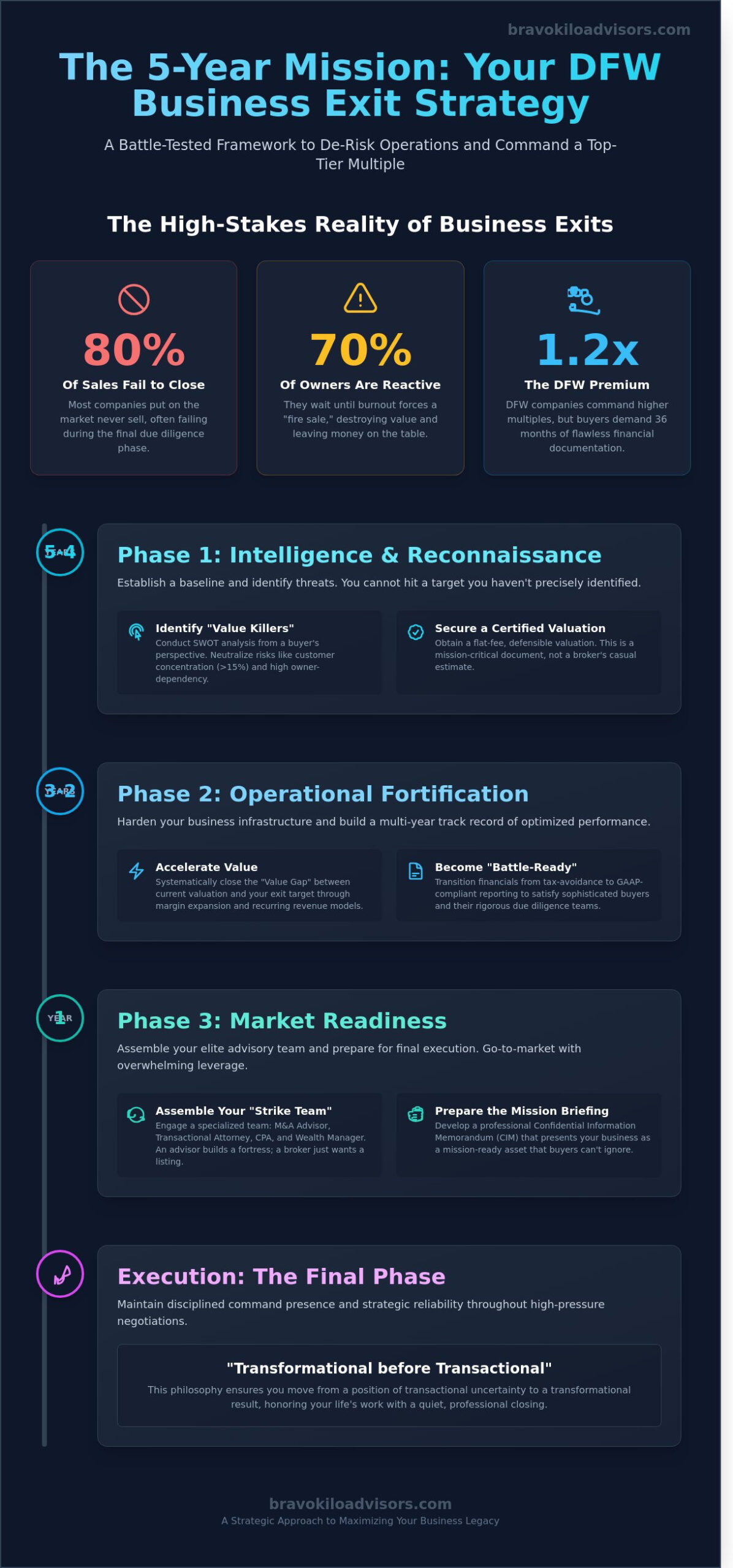
Most North Texas business owners don’t realize that 80% of companies put on the market never actually close, often failing during the final 30 days of due diligence because of preventable operational gaps. If you’re asking how to build a 5-year exit strategy for my DFW company, you’re already ahead of the 70% of owners who wait until burnout forces a fire sale. You’ve spent decades building a legacy. The thought of a messy transition or leaving money on the table is a weight you shouldn’t have to carry alone. We understand the pressure of protecting your life’s work while facing the volatility of the Dallas, Fort Worth market.
This article provides a battle-tested, year-by-year framework designed to de-risk your operations and command a top-tier multiple when it’s time to execute your mission’s final phase. We’ll outline the tactical steps from initial valuation to the quiet, professional closing that honors your work. You’ll learn how to transform your business into a mission-ready asset that sophisticated buyers can’t ignore. This is about moving from transactional uncertainty to a transformational result.
Key Takeaways
- Learn why the “DFW Premium” demands a proactive mission to secure maximum value and navigate the region’s rigorous due diligence standards.
- Identify and neutralize “Value Killers” early by establishing a certified baseline valuation and reducing owner-dependency within your operations.
- Transition from tax-avoidance to GAAP-compliant reporting to ensure your financials are battle-ready for sophisticated buyers.
- Discover how to assemble a specialized strike team and prepare a tactical mission briefing to execute a successful 5-year exit strategy for my DFW company.
- Adopt a “Transformational before Transactional” approach to maintain disciplined command presence and strategic reliability throughout high-pressure negotiations.
Why a 5-Year Lead Time is Mission-Critical for DFW Business Owners
Most owners view a sale as a single event. They’re wrong. A 5-year exit strategy for my DFW company isn’t a white flag; it’s a proactive value-acceleration mission. It transforms a reactive liquidation into a tactical victory. We operate on a philosophy of being Transformational before Transactional. This lead time allows you to harden your business infrastructure long before the scrutiny of a buyer begins. You don’t enter a high-stakes negotiation without a briefing; you shouldn’t list a company without a multi-year track record of optimized EBITDA.
Life doesn’t always respect your timeline. Statistics show that death, disability, and divorce account for approximately 50% of all business exits. Without a 5-year plan, these involuntary exits destroy value. You’re forced to sell at a steep discount because you lack the leverage of time. Building a roadmap now serves as a strategic insurance policy for your life’s work. It requires mastering exit planning fundamentals to ensure the enterprise functions independently of your daily presence. We advocate for Advisors before Brokers because a broker wants a listing, while an advisor builds a fortress.
The Reality of the North Texas M&A Landscape
Capital from high-tax states like California and New York is flooding the Dallas-Fort Worth metroplex. These sophisticated investors are looking for a flight to quality. They’ll pay the DFW Premium for businesses with clean books and scalable systems. In 2026, DFW small-to-mid-market companies are commanding valuation multiples 1.2x higher than the national average. However, this premium comes with a cost: buyers now demand 36 months of flawless financial documentation and contract clarity before they’ll wire a single dollar.
The Hidden Costs of Waiting Until the Last Minute
Waiting creates a Value Gap. This is the spread between your current valuation and the specific number you need to fund your post-exit life. Closing a $3 million gap through organic growth and operational efficiency takes years, not months. If you wait until you’re burnt out, you’ll succumb to Deal Fatigue. This exhaustion causes owners to accept “haircuts” on their asking price just to end the process. Consider these tactical risks:
- The 1-Year Gamble: Short-term plans have a 70% failure rate in meeting the owner’s original asking price.
- Due Diligence Exposure: Rushed sales often reveal “skeletons” in payroll or tax compliance that a 5-year plan would have neutralized.
- Loss of Leverage: When a buyer senses you need to leave, the power dynamic shifts entirely in their favor.
Years 5-4: Intelligence Gathering and Baseline Valuation
The first 24 months of your 5-year exit strategy for my DFW company represent the reconnaissance phase. You cannot hit a target that you haven’t identified with absolute precision. We begin by conducting an internal SWOT analysis through the lens of a sophisticated private equity buyer or a strategic competitor. This isn’t a standard corporate exercise; it’s a cold-blooded look at “Value Killers” that could compromise your mission. If a single customer accounts for more than 15% of your total revenue, your valuation suffers an immediate discount. If the business stops functioning when you take a ten-day vacation, you don’t have an asset; you have a high-paying job. We identify these vulnerabilities now so we have four years to neutralize them before the first offer arrives.
Setting the “Target Extraction Value” is the next priority. This involves aligning the eventual sale price with your post-exit financial requirements. We look at the data: 60% of business owners experience seller’s remorse because they didn’t calculate the net proceeds after taxes and fees. We work backward from your desired lifestyle to determine the exact EBITDA growth required over the next 48 months to hit that extraction goal.
This is also the stage where you should consult with a wealth manager to plan for handling the proceeds. Even if you’re in Texas, the principles are the same, and an experienced fiduciary financial advisor Farmington Hills MI can provide a framework for structuring your post-sale life, covering everything from tax implications to long-term investments.
Securing a Certified Business Valuation
A “broker’s opinion of value” is often a casual estimate designed to win a listing. In this mission, we require a Certified Business Valuation Frisco. This is a flat-fee, defensible document that stands up to IRS scrutiny and aggressive due diligence. Having a defensible number 5 years out allows for strategic course correction. If the current valuation is $5 million but your extraction target is $8 million, we have a clear tactical window to bridge that $3 million gap through margin expansion and recurring revenue models.
The Personal Readiness Assessment
Mission failure often occurs because the founder isn’t emotionally prepared to detach from the company. We establish a confidential “War Room” to manage planning away from the eyes of your employees, ensuring zero loss in productivity. This is where we utilize a succession planning toolkit to ensure your leadership bench is deep enough to survive your departure. Planning for life after the exit prevents the psychological paralysis that often kills deals at the closing table. Before moving into the operational cleanup phase, request a tactical assessment to see where your current baseline sits against market expectations.
Years 3-2: Operational Recon and Value Acceleration
In the middle phase of your 5-year exit strategy for my DFW company, the focus shifts from high-level planning to aggressive operational hardening. This is the recon phase. You must identify every vulnerability that a sophisticated buyer will exploit during due diligence. We’ve seen 15% to 20% of deal value evaporate because owners failed to professionalize their operations during this critical two-year window.
Step 1: Financial Cleanup. Most DFW business owners use accounting to minimize tax liabilities. While this is smart for annual cash flow, it’s toxic for a business sale. You must transition from tax-avoidance accounting to GAAP-compliant reporting. This ensures your books withstand the scrutiny of institutional buyers.
Step 2: Transferring Command Presence. You need to move out of the tactical seat. If you’re the only one who can close a major account or solve a technical crisis, the business is a liability. You must develop a leadership team that functions without your daily input.
This transition requires not just delegation but enhanced executive influence to build a self-sufficient leadership team. To prepare for this, many owners explore Communication Mastery System to sharpen their ability to command presence and lead through others effectively.
Step 3: Diversifying the Mission Profile. High customer concentration is a deal killer. If a single client represents more than 15% of your total revenue, you’re at risk. Spend these two years aggressively expanding your client base to dilute that exposure.
Step 4: Enhancing the Sales Engine. Replace founder-led sales with a predictable, scalable system. A buyer needs to see a documented pipeline and a CRM that tracks lead-to-close ratios with 95% accuracy.
Step 5: Modernizing the Tech Stack. Implement systems that provide real-time data. If you can’t produce a clean profit and loss statement within 24 hours, you aren’t ready for a mission-critical exit.
Removing the “Owner Trap”
A business that can’t run without the owner is worth 30% to 50% less than a managed enterprise. This is the “Owner Trap.” To escape it, you must empower a middle-management layer. In the DFW SMB market, this usually involves promoting a lead operator or hiring a dedicated General Manager to handle the 8:00 to 5:00 decisions. “If you are the business, you don’t have an asset; you have a high-stress job you can’t sell.” You must become redundant to become valuable.
Financial Fortification and QoE Readiness
Sophisticated buyers will conduct a Quality of Earnings (QoE) report to verify your EBITDA. Don’t wait for them to find the skeletons. Run a sell-side QoE on your own books first. This allows you to clean up discretionary “add-backs” and prove your true profitability. Understanding your standing relative to EBITDA Multiples for DFW Businesses is critical during this window. By fixing these issues now, you protect your valuation during the final 24 months of your 5-year exit strategy for my DFW company.
Year 1: Assembling Your DFW Strike Team and Market Readiness
The final 12 months of your 5-year exit strategy for my DFW company represent the transition from operational growth to tactical execution. You’re no longer just running a business; you’re preparing for a handoff that requires the precision of a mission-critical operation. This stage demands a strike team of elite professionals. Your lead M&A advisor acts as the mission commander, supported by a specialized CPA for tax mitigation and a transaction attorney to secure the legal perimeter. Together, they’ll draft your Confidential Information Memorandum (CIM). This document serves as the mission briefing for potential buyers, detailing your 18% average profit margins and the proprietary systems that make your company a North Texas powerhouse.
Before entering the market, you must define your target. We categorize potential acquirers into three distinct profiles:
- Strategic Buyers: Competitors or adjacent firms often willing to pay a 20% to 40% premium to acquire your market share or technology.
- Financial Buyers: Private equity groups looking for a platform with strong cash flow and a 5-year track record of stability.
- Family Offices: Investors focused on long-term legacy who prioritize cultural fit and steady, lower-risk returns.
Your pre-flight checklist is the final safeguard. We conduct a rigorous review of every commercial lease signed since 2019, update employee handbooks to meet 2024 Texas labor standards, and ensure all customer contracts are transferable. This eliminates deal-killers before they reach the negotiation table.
Choosing the Right M&A Advisor in Dallas
Local DFW expertise is non-negotiable for navigating regional lease laws and the competitive North Texas labor market. You don’t need a listing agent who simply posts your business on a website; you need a tactical partner who understands the local terrain. At Bravo Kilo Advisors, we operate on the principle of being advisors before brokers. This means we focus on transformational outcomes rather than just closing a deal. If you’re ready to build your team, consider the advantages of hiring a business broker in Dallas, TX who brings a command-presence to the boardroom.
The Confidential Marketing Phase
Maintaining Operational Security (OPSEC) is your top priority during the 5-year exit strategy for my DFW company. If competitors or key staff learn of a potential sale prematurely, it can destabilize your valuation. We utilize a “Blind Profile” strategy to attract interest without revealing your company’s identity. This high-level summary highlights your $5 million in recurring revenue and geographic dominance without naming the firm. We control the flow of information through secure data rooms, ensuring only vetted, high-intent buyers gain access to your sensitive financials.
Executing the Mission: The Bravo Kilo Advantage
A successful exit isn’t a happy accident. It’s the result of a deliberate, high-stakes operation. When you execute a 5-year exit strategy for my DFW company, you need an advisor who understands that the boardroom is a tactical environment. Our team brings experience from federal service and law enforcement to the negotiation table. This background allows us to maintain a calm, methodical rhythm even when a buyer attempts to re-trade the deal at the eleventh hour. We don’t just facilitate sales; we manage missions.
Our philosophy is centered on being Transformational before Transactional. While typical brokers focus on their 2% to 10% commission, we focus on the 100% impact on your life after the sale. This approach is vital in the North Texas market, where business culture is built on relationships and trust. We ensure that moving from the Letter of Intent (LOI) to the Final Closing doesn’t result in value leakage. Industry data shows that roughly 50% of deals fail or see price drops during due diligence. We mitigate this risk through disciplined preparation and a command presence that keeps the buyer accountable to the original terms.
- Tactical Negotiation: We use proven communication techniques to de-escalate tension and maintain leverage.
- Value Protection: Our advisors identify and neutralize “deal killers” before the buyer finds them.
- Legacy Continuity: We prioritize the welfare of your employees and the survival of your brand post-closing.
Why Mission-First Advisors Win the Deal
We operate with a mission-first mindset. This means we protect your emotional equity while we handle the hard-nosed financial data. Traditional brokers often treat businesses like commodities; we treat them like the culmination of a career. Our battle-tested authority ensures that your interests are defended with precision. You can Build Your North Texas Exit Strategy with Bravo Kilo Advisors to ensure your transition is handled with elite-level competence.
Your Next Step: The Initial Recon Call
The first step is a confidential discovery session. We call this a recon call. We’ll examine your current EBITDA, identify operational gaps, and start the 5-year clock. Waiting until year four to plan can reduce your potential valuation by as much as 25% or more. Starting now gives us the runway to optimize your balance sheet and maximize your multiple. Your legacy deserves a professional extraction. It’s time to start the briefing and secure your future.
Command Your Company’s Final Chapter
Your business represents years of discipline and sacrifice. Executing a successful transition requires more than a simple listing; it demands a rigorous 5-year exit strategy for my DFW company that prioritizes intelligence gathering and operational recon. Industry data suggests that business owners who start planning 60 months in advance can increase their final sale price by up to 40% compared to those who rush the process. By initiating this 5-year lead time, you secure the window needed for certified business valuations and deep-tier value acceleration. We operate on a philosophy of Advisors before Brokers, ensuring your exit is transformational rather than just transactional. Our team brings tactical M&A experience and federal service discipline to the North Texas market, protecting your interests through every high-pressure negotiation. You’ve built a legacy worth defending with precision. It’s time to ensure your transition is as successful as your growth.
Secure Your Legacy: Schedule a Confidential Discovery Call
Frequently Asked Questions
When is the absolute best time to start a 5-year exit strategy?
The tactical baseline for starting your transition is exactly 60 months before your target departure date. This window provides enough lead time to complete two full tax cycles and demonstrate three consecutive years of optimized EBITDA growth. Starting five years out allows us to identify and neutralize structural vulnerabilities that typically lead to a 20% valuation haircut during due diligence.
Can I sell my DFW company if I still have significant customer concentration?
You can sell, but you’ll likely face a 1.0x to 1.5x reduction in your multiple if one client represents more than 15% of your total revenue. Buyers view this as a high-risk tactical liability. During a 5-year exit strategy for my DFW company, we work to diversify your accounts so no single entity exceeds 10% of gross sales, protecting your mission-critical value.
How much does a professional exit planning advisor cost in North Texas?
Professional exit planning in the Dallas-Fort Worth area typically requires a monthly retainer between $2,500 and $7,500, depending on company size. Most elite firms also charge a success fee ranging from 3% to 7% of the final transaction value. This investment is designed to capture the 25% valuation premium that prepared companies command in the current North Texas market.
What is the difference between a business broker and an M&A advisor in Dallas?
Business brokers generally facilitate smaller transactions under $2 million using standardized templates, whereas M&A advisors manage complex deals for mid-market companies requiring sophisticated financial engineering. Our “Advisors before Brokers” philosophy means we prioritize long-term strategic positioning over a quick commission. We act as tactical partners throughout the 60-month process to ensure your legacy remains intact.
Will my employees find out if I start an exit strategy 5 years in advance?
No, we maintain operational security through strict non-disclosure protocols and off-site strategy briefings. Information is disseminated on a strictly need-to-know basis, usually involving only your CFO or a primary stakeholder. Statistics show that only 5% of staff learn about a potential sale before the formal due diligence phase, ensuring your daily mission continues without internal disruption.
Do I need a Quality of Earnings (QoE) report if I already have a CPA?
Yes, because a CPA focuses on historical tax compliance while a QoE report validates the future sustainability of your cash flow. Buyers in the $10 million to $50 million range require this third-party verification to mitigate their investment risk. Commissioning a QoE report 24 months before your exit identifies 90% of potential deal-killers before they ever reach the negotiation table.
How do DFW business multiples compare to the national average in 2026?
North Texas companies currently command a 0.5x to 0.8x premium over national averages due to our region’s 15% lower operating costs. While national service-sector multiples may hover around 4.2x EBITDA, a 5-year exit strategy for my DFW company often targets 5.0x or higher. This regional strength creates a significant tactical advantage for owners who prepare their financials for a 2026 or 2027 liquidity event.
What happens if I receive an unsolicited offer during my 5-year planning phase?
Treat every unsolicited offer as a tactical intelligence gathering opportunity rather than a final destination. Most unexpected bids undervalue a company by 25% to 30% because they lack the pressure of a competitive environment. We analyze these offers to establish a valuation floor while maintaining our steady 60-month trajectory toward a maximum-value closing that meets your specific financial objectives.